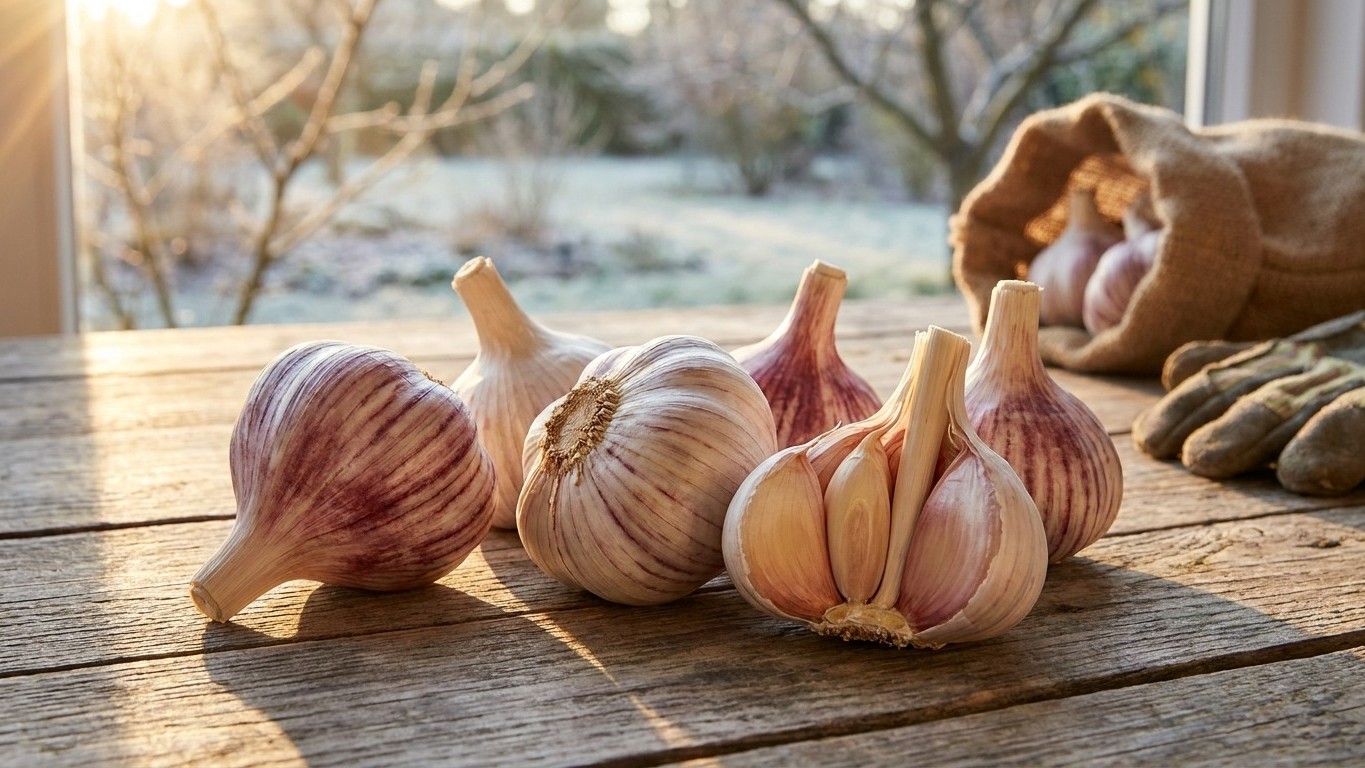

Garlic in New York is ready to lift when the lower third to half of the leaves have browned and dried while five or six upper leaves stay green, a point that typically falls in the back half of summer. Curing takes two to four weeks in a dry, shaded, airy spot with the tops and roots still attached. Skip either step and bulbs that looked perfect at harvest can rot, sprout, or shrivel by January.
When garlic is ready to lift in New York
Garlic grown in New York goes into the ground in autumn, sits through winter as a rooted clove, and doesn’t get pulled until the following summer. That long lag is why the fall planting window matters so much to the harvest that comes eight or nine months later. In the New York City area, the first fall frost lands, on average, somewhere between November 14 and November 27, according to NOAA’s National Centers for Environmental Information, drawing on 1991-2020 Climate Normals for Central Park. That’s a midpoint, not a promise: in roughly one year out of two, the first freeze actually shows up later than that window, and in the other half it arrives earlier. Central Park also sits in a warmed, dense urban pocket, so gardeners upstate and in the Adirondacks routinely see their first hard frost well ahead of that city-based figure, and their last spring frost linger longer into the season.
Once the crop is up and growing the following spring, the signal to watch for isn’t a date on a calendar, it’s the plant itself. A garlic plant carries roughly ten to twelve leaves over its life, and each leaf corresponds to a wrapper layer around the bulb underneath. As the bulb finishes sizing up, the lowest, oldest leaves start browning and drying from the tip down. The moment to lift is when that browning has crept up through the bottom leaves but five or six leaves at the top are still green. Pull too early, while most of the plant is green, and the bulb hasn’t finished filling out or forming distinct cloves under its wrappers. Wait too long, until nearly every leaf has died back, and the wrappers that protect the bulb in storage start disintegrating in the soil, leaving cloves exposed and far more likely to rot in the cellar later.
Soil moisture at the moment of harvest matters as much as leaf color. Garlic pulled from wet, recently rained-on ground brings mud into the curing space and tends to mold faster. Where possible, plan the lift for a stretch of dry weather, and ease bulbs out of the ground with a garden fork rather than yanking by the stalk, which can snap the neck and open a path for rot before curing even starts.
Curing it, and where to hang it here
Curing is the step that turns a freshly dug bulb, still damp and biologically active, into something that will keep for months. It isn’t optional, and it isn’t the same as simply letting garlic dry on a countertop for a few days. The process needs two to four weeks in a location that stays dry, shaded, and well ventilated, with the roots and foliage left on the bulb the whole time. Don’t wash the bulbs first. Brushing off loose soil is fine; running them under water invites the moisture back in and slows drying at exactly the point when the outer wrappers need to seal up tight.
Finding the right spot
New York summers bring enough humidity in July and August that airflow becomes the deciding factor in a successful cure, more than temperature. A covered porch with a box fan running, an open garage with the doors cracked for cross-breeze, a barn loft, or a shaded shed all work, as long as direct sunlight doesn’t hit the bulbs. Sun exposure during curing can scald the outer layers and cook the cloves closest to the surface, which then rot from the inside once bagged for storage. Bundling stalks into small groups and hanging them from rafters, or laying bulbs in a single layer on mesh screens or slatted crates, both work; what matters is that air moves freely around every bulb rather than just the ones on top or on the outside of a pile.
Garlic is cured and ready for the next step when the outer wrappers feel papery and dry to the touch, the neck where the stalk meets the bulb has gone dry and tight rather than soft or green, and the roots have turned brittle. Trying to rush this by cutting curing short to a week or so is one of the more common reasons a batch that looked fine in August turns soft and moldy by Thanksgiving.
Storing it through a New York winter
Once cured, trim the roots down close to the base and cut the stalks to an inch or two above the bulb, unless the plan is to braid softneck varieties, in which case the tops stay on. From there, garlic wants three things for the winter ahead: cool temperatures, moderate humidity, and darkness with continued airflow. Mesh bags, loosely woven baskets, or shallow crates all let air circulate around the bulbs, which matters more once they’re packed together than it did during curing, since a sealed plastic bag or airtight container traps the small amount of moisture bulbs still release and speeds up mold.
An unheated closet, an insulated but unheated basement corner, or an enclosed but not climate-controlled porch tend to work well across most of New York, since they stay cooler than a heated living space without swinging to the extremes of an attached garage. The bigger risk in a New York winter is the opposite problem gardeners usually worry about with produce: not warmth, but hard freezing. A garage or shed that regularly drops well below freezing for extended stretches can freeze stored bulbs solid, and garlic that freezes and thaws repeatedly turns soft and translucent, essentially cooked from the inside by ice crystals rupturing the cell walls. That bulb won’t rot outright right away, but it won’t keep, and it won’t be worth planting back for next year’s crop either.
For growers who want more detail on regional storage conditions or run into a batch that isn’t keeping the way it should, Cornell Cooperative Extension maintains local offices across the state that field exactly these kinds of questions county by county.
What goes wrong here
Most garlic failures in New York trace back to one of three points: the harvest date, the cure, or the storage temperature, and rarely to the growing season itself. Pulling bulbs too early because the calendar “felt right” rather than watching the leaves is the single most common mistake, followed closely by curing in a spot with poor airflow, like a closed plastic tote or a still, humid basement corner where mold gets a foothold before the wrappers finish drying.
Pest pressure on garlic specifically is limited in the region compared to other backyard crops. Cornell University’s Insect Diagnostic Laboratory documents onion maggot as a regional pest affecting allium crops, garlic included, and it’s the one most worth watching for at the base of stalks or among rotting bulbs left too long in wet soil. The lab’s broader pest list for New York growers, covering crops like apples, asparagus, cabbage, and squash, names insects such as apple maggot, asparagus beetles, cabbage maggot, Colorado potato beetle, fourlined plant bug, imported cabbageworm, squash vine borer, striped cucumber beetle, and viburnum leaf beetle, none of which are documented garlic pests in this dataset, so there’s no reason to treat garlic beds against them.
The other recurring problem is saving soft, blemished, or undersized bulbs for next year’s seed stock simply because they’re what’s left over after the good ones are set aside for eating. Garlic doesn’t improve on its own from one generation to the next; a bulb that struggled to cure properly or came out of storage soft tends to pass that weakness forward. Setting aside the largest, cleanest, best-cured bulbs specifically for fall replanting, before any get eaten, tends to matter more for next summer’s harvest than almost any other single decision made during the season.
Common questions
How long does cured garlic actually keep in New York?
That depends heavily on storage conditions rather than a fixed number of months; bulbs kept cool, dry, dark, and well ventilated hold up far longer than those left somewhere warm or damp. A basement corner that stays consistently cool but doesn’t freeze tends to outperform a kitchen counter or a garage that swings with outdoor temperatures.
Can I harvest garlic before all the lower leaves have browned?
Waiting for roughly five to six green leaves to remain at the top, with the lower leaves browned, gives the bulb time to finish forming distinct cloves under intact wrappers. Pulling much earlier usually means a smaller bulb with wrappers that haven’t finished developing.
Does the New York City frost date apply to my garden upstate?
Not directly. The November 14 to November 27 window comes from Central Park data specifically, and upstate areas along with the Adirondacks see meaningfully earlier fall frosts and later spring ones, so that figure should be treated as a New York City reference point rather than a statewide one.
Why did my cured garlic turn soft over the winter?
Softening after a proper cure usually points to freezing temperatures in the storage space rather than rot. Garlic that freezes and thaws repeatedly turns soft and translucent from ice damage to the cloves, which is a different failure than mold or improper curing and calls for a warmer storage spot the following year.