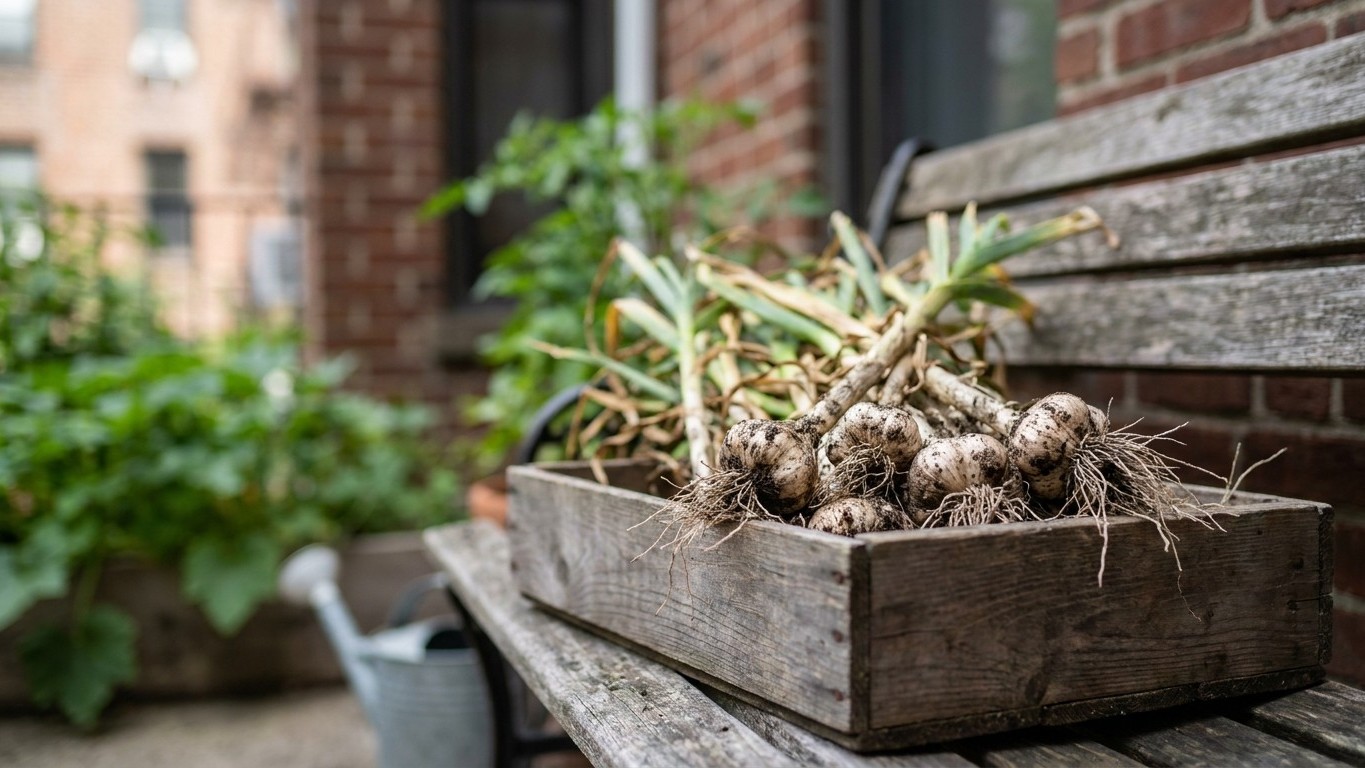

Late October through early November is when New York’s garlic cloves need to go into the ground — whether you’re tucking in softneck Inchelium Red or a hardneck like Chesnok Red. That window isn’t tied to any cultivar’s maturity date; it’s tied to soil temperature dropping enough to wake roots without pushing leaves above ground before winter locks things down. Count back three or four weeks from the region’s typical late-fall freeze, and you land right in that stretch.
The short answer for New York

New York’s planting window for garlic runs from late October to early November across most of the state. Every named cultivar carries that same fall window, from softnecks like Inchelium Red and Lorz Italian to hardnecks like German White and Chesnok Red, because garlic planting dates are set by soil cooling, not by the days-to-maturity figure that decides a tomato or pepper date. Early Red Italian, Italian Late, Fall Festival and Ivan all share it too. Cloves planted this fall spend the winter dormant, resume root and leaf growth in spring, and reach harvest the following summer.
That window is worked backward from NOAA’s frost figure for New York City. Planting three to four weeks ahead of the November 14-27 range gives cloves enough time to grow roots before the ground locks up, without pushing so much top growth that a hard freeze damages the shoot.
Treat the frost date as a midpoint
The November 14-27 range is a midpoint, not a deadline. In roughly half of all years, the first freeze at this reference station arrives after November 27, and in the other half it arrives before November 14. Planting on schedule protects you either way, because the goal is root establishment before the ground freezes solid, not beating the very first frost by a specific number of days.
Once cloves go in, a few inches of straw or shredded leaf mulch keeps soil temperature from swinging hard during the freeze-thaw cycles common to a New York winter, and it can be pulled back partway once green shoots appear in spring.
Working it out for your own garden
New York is not one climate, and a single planting date printed on a seed packet can only ever describe one place. Reworking the calculation for your own garden starts with the same two numbers used for the statewide range: your local first fall frost date, and the three-to-four-week lead time garlic needs to root before that ground locks up.
Start with your own frost date, not the city’s
NOAA’s Climate Normals put the first fall frost at Central Park between November 14 and November 27. That is a coastal, densely built site, warmed overnight by pavement and by the ocean nearby, and it runs later in the season than most of the rest of the state. If your county’s documented frost date falls two weeks earlier than the city’s, shift the whole planting window two weeks earlier too, landing closer to mid-October than to early November.
Why three to four weeks, and not two or six
Garlic cloves need enough time in the ground to grow roots before hard freezes stop root growth altogether, but not so much time that the shoot pushes well above the soil line before winter sets in. Three to four weeks ahead of frost is the balance most New York growers work from. As an example: if your local record puts the first freeze in the last week of October, counting back three to four weeks lands you in late September to the first week of October, a full month ahead of the city’s own window.
If your county sits at a noticeably higher elevation than the reference station, or lies near a body of water large enough to hold summer heat into autumn, both the frost date and the planting window around it shift. Neither adjustment comes with one number that applies everywhere, which is why the county-level figures Cornell Cooperative Extension keeps, covered further down, are worth checking against whatever date you land on here. Once you’ve settled on a window, the earlier steps of site prep and seed selection covered in Growing Garlic in New York are worth confirming before you plant.
What changes across New York
The November 14-27 window belongs to Central Park, a coastal, built-up site that holds heat overnight better than open farmland and runs later than most of the rest of the state. Move away from that single reference point and the calendar shifts in specific, namable directions.
Elevation and the interior
The Adirondacks and the higher elevations of the Southern Tier cool faster in autumn than a low-lying river valley, since air temperature drops with elevation and cold air pools in the valleys between ridges overnight. Growers in these districts should expect their own first frost, and their own garlic planting window, to run ahead of the city’s by a margin worth checking locally rather than assuming.
The Great Lakes shoreline
The Tug Hill Plateau and the shoreline downwind of Lake Ontario and Lake Erie answer to a different mechanism. The lakes hold summer warmth well into fall and release it as the air above them cools, which delays the first hard freeze right along the shore even as it dumps lake-effect snow a little further inland. Two towns twenty miles apart in western New York can carry meaningfully different frost timing because of that effect alone.
The coast and the city’s shadow
The lower Hudson Valley and Long Island sit closer to the ocean and to New York City’s own moderating mass of buildings and pavement, and both tend to track closer to the Central Park figure than the interior of the state does. A garden in Nassau or Suffolk County has more in common, climate-wise, with the city than with a garden two hours north in Delaware or Otsego County. None of these effects come with a single county-by-county number in this piece, since a lake-shore town and a ridge-top farm ten miles apart can differ by more than a week. Treat every regional description here as a direction to check, not a substitute for your own record.
The mistakes this climate punishes
New York’s winter is cold enough that under-chilling is rarely the problem. Regional NOAA climate data logs roughly 17.4 weeks with mean temperatures below 40°F each winter, well past the six to eight weeks University of Georgia Extension (Publication C854) says garlic needs after planting to split into distinct cloves. The mistakes that actually cost a New York grower a crop happen on the calendar and in the planting hole, not in the thermometer.
Planting too late to root
Cloves set into cold, nearly frozen soil in late November or December have too little time to grow roots before the ground locks up completely. A clove with no root system going into deep winter is far more likely to heave out of the soil during a freeze-thaw cycle, or to rot before it ever sprouts in spring. If a fall gets away from you, planting on the early side of the window the following year is a better fix than trying to catch up in December.
Planting too shallow
A clove set just under the surface has almost no buffer against a hard freeze, and the repeated freeze-thaw cycles typical of a New York winter can push it up out of the ground before spring, exposing it to cold and to birds. A generous planting depth, topped with a thick layer of straw or shredded leaves, keeps soil temperature around the clove more stable through the coldest stretch of the year.
Sourcing seed garlic without knowing where it’s been
Garlic bought for eating, rather than sold as certified seed stock, can carry soilborne pathogens into a garden with no history of them. White rot, caused by the fungus Sclerotium cepivorum, has a published soil-temperature range of 50 to 75°F. Mean air temperature in this region falls inside that numeric range in five months of the growing season, September, October, April, May and June, according to the University of California’s Statewide IPM Program (UC ANR Publication 3453), though soil temperature lags air and swings less than air does, and a monthly average inside the range doesn’t mean every day that month favored the fungus. As with the frost dates above, that count comes from one reference station and will differ elsewhere in the state. What matters more than the weather is the source: infected seed cloves can introduce the fungus to a garden regardless of the year’s climate, and once established it can persist in soil for decades.
- Planting after the window closes, when soil is already nearly frozen
- Setting cloves too shallow for the freeze-thaw cycles typical of a New York winter
- Buying seed stock of unknown origin instead of certified, disease-tested cloves
- Skipping mulch in a winter that swings between thaw and hard freeze
Cold-hardy hardneck varieties such as Duganski, Bavarian Purple, Blue Music, Georgian Crystal, Georgian Fire and German Red all handle New York’s winter without special protection beyond a normal mulch layer, since the chilling they need to split into cloves is, as above, well within what the region provides most years. For a fuller comparison of flavor and storage life across both neck types, see Garlic Varieties That Suit New York Winters.
Checking this against your county
Everything above is built from one reference station in New York City, and the only way to know your own numbers is to check them locally. Cornell Cooperative Extension keeps offices in counties across the state, each with access to local frost records and planting guidance suited to that specific district rather than to the coast. Find your county’s office through Cornell Cooperative Extension and ask for the first fall frost data they use, then run the three-to-four-week calculation from that number instead of from Central Park’s. A five-minute call before you order seed garlic is cheaper than replanting a bed that froze before it rooted.
Common questions
What happens if I plant garlic too early in New York?
Cloves planted well ahead of the late October to early November window can push visible green shoots before a hard freeze arrives, and that top growth is more exposed to winter injury than a clove that stayed dormant just below the surface. It usually doesn’t kill the plant outright, but a shoot burned back by cold can slow the bulb the following summer.
Do I really need to mulch garlic in New York?
Most growers do, because New York winters cycle through freeze and thaw rather than staying frozen straight through, and mulch buffers the soil temperature swings that would otherwise heave a shallow-rooted clove. Straw or shredded leaves, several inches deep, is the usual choice, pulled back partway once shoots appear in spring.
Does softneck garlic survive a New York winter as well as hardneck?
Yes. The state’s winters clear the chilling requirement both types need well past the minimum, so cold survival isn’t the deciding factor. Softneck varieties are usually chosen for longer storage life in the pantry rather than for hardiness, while hardnecks tend to be picked for flavor and easier peeling.
What if my county’s frost date isn’t listed anywhere I can find?
Cornell Cooperative Extension’s county offices are the fastest route to a real local figure. NOAA also publishes Climate Normals for weather stations across New York beyond Central Park, so searching for the station nearest your town, rather than relying on the New York City figure used throughout this piece, is worth the extra few minutes if you want to check the data yourself.
Some gardeners also time this by the Moon: when to plant garlic by the moon, as almanac tradition rather than fact.