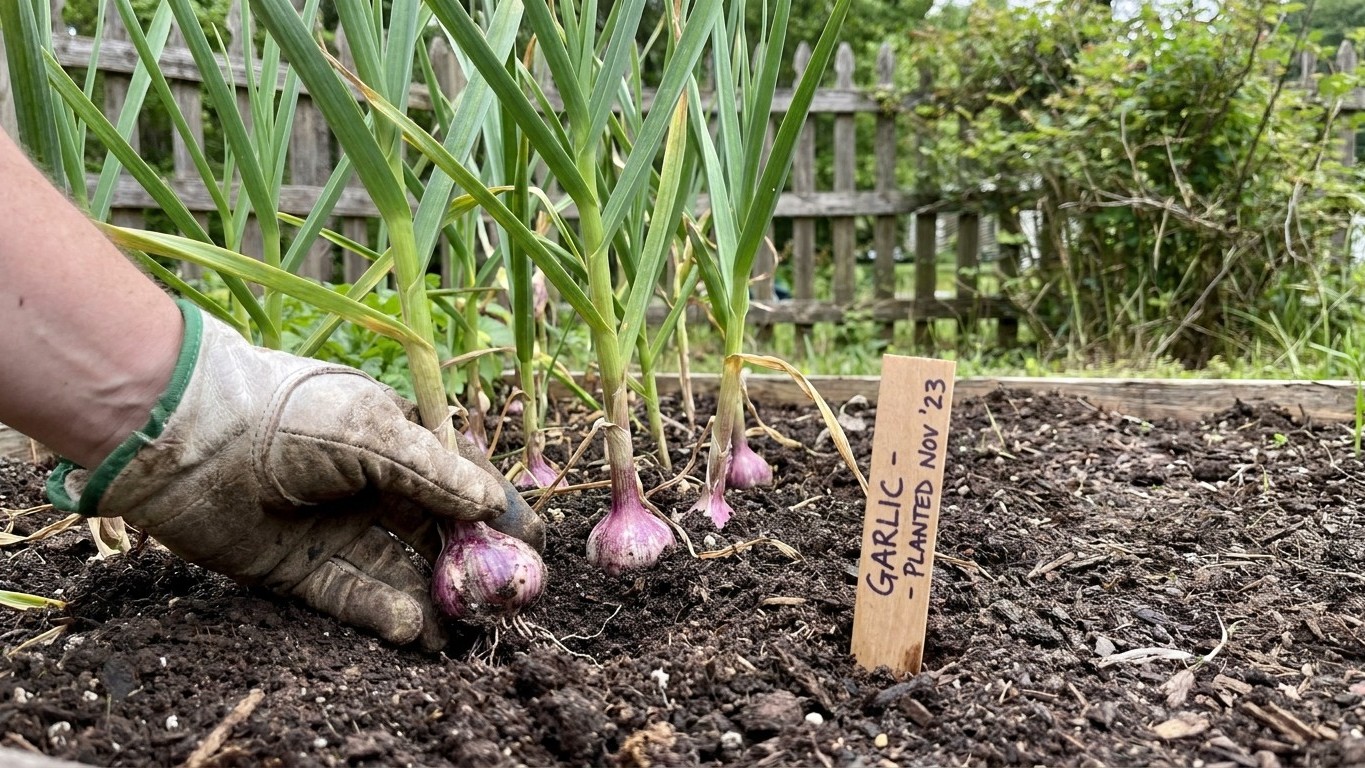

North Carolina’s Piedmont and mountain winters get cold enough, for long enough, that almost every garlic type sold by seed catalogs performs here. NOAA’s 1991-2020 climate normals put Charlotte’s first fall freeze between October 30 and November 8, and that range is what the planting window below is built backward from. Set cloves in the ground from early October to mid October, then check your own county’s frost record before you lock in a date, since Charlotte is only one station in a large state.
The short answer for North Carolina

November 8 comes and goes, cloves still sitting in the bag because that date got treated as a deadline instead of a midpoint — and by the time they finally go in, roughly half the years on record have already delivered their first freeze. Root-less cloves entering winter unanchored lose stand count and bulb size by July, no matter how well-suited the variety. The safer move is planting to the early edge of the window, not the average of it — cold here is never the problem; timing is.
That October 30 to November 8 range is a midpoint, not a guarantee. NOAA’s normals describe the span where the probability of a 32°F freeze runs from 30 to 70 percent across the 1991-2020 record, which means in roughly half the years on record the first freeze lands later than November 8, and in the other half it lands earlier than October 30. Treat mid-October as the safer edge of the planting window if the goal is rooted cloves well ahead of any freeze, not just the average one.
Cold is not the limiting factor here. Charlotte-area winters run about 21.8 weeks with mean air temperatures below 40°F, comfortably clearing the six to eight weeks of chilling that University of Georgia Extension publication C854 sets as the requirement for a garlic clove to split into a full head rather than growing on as a single round. That means hardneck types are not a gamble in North Carolina the way they would be in a genuinely mild winter climate. Both softneck and hardneck catalog types get enough cold here to perform as their descriptions promise:
- Softneck: Early Red Italian, Inchelium Red, Italian Late, Lorz Italian
- Hardneck: Bavarian Purple, Blue Music, Chesnok Red, Duganski, Fall Festival, Georgian Crystal, Georgian Fire, German Red, German White, Ivan
Working it out for your own garden
The early-October-to-mid-October window above is anchored on Charlotte, and Charlotte is Piedmont, not the mountains and not the coast. To adjust it for your own ground, start from your own county’s average first fall freeze rather than borrowing Charlotte’s. NOAA’s normals are recorded station by station, and the October 30 to November 8 range is one station’s record, not a statewide date.
The arithmetic, shown
Subtracting three to four weeks from the early edge of Charlotte’s frost range, October 30, lands in late September to early October. Subtracting that same three to four weeks from the late edge, November 8, lands in mid to late October. That is why the catalog window of early October to mid October lines up with the frost-based math for the Piedmont itself, and it is the same calculation When to Plant Garlic in North Carolina: Counting Back From the First Frost walks through for other parts of the state. Whatever county you start from, treat the result as a window, not a single day, since a frost date is a midpoint and the count back from it inherits that same uncertainty.
Elevation changes the starting point the most. Gain enough elevation moving into the foothills or the Blue Ridge and the growing season shortens at both ends, so frost arrives earlier in fall and the planting window should shift earlier by a comparable margin, often on the order of two weeks for that kind of elevation change. A large lake or the immediate coast works the other direction, holding heat into autumn and delaying the first frost, which buys extra time before cloves need to be in the ground.
None of this changes how deep or how far apart to plant, only when. If the bed prep, spacing and mulch steps are already familiar, Growing Garlic in North Carolina covers those for the state generally.
What changes across North Carolina
Three broad parts of the state handle this timeline differently, and each is driven by a different mechanism. NOAA’s normals for Charlotte come with a caution attached: the Blue Ridge Mountains to the west run their spring several weeks behind the Piedmont, while the coastal plain runs ahead of it. The same elevation and ocean effects work in reverse each fall. The mountains cool off first, and the coastal plain tends to stay mild longest.
| Region | Fall frost relative to Charlotte | Planting window shift | Main driver |
|---|---|---|---|
| Blue Ridge Mountains (west) | Arrives earlier | Toward late September to early October | Elevation |
| Piedmont (Charlotte and similar) | NOAA’s October 30 to November 8 reference range | Early October to mid October (baseline) | Interior, mid-latitude location |
| Coastal Plain (east) | Arrives later | Can extend toward mid to late October | Ocean’s moderating effect, lower elevation |
Don’t borrow a coastal planting date for a mountain garden, or the reverse. Cloves set out on the same October date face a colder start in a high-elevation garden than they do near the coast, even though both gardeners are working from the same catalog varieties and the same six-to-eight-week chilling requirement.
The mistakes this climate punishes
North Carolina’s climate does not rule out any garlic disease outright. It only makes some more likely to find favorable conditions in certain months, and the mistakes worth avoiding here are the ones that hand a pathogen exactly what it wants.
Buying uncertified cloves
White rot, caused by the fungus Sclerotium cepivorum, has a published air temperature range of 50 to 75°F according to the University of California’s IPM guidelines for onion and garlic (UC ANR Publication 3453). Charlotte’s growing-season mean air temperature falls inside that range in six separate months, September through November and March through May, with one of those months sitting at the pathogen’s optimum. Fusarium basal rot, caused by Fusarium oxysporum f. sp. cepae, has a wider published range of 59 to 90°F per the same UC IPM guidelines, and also lands inside it for six months of the growing season. None of that means either disease is present in a given garden. It only means the temperature is not the thing keeping it out. The mistake is planting cloves from an unknown source, since both pathogens travel mainly on infected seed garlic and persist in soil for years once established, regardless of how mild or cold the following winters are.
Two caveats matter here. The published thresholds are soil temperatures, and soil lags behind air temperature and swings less through a given month, so a mean air temperature inside a disease’s range is a rough proxy, not a soil reading. And a monthly average hides real variation. A month that averages inside a pathogen’s window still holds plenty of days on either side of it, and Charlotte is one station, so a different county’s monthly averages will run somewhat differently.
Planting depth and the ends of the window
Piedmont winters move through repeated freeze-thaw cycles rather than one sustained deep freeze, and that pushes shallow-set cloves up and out of the ground over a season more reliably than a single hard cold snap would. Set cloves at a depth that keeps the whole clove, not just the tip, under soil, and mulch enough to buffer the surface without keeping it wet enough to feed the diseases described above. Planting after mid-October cuts into the three to four weeks of root establishment this window is built on, and cloves that go in without an anchored root system are the ones frost heave finds first. At the other end of the season, pink root, caused by Setophoma terrestris, reaches its published 75 to 85°F optimum in exactly the two months, June and July, when most North Carolina garlic is being lifted and cured. Southern blight, caused by Sclerotium rolfsii, becomes less active as air temperatures fall short of its 86 to 95°F optimum here, though less active is not the same as absent. Good airflow during curing matters more than most gardeners expect for that reason.
Checking this against your county
Charlotte’s frost normals are a starting point, not a substitute for your own county’s numbers. NC State Extension maintains county offices across North Carolina, and the center nearest you is the right place to confirm local frost timing and any garlic-specific guidance for your soil and elevation. County agents can also flag local disease pressure and recommend a soil test, which matters more for garlic than for most vegetables since white rot sclerotia can persist in a field for years once they take hold.
Common questions
Should I plant garlic in spring instead of fall in North Carolina?
Fall planting is what makes garlic form a proper bulb here. Spring-planted cloves miss most of the chilling period that splits a clove into a full head, and they tend to bulb small or not divide at all, hardneck types especially, since they carry the strongest chilling requirement of the catalog types listed above.
What happens if I plant garlic after mid-October?
The later a clove goes in, the less time its roots have to establish before the ground turns cold, and that raises the odds of frost heave and winter losses rather than of the crop failing outright. A clove planted in late October in a mild year can still produce, but it starts the season with a weaker root system than one planted on schedule.
Can I use garlic from the grocery store instead of seed garlic?
It’s a poor bet in this climate specifically. Grocery garlic is often treated to slow sprouting, carries no disease certification, and is one of the main ways white rot and fusarium basal rot get introduced to a garden that never had them, both of which persist in soil for years once present.
Do the same varieties work in the mountains and on the coast?
The varieties themselves don’t change. What changes is the calendar date you count back to from your local frost, since the catalog characteristics of a cultivar like German Red or Georgian Fire are fixed everywhere they’re sold, but the window for setting cloves in the ground shifts earlier in the mountains and later toward the coast.