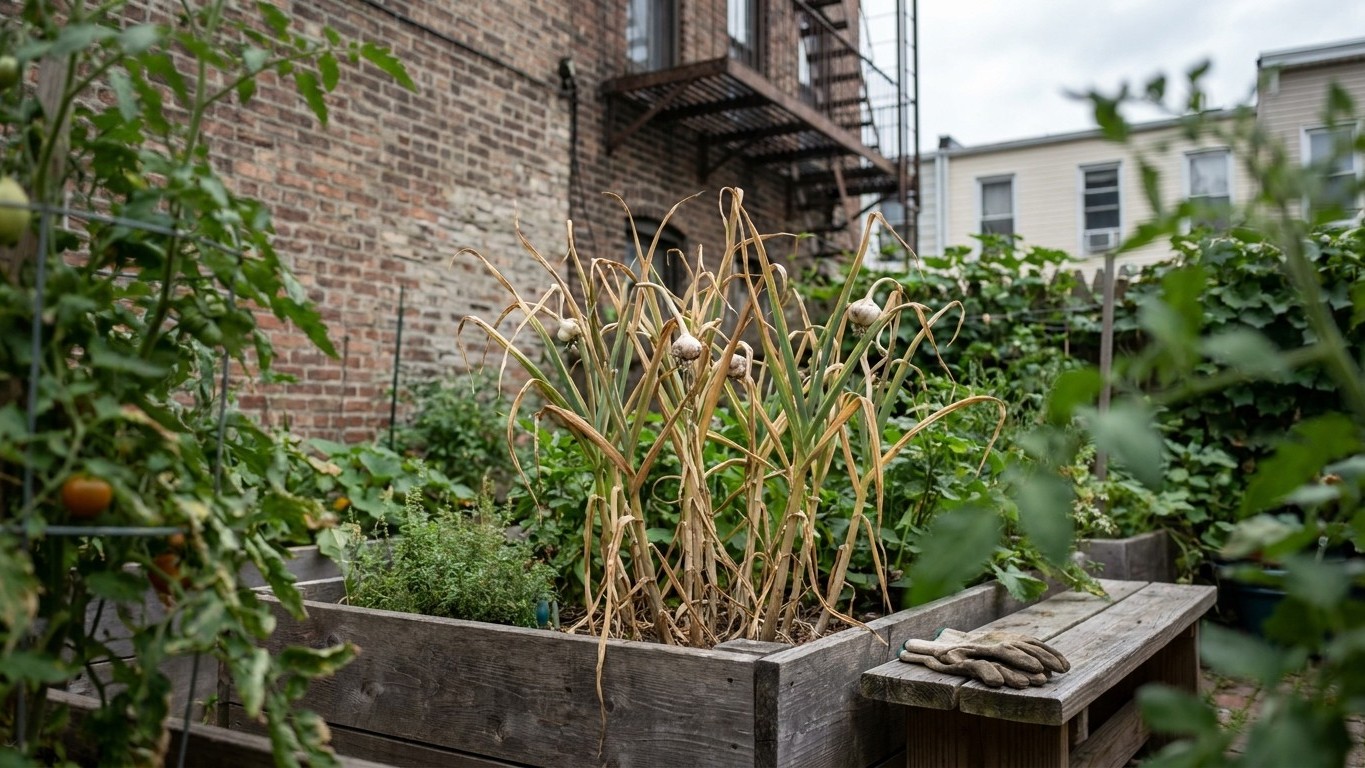

A round bulb with no cloves inside is what you get when garlic misses its cold. Some grower plants late, or plants in spring to make up for a missed fall window, and come July they’re cracking open what should be a head and finding one smooth, solid lump instead. That’s not disease or bad luck — that’s a clove that never got its six to eight weeks below 40°F. In New York, running short on cold is almost never the actual risk. Running out of time to root before the ground locks up is.
Will garlic get the cold it needs in New York

Garlic is not like a tomato you can grow anywhere with enough sun. It is triggered by cold. University of Georgia Extension publication C854 states that garlic needs a run of six to eight weeks of soil temperatures below 40°F after planting for the clove to divide into a full head. Skip that chill and the plant puts up a single rounded bulb with no internal cloves at all, a result growers call a “round.” It is edible, but it is not what you planted for.
New York, even in its mildest corner around New York City, sees long stretches of sub-40°F weather every winter, and the Finger Lakes, the Southern Tier, the North Country and the Adirondacks see far colder and far longer cold than that. If the relatively urban, ocean-buffered New York City area clears the vernalization threshold that UGA Extension describes, the rest of the state clears it with room to spare. This is not a state where a grower needs to worry about garlic failing to bulb from lack of cold. If anything, New York’s risk runs the other way: cold arriving hard and fast before a fall-planted clove has rooted in.
The one situation where the cold question actually matters here is a grower who missed the fall window entirely and is looking at a spring planting instead. Garlic set out in spring has not had its weeks below 40°F, and the fix is to refrigerate the cloves for several weeks before planting to simulate the missing winter, understanding that bulbs from a late, refrigerated planting usually come in smaller than a properly fall-planted crop. The other option, if a grower simply prefers not to fuss with refrigeration, is to lean on a softneck variety from the Garlic Varieties That Suit New York Winters lineup, which tolerates a shorter or missed chill period better than a hardneck does and still produces a usable, if smaller, bulb. Neither is as good as planting on time in the fall, but both beat an empty bed.
When to put the cloves in
Anchor the planting date on the first fall frost, not on a page from a calendar. NOAA’s 1991-2020 climate normals for the New York City area put that first freeze between November 14 and November 27. The middle of that range, around November 20, is the reference point to work from rather than either edge of it. For a full week-by-week breakdown, the garlic planting dates guide lays out the specifics. Garlic goes in three to five weeks before that point, which lands the planting window somewhere in mid-to-late October for most of the metro area, sliding earlier as you move away from the city’s moderating effect.
What pushes the date earlier or later
NOAA’s figure is measured at Central Park, a dense, heat-retaining urban site, and it runs later than almost anywhere else in the state. Move upstate, gain elevation, or garden away from the coast and Long Island Sound, and the first fall frost arrives measurably earlier, which pulls the whole planting window forward with it. A large lake nearby, most notably in the western part of the state near Lake Erie and Lake Ontario, has the opposite effect locally, holding warmth into fall along the immediate shoreline while inland spots just a few miles away frost much sooner.
- Coastal and NYC-metro gardens: later frost, later planting window, closer to the late end of the range
- Upstate, inland and higher-elevation gardens: earlier frost, earlier planting window
- Lake-effect shorelines: locally milder fall than surrounding inland areas at the same latitude
The goal in every case is the same: enough weeks of soil warmth left for roots to establish, but not enough for the shoot to push much above ground before hard freeze. A clove that roots without much top growth over winters cleanly. A clove that sends up several inches of green growth before the ground freezes solid is more exposed to winterkill, particularly in an open, wind-scoured bed with thin snow cover.
Which types suit New York
Hardneck garlic wants a real winter. It needs that sustained cold to perform, it produces a scape you cut and can eat in early summer, and it tends to carry stronger, more complex flavor. Softneck garlic tolerates mild winters better, skips the scape, and stores markedly longer in a pantry or root cellar. New York’s winters, upstate especially, favor hardneck, and it is what most serious growers in the colder two-thirds of the state plant. The city and the immediate coastal strip run mild enough that softneck also does well there, and a grower in that zone gets the longer storage life as a real advantage.
| Type | Winter needs | Storage life | Scape | Example varieties |
|---|---|---|---|---|
| Hardneck | Wants sustained cold | Shorter, several months | Yes, cut in early summer | Bavarian Purple, Duganski, German Red |
| Softneck | Tolerates mild winters | Long, often into the following spring | No | Inchelium Red, Lorz Italian |
Among hardnecks, Bavarian Purple and Blue Music are both reliable performers in a cold climate, and Duganski and German Red add strong, hot flavor to that mix. Chesnok Red and Georgian Crystal are worth growing if you plan on baking whole heads. German White, Georgian Fire, Fall Festival and Ivan round out the hardneck options for New York gardens. On the softneck side, Inchelium Red and Lorz Italian both keep well past the New Year, and Early Red Italian and Italian Late are worth a look if long storage is the priority over scapes and flavor intensity. All of these are set out in the same late-October-to-early-November window described above. Further south, growers in warmer states lean harder toward softneck for exactly the opposite reason New York leans hardneck: the winter simply is not cold enough for hardneck to perform reliably, a contrast laid out in Growing Garlic in North Carolina: Planting Dates, Varieties and Winter Cold, and again in the milder winters covered in Growing Garlic in Arkansas: Planting Dates, Varieties and Winter Cold.
Soil and bed preparation
Garlic sits in the same patch of ground for eight or nine months, through freeze, thaw and every wet spell in between, so drainage comes before anything else. A clove that sits in standing water rots before winter is even over, long before any fungus or pest gets involved. If your soil is heavy clay or the bed holds puddles after rain, raise it. A raised bed or a mounded row four to six inches above grade solves most drainage problems that would otherwise sink a fall-planted crop.
Work compost or aged manure into the bed a few weeks before planting, not right at planting time, so it has a chance to settle rather than sitting in direct contact with the fresh-cut clove. Garlic likes a loose, fertile, well-drained loam and does not want freshly worked, chunky, unsettled soil around its roots going into winter. A soil test through your local extension office will tell you whether pH needs adjusting. Garlic prefers a soil on the neutral side, and heavily acidic soil, common in parts of the state with a lot of pine or hemlock cover, benefits from lime worked in ahead of planting.
Skip a heavy, fast-release nitrogen feed at planting. Garlic wants to put its energy into rooting through fall, not into soft top growth that then has to survive a hard freeze. Save the nitrogen for spring, once the plant is actively growing again and building the leaves that eventually feed bulb size.
What the climate here favours, and what it does not
UC IPM’s Pest Management Guidelines for Onion and Garlic, UC ANR Publication 3453, publish the temperature ranges several major garlic diseases need to be active. Matching New York’s average air temperatures through the growing season against those published ranges shows which diseases the climate here tends to favor and which it does not, with one caveat stated plainly: those published thresholds are soil temperatures, and the figures compared here are air temperatures, which lag and swing less than air does. This is a tendency, not a forecast, and a monthly average hiding days both well above and below that average.
White rot and Fusarium basal rot are the ones to watch
White rot, caused by the fungus Sclerotium cepivorum, has a published active range of 50 to 75°F. New York’s growing-season air temperature falls inside that range in five separate months, September, October, April, May and June, including one month sitting right at the pathogen’s published optimum. That is the widest window of any disease on this list and it lines up closely with the exact weeks garlic is either freshly planted or breaking dormancy in spring, both vulnerable periods.
Fusarium basal rot, from Fusarium oxysporum f. sp. cepae, has a published range of 59 to 90°F, and New York’s air temperature sits inside that range across four months of the growing season: September, May, June and July. Neither of these counts means either disease is present in your garden. It means the climate does not rule them out, and the real defense against both is planting clean, certified seed garlic rather than saving cloves from a bulb of uncertain origin, since both pathogens travel primarily on infected planting stock and in contaminated soil.
Pink root and southern blight matter less here
Pink root, caused by Setophoma terrestris, has a published optimum of 75 to 85°F, and New York’s air temperature reaches that optimum in exactly one month of the growing season, July, right around harvest time for most varieties. Southern blight, from Sclerotium rolfsii, has a published optimum of 86 to 95°F, and no month of New York’s growing season reaches that range at all. That does not mean southern blight is impossible here. It means the disease runs well below its most active state in this climate, and it stays a much smaller risk in New York than it is in a hot Southern growing season.
Getting it through the winter
Mulch is what separates a clean stand of garlic in spring from a patchy one. Once the ground begins to firm up with the season’s first real cold, lay a generous layer of clean straw or shredded leaves over the bed. That mulch does two jobs: it moderates the freeze-thaw cycling that otherwise heaves shallow-planted cloves right up out of the soil over the course of a hard winter, and it holds a more even soil temperature through the coldest stretch. Planting depth matters here as much as mulch does: a clove set too shallow is far more prone to heaving regardless of how much straw sits on top of it.
Come spring, as soon as green shoots start pushing through, pull the mulch back partway rather than leaving it piled thick over the emerging plant. Left too heavy for too long, mulch traps moisture against the new shoot and can rot it before it gets going, and it also shades and slows the plant right when it wants full sun to start building leaf mass. A thin layer left in place through the growing season still earns its keep by suppressing weeds and holding soil moisture through summer.
Snow cover, where you get it reliably, is free insulation and reduces how hard mulch has to work. An open, wind-scoured bed with little snow accumulation needs a heavier mulch layer than a sheltered bed that reliably holds several inches of snow through the coldest months, and that difference is one more reason a single mulch recommendation does not fit every New York garden equally.
Harvest and curing here
Read the plant, not the calendar. Garlic is ready to lift when the lower third to half of the leaves have browned and died back while the upper leaves are still green. Pull a test bulb or two before committing to the whole bed. A bulb pulled too early has papery wrappers that haven’t fully formed and won’t store well. A bulb left too long in the ground starts splitting its wrapper and the cloves separate, which also hurts storage.
Curing depends on the summer you get
Curing is where a lot of otherwise good garlic gets lost, and New York’s summers vary enough from a humid, sticky stretch to a comparatively dry one that a single fixed curing routine will not serve every year the same way. Cure bulbs somewhere shaded, dry and with real airflow, never in direct sun. In a humid summer, that airflow matters even more, since damp, still air around curing bulbs invites mold before the wrappers have fully dried down. A box fan aimed across the curing rack solves most humidity problems. Do not wash the bulbs or trim the roots and tops close until curing is complete, since cutting into a bulb before it has cured properly opens a path for rot to set in during storage. Cure until the wrappers are fully papery and the neck is tight and dry, then trim, brush off loose soil, and move the bulbs to storage.
Local help
County-level planting dates, soil test results and disease pressure all vary across a state as large and climatically varied as New York. For a planting date and soil recommendation specific to your own county, contact Cornell Cooperative Extension, which runs a local office in most New York counties and can also run a soil test ahead of your fall planting.
Common questions
Can I Plant Garlic in the spring instead of fall in New York?
You can, but expect a smaller bulb. Garlic planted in fall gets its full run of winter chill and roots undisturbed before spring growth starts, while spring-planted garlic misses most or all of that chill unless the cloves were refrigerated first, and it also has a much shorter season to size up before summer harvest.
What happens if I plant too early and the shoots come up before winter?
Some top growth before hard freeze is normal and not a disaster on its own, but several inches of soft green growth going into a hard freeze is more vulnerable to winterkill than a clove that has only rooted without pushing much top growth. Planting closer to the later end of the recommended window, rather than the earlier end, reduces this risk in a mild fall.
Can I plant garlic from the grocery store?
It is not a good idea. Grocery store garlic is frequently treated with a sprout inhibitor, is often a variety not suited to your climate, and can carry soil-borne diseases into a garden bed that then persist for years. Certified seed garlic from a garlic-specific grower costs more but avoids all three problems.
Do I need to cut off the garlic scapes?
On hardneck varieties, yes, and most growers cut the scape once it curls, both because the scape is good eating and because leaving it on diverts energy away from bulb growth. Softneck varieties do not send up a scape at all, so the question does not apply to them.
Why did my garlic come up as one round clove instead of a full head?
That is a sign the plant did not get enough sustained cold to trigger clove division, the six-to-eight-week threshold below 40°F that University of Georgia Extension describes. It usually happens with a very late fall planting, a spring planting with no refrigeration beforehand, or an unusually mild winter for your specific site.