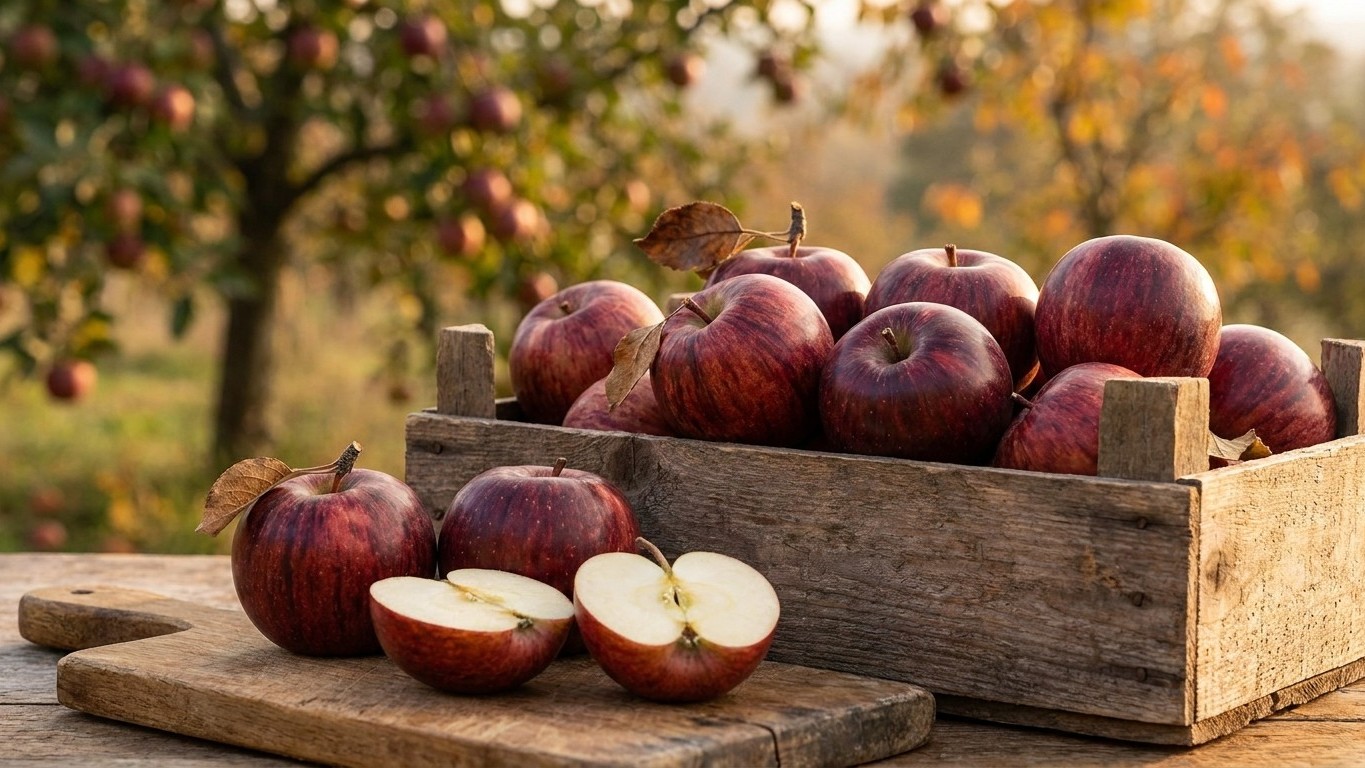

The honest answer is: it depends on where in Texas you’re standing, and on the variety more than the date on the calendar. A backyard tree in Houston can finish fruiting weeks apart from one in the Hill Country or the Panhandle, because bloom timing follows the local frost pattern, not a fixed month. What actually tells you a Texas apple is ready is the tree’s stage, and that stage is set by chill accumulation and frost risk specific to your region.
When apples are ready to pick in Texas
Texas covers four USDA hardiness zones, and treating the state as one climate is the fastest way to pick too early or lose a crop to frost. The mild end of that range sits along the Gulf Coast. At Houston, the mean daily minimum temperature of the coldest month is 43.7°F, according to NOAA NCEI Climate Normals (1991-2020). That’s a station reading, not a record low, and it’s the figure that actually decides whether a fruit tree survives the winter there at all rather than just how cold an unusual night got.
That same Houston station, IAH, gives a last spring frost window of February 4 to March 1, and a first fall frost window of December 1 to December 19, both from NOAA NCEI’s 1991-2020 Climate Normals in the 30-70% freeze-probability band. Those dates matter because apple bloom timing is anchored to them. Bud break happens once accumulated cold hours are satisfied, and how early that break occurs pushes the whole ripening calendar earlier or later. Hobby airport, just miles away, runs about two weeks milder than IAH, which is a useful reminder that even inside one metro area, the same “Houston” label hides real variation.
Move away from the coast and none of these Houston figures apply. North Texas and the Hill Country see harder, longer winters; the Panhandle freezes months earlier in fall and holds cold months later into spring. No single planting or harvest calendar covers all of that. What does hold across regions is the logic: a tree flowers once its chill requirement is met, and it fruits a set number of weeks after flowering depending on variety. Read the stage on your own tree, don’t read a date off a chart built for a different part of the state.
Hardiness and chill are two different filters
Winter hardiness tells you if the tree survives the cold at all. Chill hours tell you if it flowers correctly once it survives. A tree can be perfectly hardy for a mild Texas winter and still bloom poorly, or erratically, if it never accumulates enough cold to break dormancy evenly. This is why low-chill apple varieties dominate recommendations for the southern half of the state: they’re bred to satisfy their chill requirement on a milder winter than a Northern apple would ever need.
But low-chill comes with a cost. A variety that breaks dormancy on less accumulated cold also flowers earlier in the season, and earlier flowering lands closer to that last-frost window rather than safely past it. In a place like Houston, where last frost can run as late as March 1, an early-flowering low-chill tree is gambling on a frost date that hasn’t necessarily passed yet. That’s the trade-off, plainly: low-chill buys you flowering at all, but it buys it at the price of frost exposure that a later-flowering, higher-chill variety would have avoided. In the Houston area specifically, that’s the risk worth taking, because the alternative (a variety that needs more winter chill than the region reliably delivers) may not flower reliably in the first place. Texas A&M AgriLife Extension (agrilifeextension.tamu.edu) is the source to check for which specific varieties are currently recommended for your county, since chill adaptation is refined at that level, not at the state level.
Which ones keep, and which must be eaten
Not every apple that ripens is an apple built to sit in storage. The general rule holds in Texas as it does everywhere: firm, high-acid, later-season apples keep for weeks to months under cold storage, while soft, low-acid, early-season apples start breaking down within days of picking. Texas orchards leaning on low-chill varieties tend to skew toward the early-season, softer end of that spectrum, which changes how you should plan for what you grow.
This isn’t a quirk of variety marketing. Acidity and firmness are the two traits that resist the enzymatic softening and sugar conversion that eventually turns a crisp apple mealy. An apple with thin flesh and low acid starts that process almost immediately after harvest, cold storage or not. A firmer, more acidic apple slows the same process down considerably, which is the entire reason certain apples show up in grocery stores months after their harvest season while others never do.
| Trait | Keeper type | Eat-soon type |
|---|---|---|
| Firmness at harvest | Hard, dense flesh | Soft to moderately firm |
| Acidity | Noticeably tart | Mild, low-acid |
| Season | Later-ripening | Early-ripening |
| Typical storage life (cold, unwaxed) | Weeks to a few months | Days to about two weeks |
The practical takeaway for a Texas grower is to sort your harvest the day you pick it, not the week after. Handle the softer, early varieties first, use or preserve them quickly, and reserve refrigerated space for whatever firmer, tarter fruit you have. Bruised or dropped fruit belongs in that first-use pile regardless of variety, since any break in the skin accelerates decay no matter how firm the flesh started out.
Storing them through a Texas winter
Northern growers lean on a trick Texas mostly can’t use: an unheated cellar or garage that naturally holds near-freezing temperatures all winter, which is close to ideal for long-term apple storage. That option isn’t reliably available across most of Texas. At the Houston reference station, the mean daily minimum of the coldest month is only 43.7°F (NOAA NCEI, 1991-2020 Climate Normals), which means an unheated space isn’t going to hold apples anywhere close to the 32-35°F range that slows ripening most effectively. A garage shelf in a Texas winter is simply too warm, most of the time, to function as cold storage.
That pushes the practical answer toward the refrigerator for anyone growing apples in the milder two-thirds of the state. A dedicated fridge drawer, kept separate from vegetables (apples release ethylene gas that speeds spoilage in nearby produce), is the closest most Texas households get to that ideal cold, humid storage environment. Wrapping apples individually or storing them in perforated plastic bags helps hold humidity around the fruit without trapping the surface moisture that promotes mold.
What this means for quantity
Because ambient Texas winter temperatures don’t offer that free cold storage, the math on how much fruit you can realistically keep changes. A grower expecting to store bushels of apples in an outbuilding the way a Northern grower might needs to recalibrate: refrigerator space is finite, and it’s the actual limiting factor here, not root cellar square footage. That argues for prioritizing preservation, drying, canning, or simply timing harvest to match what you can eat or process within the shorter window that ambient Texas conditions allow before quality drops. Colder regions of the state, at higher elevation in the Hill Country or in the Panhandle, get closer to that Northern-style cold snap, but no published figures here confirm how close, so treat that as regional variation worth checking locally rather than a number to rely on.
What goes wrong here
The most common failure in Texas apple growing traces back to the low-chill trade-off discussed earlier: a tree flowers early because that’s what its chill requirement demands in a mild winter, and then a late frost inside that February 4 to March 1 window at the Houston reference station catches the open blossoms before they’ve set fruit. This isn’t a rare fluke. It’s the built-in cost of choosing a variety that can flower reliably in a climate that doesn’t deliver much winter cold, and growers who don’t plan for it lose part or all of a season’s fruit to a single cold night in a month that otherwise felt like spring.
Insufficient chill accumulation causes a quieter version of the same problem: erratic or extended bloom, where flowers open over a drawn-out period instead of together, which weakens pollination and reduces the eventual crop even without a hard frost involved. This is a different mechanism from frost damage but produces a similarly disappointing harvest, and it’s specific to choosing a variety poorly matched to the actual winter cold a given part of Texas receives.
Humidity brings its own set of problems once fruit is on the tree and after it’s picked. Texas summers combine heat and moisture in ways that favor fungal disease on the tree and faster spoilage after harvest, particularly for the softer, low-acid varieties already prone to quick decline. Storage failures compound this: apples left at room temperature in a Texas home, rather than refrigerated, soften and spoil far faster than the same fruit would in a naturally cooler Northern kitchen, simply because ambient indoor and outdoor temperatures run warmer here for more of the year.
None of this means apples can’t be grown successfully across Texas. It means the failure points are climate-specific: frost timing relative to bloom, chill sufficiency relative to variety, and heat relative to storage. Texas A&M AgriLife Extension is the resource to check for county-level variety recommendations that account for these local risks rather than a general Southern gardening guide.
Common questions
Can you grow apples in Houston specifically?
Yes, using low-chill varieties suited to the region, with the understanding that early flowering (a consequence of low chill requirement) increases exposure to the area’s last frost window of February 4 to March 1, per NOAA NCEI Climate Normals for station IAH. Texas A&M AgriLife Extension is the source for current county-level variety guidance.
Why do Texas-grown apples seem softer than store-bought ones?
Store-bought apples are frequently later-season, high-acid varieties bred and stored specifically for firmness over months. Many varieties suited to Texas’s milder winters ripen earlier and lean toward the softer, lower-acid end of the spectrum, which is a real trait difference, not a sign of poor growing.
Does an unheated garage work for apple storage in Texas?
Generally no, in the milder parts of the state. At the Houston reference station the mean daily minimum of the coldest month is 43.7°F (NOAA NCEI, 1991-2020), well above the near-freezing range that makes unheated storage effective further north. A refrigerator is the more reliable option.
Is the same frost date true for all of Texas?
No. The February 4 to March 1 last-frost window and the December 1 to December 19 first-frost window come specifically from the Houston-area IAH station. The Panhandle, North Texas, and the Hill Country all have different frost timing, and no single date applies across the whole state.