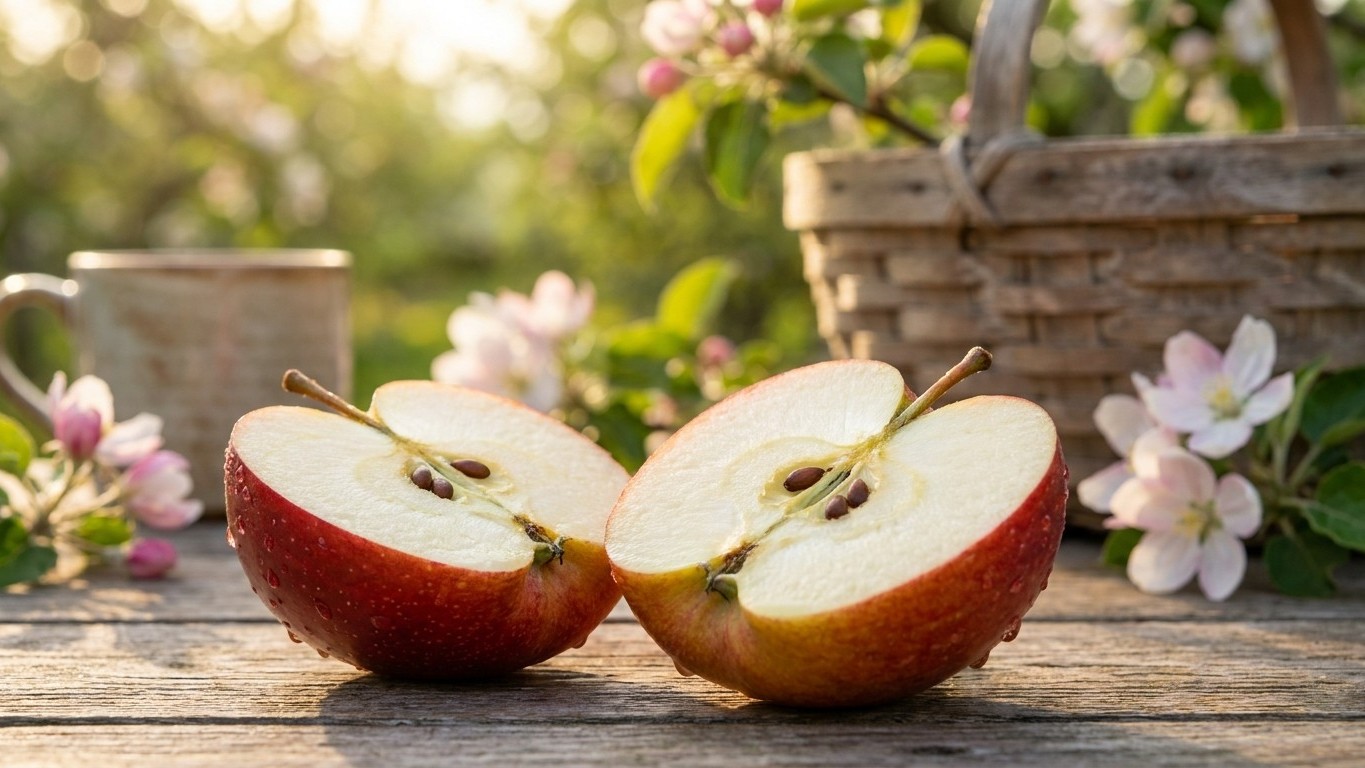

West Virginia’s apple harvest runs roughly from mid-August through late October, depending on variety and elevation, with early apples ready weeks before the first fall frost and late-keeping types picked right up against it. How long the fruit then lasts ranges from a couple of weeks on the counter to several months in cold, humid storage. The variety you pick and the way you store it, not the calendar date, decide which outcome you get.
When apples are ready to pick in West Virginia
Forget the date on a calendar. An apple tells you it’s ready through its own stage of development: the background color under the red or green blush shifts from grass-green toward yellow or cream, the seeds inside turn from white to brown, and the stem lets go with a gentle upward twist instead of a fight. Growers who rely on a fixed date end up picking half their crop too early and leaving the rest to drop.
What you can anchor to is the frost window. In the Charleston area, the last spring freeze typically falls between April 9 and April 23, and the first fall freeze arrives between October 18 and November 1, according to NOAA’s 1991-2020 climate normals for that reference station. Bloom follows the spring thaw by a few weeks, and everything downstream, from fruit set to final ripening, shifts later or earlier with that starting point. A cold, late spring pushes the whole season back; a warm one pulls it forward.
Elevation changes everything
Charleston sits in a river valley, and that matters more than it sounds. Higher ground across the state, the Allegheny highlands, the ridges around Canaan Valley, the Greenbrier highlands, cools off earlier in autumn and warms more slowly in spring than the valley floor does. An orchard at 3,000 feet can see its first hard freeze two to three weeks ahead of a valley orchard, which means the same variety needs picking earlier up high than it would down low. If you’re growing at elevation, treat the Charleston frost dates as a starting reference, not a schedule, and watch your own trees.
In practice, this breaks the season into three loose windows. Early-season apples, the kind bred to ripen fast and not linger, generally come off in the weeks before the first fall frost threat even becomes serious. Mid-season varieties ripen through the heart of that window. Late-season apples, the ones bred for storage rather than speed, are still hanging when the October 18 to November 1 freeze window opens, and growers race to get them off the tree before a hard freeze softens the flesh and ruins the keeping quality that was the whole point of growing them.
Which ones keep, and which must be eaten
Not every apple wants the same fate. Thin-skinned, early-ripening varieties are built for quick eating: they lose crispness fast at room temperature and don’t hold up well even under refrigeration for more than a few weeks. Late-season apples, by contrast, have denser flesh, thicker skin, and a slower metabolic rate after picking, which is exactly what lets them sit in cold storage for months without turning to mush.
The distinction isn’t cosmetic. An early apple picked in late summer and a late apple picked in October are, biologically, running on different clocks. The early one is already past its peak firmness within days of harvest even in a refrigerator. The late one is just getting started.
| Harvest timing | Typical keeping behavior | Best use |
|---|---|---|
| Early season | Short window, softens quickly even chilled | Fresh eating, immediate use, short-term fridge storage |
| Mid-season | Moderate hold, weeks rather than months | Fresh eating, baking, some short-term storage |
| Late season | Long hold in proper cold storage | Root cellar or cold storage through winter |
None of this is published as a formula anywhere specific to West Virginia; it’s general orcharding knowledge that applies wherever apples grow. What West Virginia’s climate contributes is the timing of that late-season harvest window, squeezed as it is against the first fall frost between October 18 and November 1. Growers here who want winter-long storage need to plan on picking the last fruit in that narrow stretch, not after it, since fruit caught by a hard freeze on the tree bruises and breaks down in storage far faster than fruit picked while still firm.
If you’re choosing what to plant with storage in mind, the practical move is to favor late-season, dense-fleshed types and accept that they demand patience: they’re the last apples off the tree, and they’re the ones still good on toast in February.
Storing them through a West Virginia winter
Cold, humid, and dark is the formula, and West Virginia’s winter climate does part of the work for free if you use it right. An unheated garage, shed, or root cellar that stays just above freezing gives long-keeping apples the conditions they want. The trouble is that “just above freezing” is a narrower band than it sounds, and an uninsulated outbuilding can swing below it on the coldest nights.
That’s where the region’s own winter numbers matter. The mean daily minimum temperature during the coldest month, based on the Charleston reference station’s 1991-2020 climate normals, runs 26.1°F. That’s below freezing on an average cold-month night, which means an unheated storage space with no insulation at all can easily dip into damaging territory for stored fruit, not just for the trees outside. Apples themselves start to suffer chilling injury below about freezing, so a storage area needs some buffer, whether that’s earth-banked walls, insulation, or simple proximity to a heated space, to stay consistently cold without going hard-freeze cold.
Practical steps that hold up here
- Wrap or bag apples individually or in small batches to slow moisture loss and limit how fast one bruised fruit spreads rot to its neighbors.
- Keep them away from potatoes and other produce that release ethylene or moisture in ways that speed spoilage.
- Check stored fruit every few weeks through winter and pull anything soft or discolored before it takes the rest down with it.
- Aim for high humidity in the storage space; apples shrivel fast in dry air even when the temperature is right.
For questions specific to your county, whether that’s soil conditions, pest pressure, or variety recommendations, West Virginia University Extension is the state’s land-grant extension service and the right first call. It does not publish a statewide chill-hour map or a county-by-county harvest calendar that this article can point to, so treat frost dates and on-tree ripeness signs as your working guide rather than waiting on a tool that doesn’t exist yet.
What goes wrong here
The most common failure isn’t storage, it’s timing at the other end of the season: a late frost catching blossoms that opened too early. This is where a mild winter becomes a trap rather than a gift. A tree needs a certain amount of accumulated cold to break dormancy properly and flower on schedule; give it too little cold and it can flower early, right into the same window where the last spring freeze, April 9 to April 23 around Charleston, is still a live threat. A low-chill variety bred for a warmer climate would flower even earlier here, and that’s exactly backward for a state where a hard spring freeze is still very much on the table into late April.
The coldest-month mean minimum of 26.1°F tells the other half of the story: winters here are cold enough that West Virginia orchards don’t lack for chill accumulation in the first place. Standard, well-established apple varieties suited to the mid-Atlantic and Appalachian region get all the dormancy they need under normal conditions. There’s no local case for reaching toward a low-chill selection here, since it would flower earlier without any corresponding benefit, and earlier flowering only raises the odds of losing a crop to frost.
Elevation compounds the risk. An orchard on high ground faces a shorter, more compressed frost-free season than the Charleston valley numbers suggest, so a spring freeze that misses the valley can still hit a mountainside block in bloom. Growers at elevation do better treating the printed frost dates as an optimistic floor and building in extra margin, both in variety choice and in how late they trust a warm early spring.
On the harvest side, the recurring mistake is simple impatience or its opposite: picking too early strips flavor and shortens storage life, while waiting too long into the October 18 to November 1 frost window risks a freeze softening fruit on the tree before it’s even picked.
Common questions
What month should I pick apples in West Virginia?
There’s no single month; early varieties are typically ready by late summer, and late-keeping varieties often aren’t picked until the weeks right before the first fall frost, which falls between October 18 and November 1 around Charleston. Read the fruit’s ripeness signs rather than the date.
Do apples keep ripening after they’re picked?
Apples continue to soften and change flavor after harvest, which is why storage temperature matters so much. Cold slows that process; warmth speeds it, which is exactly why an apple left on the counter softens in days while the same variety in cold storage can last months.
Can I grow low-chill apple varieties in West Virginia?
There’s little reason to. With a coldest-month mean minimum of 26.1°F, the state’s winters already supply ample chill for standard varieties. A low-chill selection would flower earlier, which only increases exposure to the region’s last spring freeze, still possible as late as April 23 around Charleston.
Does harvest timing differ between the valleys and the mountains?
Yes. Charleston’s frost dates come from a valley station, and higher elevations across the state, including the Allegheny highlands and areas like Canaan Valley, see earlier fall frosts and later spring warming. Orchards at elevation should expect to pick earlier than valley timing suggests and build in a wider safety margin against both spring and fall freezes.