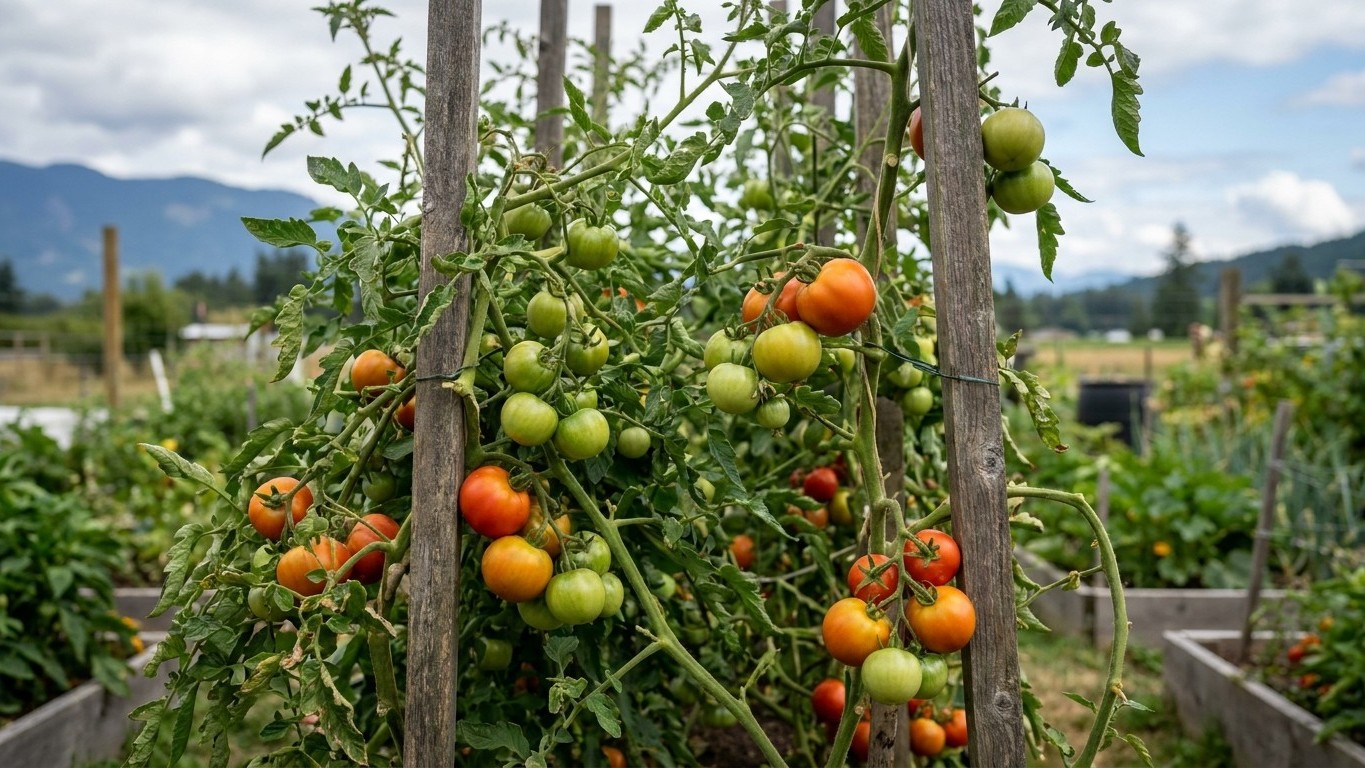

The short answer: plan to bring in your tomato harvest, ripe or not, by late August, because the Whitehorse area averages a first fall frost around August 25. That’s not a safe date, though. It’s a midpoint, and plenty of years bring frost earlier or later. What actually decides your picking day is the weather forecast in front of you, not a calendar square.
When to pick tomatoes in Yukon
Start with the math nobody tells you outright: the gap between an average last spring frost on June 5 and an average first fall frost on August 25 at the Whitehorse A station leaves about 81 frost-free days in a typical year. That’s the whole runway a tomato plant gets to flower, set fruit, and size it up before the cold comes back. Compare that to a garden a thousand miles south with a five- or six-month season, and you can see why timing the harvest matters more here than almost anywhere else growers write to us from.
Both of those dates are averages from Environment and Climate Change Canada’s 1981-2010 climate normals, not guarantees. In one year out of two, the actual last spring frost lands later than June 5, and in one year out of two the first fall frost lands later than August 25 too, which cuts both ways: some years you get a bonus few weeks, others you lose them. Treat August 25 as the center of a window that can swing more than two weeks in either direction, not a date you circle and relax about.
Reading the plant instead of the calendar
Because the frost date is unreliable, the better trigger is the forecast itself. Once nighttime lows are forecast to dip near or below freezing, that’s your signal to pick everything with size, whether it’s blushing red or still hard and green. Waiting for full color is a luxury this climate rarely offers. A tomato that has reached its mature size, with a slight paling from deep green to a lighter, almost silvery green, will ripen off the vine even if it never saw a hint of pink outdoors. Fruit that’s still small and dark green, with no size change in the last week or two, is unlikely to do much once picked, though it isn’t wasted (more on that below).
Elevation and local terrain push this earlier still. The Whitehorse A figures describe one station, and the Yukon is not one climate. Valley bottoms and low-lying gardens collect cold air and frost before hillside or south-facing plots do, sometimes by a week or more. If your garden sits in a natural cold pocket, or if you’re gardening farther north or at higher elevation than Whitehorse, shave days off that August 25 midpoint rather than adding them. This region also sits in Canadian hardiness zone 1b, a rating built from seven different climate variables under Natural Resources Canada’s system, not the single-factor USDA scale used south of the border. Don’t try to line it up with a USDA number; it doesn’t convert cleanly and never means the same thing on both scales. What it does tell you plainly is that this is about as demanding a climate as tomato growers face on this continent, and the harvest window deserves to be treated that way.
What to do with the green ones
Once you’ve stripped the plants ahead of frost, you’re going to be looking at a mixed pile: some fruit close to ripe, plenty of it fully green. The first job is sorting, because not every green tomato has the same future.
Sorting by maturity, not just color
Mature green tomatoes have finished sizing up. They feel firm but not rock-hard, the skin has a faint waxy sheen, and if you slice one open the seeds are formed and surrounded by gel rather than looking flat and undeveloped. These are the ones worth setting aside to ripen, because they carry enough stored sugar and structure to color up decently on a counter or in a box. Immature green tomatoes, the small, hard, glossy ones that were still growing when the cold hit, rarely ripen well. They tend to shrivel or rot before they turn, since they don’t have the internal reserves a mature fruit does.
Rather than force those immature ones to ripen, use them as green tomatoes on purpose. Fried green tomato is the obvious use, but relish, chutney, and pickled green tomato all lean on that firm, tart, unripe flesh, and they’re a practical way to get value out of fruit that was never going to turn red no matter how long you waited. Sorting them out at harvest, rather than mixing everything into one bin, saves you from discovering rot in your ripening boxes three weeks later.
Whole-plant pulling is another option some Yukon gardeners lean on, especially with a heavy late crop still loaded with green fruit. Pull the entire plant by the roots before frost, shake off loose soil, and hang it upside down somewhere cool, dry, and out of direct sun, a shed or unheated porch works. The fruit continues drawing a little from the vine and ripens gradually over the following weeks, staggering your harvest instead of dumping every tomato into ripening boxes at once. It’s slower than picking individually, but it spreads out the work and the eating.
Ripening indoors, and how long they keep
Individually picked mature green tomatoes ripen best out of the sun, not in it. A sunny windowsill feels intuitive but actually speeds up softening and rot without doing much for color, since it’s warmth and ethylene that drive ripening, not light.
Setting up a ripening spot
Lay the fruit in a single layer in a shallow box or tray, not stacked, with a little space between each tomato so air moves around them and one soft spot doesn’t spread to its neighbors. A room temperature between roughly 65 and 70 degrees Fahrenheit ripens fruit at a reasonable pace; anything much colder slows the process to a crawl, and anything close to refrigerator temperatures can stop it and damage the fruit’s texture permanently, a problem known as chilling injury. Wrapping each tomato loosely in newspaper, or tucking a ripe banana or apple into the box, adds ethylene gas and speeds things along, which matters when the calendar is already working against you at this latitude.
Check the box every couple of days. Any fruit that’s gone soft, wrinkled, or shows a spreading dark patch needs to come out immediately, both to eat or use right away and to keep it from taking down the tomatoes around it. Mold spreads fast in a closed box.
How long they keep depends entirely on how mature they were at picking. Fruit that was already showing a blush of color when harvested often finishes ripening within a week to ten days. Fully mature green fruit, no color at all but firm and properly sized, commonly takes two to four weeks to color up indoors, and some stragglers can take longer still. Realistically, a batch of mature green tomatoes picked ahead of an August frost can keep you in fresh, ripening fruit well into September or even October, which is no small thing in a place where the outdoor season closed weeks earlier.
What goes wrong here
The single most common mistake is picking too late, gambling on a few extra days of color and losing the whole fruit to frost damage overnight. A tomato that’s actually been touched by frost, even briefly, turns soft and water-soaked within a day or two, and it will not ripen properly afterward. If the forecast even mentions a possible frost, pick first and sort later; you can’t undo a freeze once it’s happened.
Storage problems that show up after picking
The other frequent failure happens after harvest, not before it. Yukon falls run cool and often damp, and a ripening box tucked into an unheated porch or garage can sit right at chilling-injury temperatures without anyone noticing until the fruit turns mealy and flavorless despite looking fine on the outside. Bringing boxes indoors to a heated room, even a modest one, protects against this far better than an attached but unheated space does.
Crowding is the third common issue. Piling green tomatoes several layers deep traps moisture, and one rotting fruit at the bottom of the pile can spoil several others before you ever spot it. Single layers, some airflow, and a daily glance cost almost nothing and prevent most of the losses growers report at this stage. None of these fixes require special equipment, just attention at the two moments that matter most: the day you decide to pick, and the weeks after when the fruit is sitting quietly on a counter doing the work the garden ran out of time to finish.
Common questions
Is August 25 a safe date to leave tomatoes on the vine?
No. It’s the average first fall frost recorded at the Whitehorse A station over the 1981-2010 period, and in about half of all years frost arrives later than that, while in others it can arrive earlier. Use it as a rough midpoint and watch the actual forecast rather than the calendar.
Do green tomatoes ripen faster with more sunlight?
No, ripening is driven by warmth and ethylene gas, not light exposure. A shaded box at a steady room temperature ripens fruit as well as, or better than, a sunny windowsill, which also raises the risk of scald and premature softening.
Should I refrigerate green tomatoes to make them last longer?
Avoid it while they’re still ripening. Temperatures near refrigerator levels cause chilling injury, damaging texture and flavor permanently. Keep unripe fruit at a moderate room temperature until it colors up, then refrigerate only once ripe if you need to hold it a little longer.
What’s the difference between a mature green tomato and an immature one?
A mature green tomato has finished sizing, feels firm with a slight waxy sheen, and shows formed seeds surrounded by gel when cut open. An immature one is smaller, harder, and glossier, with underdeveloped seeds, and it generally won’t ripen well off the vine, making it better suited to green-tomato recipes than to a ripening box.