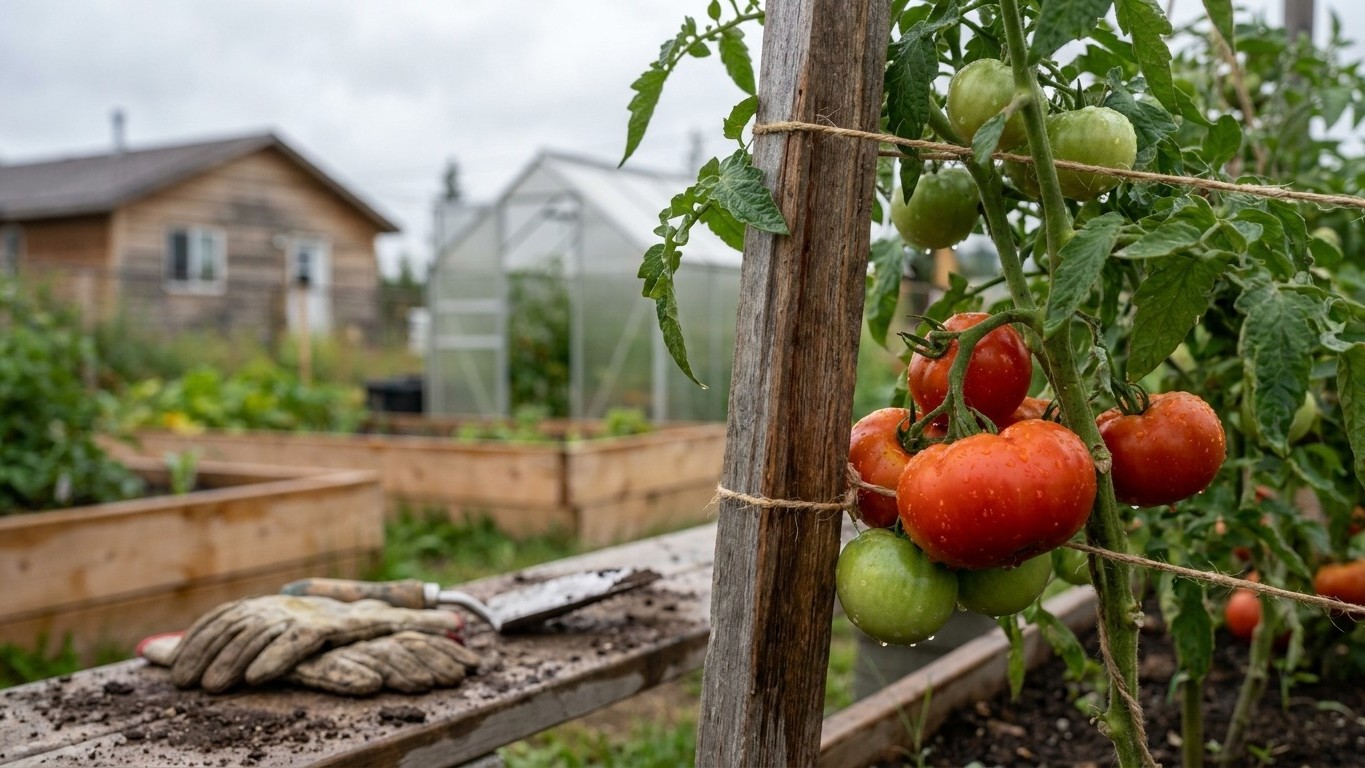

Eleven weeks, give or take, is what Whitehorse hands you between a mean last frost near June 5 and a mean first fall frost around August 25 — one of the tightest tomato windows anywhere on this site. But “mean” is the catch: half the years run later on one end or earlier on the other, so that square on the calendar is a midpoint, not a promise. Counting backward from it, rather than trusting it outright, is what actually sets your planting date here.
What this comes down to in Yukon

Environment and Climate Change Canada’s 1981-2010 climate normals for the Whitehorse A station put the mean last spring frost at June 5 and the mean first fall frost at August 25. That gives a mean frost-free stretch of roughly eleven weeks, one of the shortest true tomato seasons this site deals with anywhere, which is one reason growing tomatoes in Yukon depends on tighter timing than it does almost anywhere else we cover.
The word mean matters more here than in most places. A mean date is the midpoint of a spread, not a guarantee. In roughly one year out of two, the last spring frost at Whitehorse falls after June 5, and in roughly one year out of two the first fall frost arrives before August 25. Treat both dates as the center of a range you cannot fully predict, and build slack into both ends of the season instead of planting or expecting a harvest right up against the calendar square.
These figures also come from Canada’s 1981-2010 averaging period, an earlier vintage than the 1991-2020 normals used on this site’s US state pages, so a direct comparison of Yukon’s frost dates against a border state’s isn’t quite apples to apples. And Whitehorse is one station in a large, elevation-varied territory. Higher, more northern, or more exposed communities run their own frost clock weeks behind the capital, and a gardener in one of those places needs to shift every date discussed here later, not just nudge it by a few days.
What follows from the numbers
Because the season is short and the frost dates are averages rather than promises, direct seeding tomatoes outdoors is not a realistic strategy anywhere in this territory. Every plan here starts from a transplant already several weeks old when it goes into the ground, and the transplant date itself has to wait on the weather, Not the Calendar. Move transplants outside only after night temperatures have held steady past the danger point, not on the strength of a warm afternoon or two.
Working it out for your own garden
Start from the two mean dates and work through the arithmetic rather than looking up a single answer. Whitehorse’s mean last frost of June 5 marks the earliest point to even consider moving transplants outside, and because it is only a fifty-fifty date, most growers wait into the following week or two before committing, watching the forecast rather than the square on the calendar. For the purpose of counting forward, call that transplant window mid-June.
Running the numbers on a real cultivar
From there, add the cultivar’s days-to-maturity, which seed catalogs count from the transplant date, not from seed. A cultivar rated 55 days from transplant, set out in mid-June, reaches first ripe fruit around mid-August, which lands roughly twelve days ahead of Whitehorse’s mean first fall frost of August 25. That twelve-day gap is the margin, and it has to absorb both a late spring frost and an early fall one landing in the same season.
Sakura and Edox, both 55-day indeterminate cultivars, run through this arithmetic with room to spare: mid-June transplant, mid-August first ripe fruit, about twelve days of cushion before the mean frost date. Push the days-to-maturity higher and that cushion disappears fast. Kuzco, a 66-day determinate cultivar, follows the same mid-June transplant to a late-August first ripe date, arriving with only about a single day of margin before the mean frost. One day of slack is not a plan. Any year the frost arrives even slightly earlier than August 25, which by definition happens about half the time, Kuzco does not finish outdoors.
The table below runs the same calculation across a spread of days-to-maturity, all counted from a mid-June transplant against Whitehorse’s mean frost dates.
| Cultivar | Days from transplant | First ripe fruit (calculated) | Margin before mean frost |
|---|---|---|---|
| Sakura | 55 | mid-August | about 12 days |
| Sun Gold | 57 | mid-August | about 10 days |
| Juliet | 60 | mid-August | about 7 days |
| Black Cherry | 64 | late August | about 3 days |
| Kuzco | 66 | late August | about 1 day |
For a full rundown of which cultivars fit this window and which don’t, see Tomato Varieties That Ripen in Time in Yukon. The point to take from the arithmetic itself, more than any single variety, is that every day of days-to-maturity added is a day of margin subtracted from the safe end of the season, and this territory has very little margin to spare.
The mistakes this state punishes

Two mistakes account for most of the failed tomato seasons in Yukon, and both come from treating the mean frost dates as fixed rather than as the middle of a spread.
Planting on a warm spell instead of a warm soil
A stretch of sunny, mild weather in late May or early June can push air temperatures well above what the season actually supports, and gardeners who plant on the strength of a few warm days get caught when the pattern reverts, which it does often enough at this latitude to matter. Wait for the soil itself to warm, not just the air, and keep row cover or cloches on hand for the week after transplanting regardless of the forecast.
Choosing a variety for a longer season than this one
A tomato rated 66 or 68 days from transplant might be an easy midseason choice in a longer climate, but against Whitehorse’s mean eleven-week window it leaves almost no room for frost to arrive even slightly early, and at this latitude it often does. Match the cultivar’s days-to-maturity to the margin the frost window actually allows, not to what performed well in a catalog photo or a friend’s garden further south.
A shorter list of smaller errors compounds both of the above:
- Starting seed too early indoors, so transplants are leggy and stressed before the soil is ready to receive them
- Skipping hardening-off because the outdoor window feels short, which sets plants back for days they cannot spare
- Leaving fruit to ripen fully on the vine into September, when Whitehorse’s mean frost date has already passed for the year
Checking this against your county
A garden in the Klondike Valley, further north, or at higher elevation runs on its own frost calendar, often weeks behind Whitehorse’s mean dates, and no single number here substitutes for your own record of when frost actually lands in your yard.
For guidance beyond these averages, Agriculture and Agri-Food Canada’s site at agriculture.canada.ca is the federal starting point for growing information, since the territorial department’s own site could not be verified for this article. Keep your own frost log for two or three seasons and weight it more heavily than any station average once you have it.
Some gardeners also time this by the Moon: when to plant tomatoes by the moon, as almanac tradition rather than fact.
Common questions
Can I start seeds indoors earlier to beat the short season?
Starting seeds indoors earlier doesn’t change the outdoor transplant date, since transplants still have to wait for frost risk to pass. Count backward from the mid-June transplant window using the weeks-to-transplant figure on your seed packet instead of just starting as early as possible.
What if it’s past the frost date but still cold at night?
A frost-free reading doesn’t mean tomatoes are safe outside. Chilly nights well above freezing still stunt growth, stall flowering, and can turn leaves purple, so wait for nights to hold reliably warmer, not just frost-free, before you transplant.
Do I need row cover or a greenhouse to grow tomatoes here at all?
Not strictly, but many Yukon gardeners use row cover, cold frames, or a greenhouse to add weeks of margin on both ends of the mean frost window described above. For a cultivar that only leaves a day or two of margin on paper, that extra protection is often the difference between a harvest and none.
Is June 5 the frost date for all of Yukon?
No. It’s specific to the Whitehorse A station, and other Environment and Climate Change Canada stations across the territory would show different means. Communities further north or at higher elevation should expect their frost-free window to open later and close earlier than the Whitehorse figures.