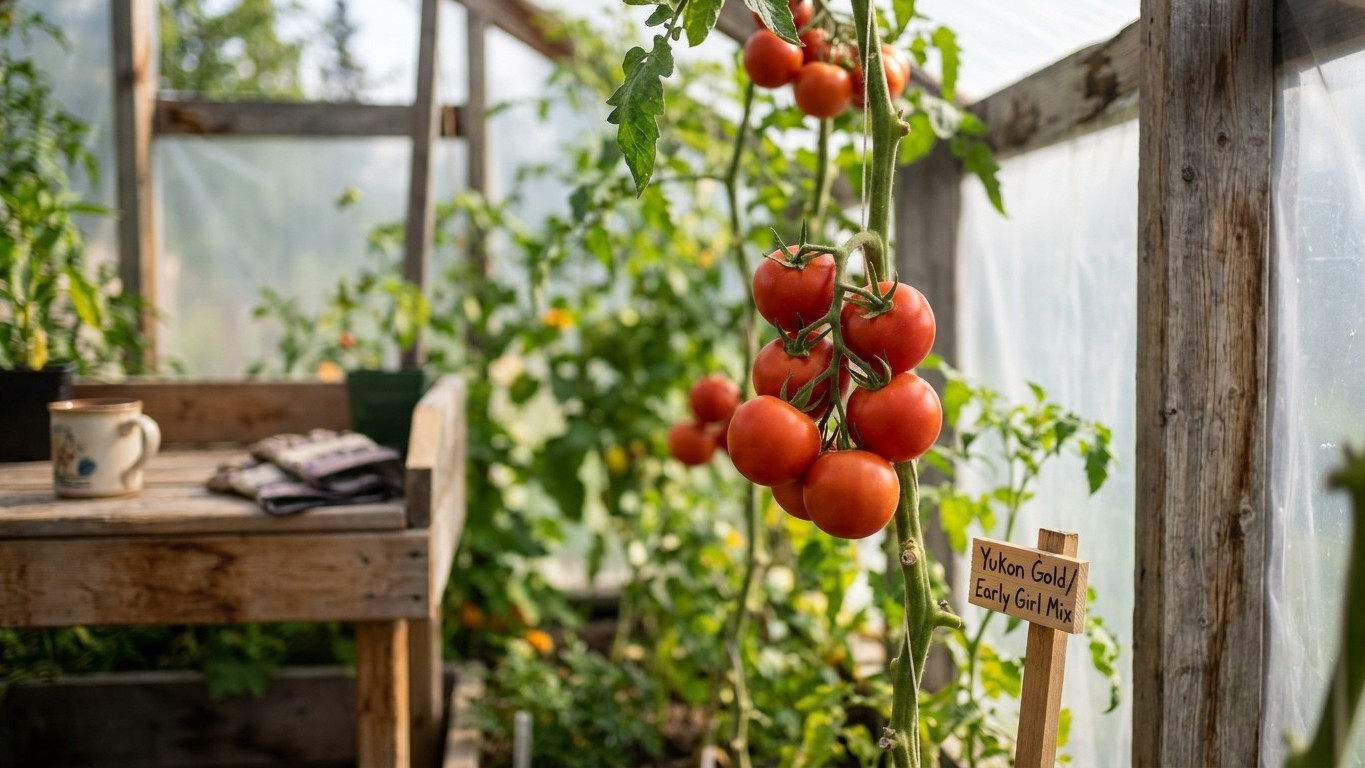

Yukon’s average frost-free season runs about 80 days, according to Environment and Climate Change Canada’s 1981-2010 climate normals for the Whitehorse A station, with a mean last spring frost on June 5 and a mean first fall frost on August 25. That leaves almost no slack for a slow tomato. Start seed indoors in early to mid April, choose a variety that ripens in 55 to 60 days from transplant — see this guide to Tomato Varieties That Ripen in Time in Yukon — and hold the plants back until mid June before they go into open ground.
When to plant Tomatoes in Yukon

Environment and Climate Change Canada’s Whitehorse A normals put the average last spring frost at June 5 and the average first fall frost at August 25, for a mean frost-free season of just 80 days. That figure comes from a single station in Whitehorse. Higher valleys, communities off the Alaska Highway, and anywhere at higher elevation than Whitehorse typically run a shorter, later-starting season, so treat June 5 as a point to adjust from rather than a fixed date for your own yard.
A mean frost date is not a safe date. In roughly half the years on record at this station, the last spring frost fell after June 5, sometimes well after. Treat the first two or three weeks of June as a genuine risk window rather than assuming the season starts cleanly on the fifth.
Hardening off before transplant
Tomato seedlings raised indoors under lights or on a windowsill need a hardening-off period before they go into the garden. Move trays outside to a sheltered, part-shaded spot for an hour or two on the first day, then add an hour a day over a week to ten days, gradually introducing full sun and wind. Skipping this step, or rushing it because the calendar looks right, is one of the most common ways northern gardeners lose a whole flat of seedlings to sunscald or a late cold snap.
Given the June 5 mean, most Yukon gardeners hold transplants until mid June, after the highest-risk days have likely passed, which lines up with the mid-June set-out date used for every variety later in this guide. That still leaves some exposure. A frost arriving after mid June is not unheard of at this latitude, so keep row cover or old bedsheets on hand for the first week or two after planting, just in case — young, stressed seedlings are also more vulnerable to insect damage, so it’s worth getting familiar with Tomato Pests in Yukon before setting plants out.
Counting back to a sowing date
Work backward from that mid-June transplant date to decide when to start seed indoors. A tomato seedling generally needs five to seven weeks of indoor growth before it is ready for the garden, so Tomato Planting Dates in Yukon: Counting Back From Your Frost Window puts the sowing date at early to mid April for most Yukon gardens. Use a heat mat under the trays if your growing space runs cool, since slow, chilly germination eats into a margin the season doesn’t have to spare. There’s no room here to sow late and hope the plant catches up outdoors.
Soil and site preparation
Tomatoes need the sunniest, most sheltered spot available, full sun for at least six to eight hours a day, ideally against a south-facing wall or fence that reflects extra warmth and blocks wind. In a climate this short on warm days, a warm microclimate does as much for a tomato plant as anything applied to the soil.
Yukon soils range from sandy river-terrace ground to heavy silt and clay, and a shallow gravel layer or slow-draining subsoil sits under many yards. Whatever the starting texture, work the bed to at least a spade’s depth and dig in several inches of finished compost or well-rotted manure the previous fall if possible, or as early in spring as the ground allows working. Raised beds warm up faster than ground-level soil in spring and drain better where the water table runs high, which makes the extra lumber and labor worth it in most Yukon gardens.
Tomatoes want soil that drains freely but still holds moisture between waterings. Wet, cold feet slow root growth in a season with none to spare, and standing water after rain is worse than dry soil for a few days. If a bed puddles for more than a few hours after a heavy rain, work in coarse sand, aged wood chips, or extra compost to open up the structure before planting.
Space indeterminate types such as Sakura, Edox and Sun Gold roughly 24 to 30 inches apart, and determinate types such as Glacier or Kuzco a bit tighter, around 18 to 24 inches, since they stay more compact. Crowded plants take longer to dry after rain or watering, which invites the leaf diseases covered further down this guide.
Varieties that suit Yukon
With an average frost-free season of just 80 days at Whitehorse, the trait that matters most is days to maturity from transplant, followed by disease resistance, since even a short northern season carries real blight and virus pressure in a wet year. Determinate versus indeterminate matters more for management than survival: determinate plants set fruit in one concentrated flush and finish sooner, while indeterminate plants keep producing until frost but demand more staking and more of the season to pay off.
| Variety | Days to maturity (from transplant) | Growth habit | Notable disease resistance |
|---|---|---|---|
| Sakura | 55 | Indeterminate | Nematodes (Int.), Tomato Mosaic Virus (High), Fusarium Wilt races 1,2 (High) |
| Edox | 55 | Indeterminate | Nematodes (Int.), Tomato Mosaic Virus (High), Fusarium Wilt races 1,2 (High) |
| Valentine | 55 | Indeterminate | Early Blight (Int.) |
| Glacier | 55 | Determinate | None listed |
| Sun Gold | 57 | Indeterminate | Tobacco Mosaic Virus (High), Fusarium Wilt race 1 (High) |
| Attracta | 58 | Indeterminate | Nematodes (Int.), Powdery Mildew (Int.), Tomato Mosaic Virus (High) |
| Supersweet 100 | 60 | Indeterminate | Verticillium Wilt (High), Fusarium Wilt race 1 (High) |
| Juliet | 60 | Indeterminate | Late Blight (Int.), Early Blight (Int.) |
| Jasper | 60 | Indeterminate | Late Blight (High), Early Blight (Int.) |
| Tidy Treats | 60 | Indeterminate | None listed |
| Black Cherry | 64 | Indeterminate | None listed |
| Cherry Bomb | 64 | Indeterminate | Late Blight (High), Early Blight (Int.) |
| Defiant PhR | 65 | Determinate | Late Blight (High), Early Blight (Int.), Verticillium Wilt (High) |
| Kuzco | 66 | Determinate | Gray Leaf Spot (Int.), Verticillium Wilt (High), Alternaria Stem Canker (High) |
Catalogue days-to-maturity figures are counted from the day a plant goes into the ground, not from seed, and they shift by a week or so in either direction depending on how warm and sunny the actual season turns out to be. Set out mid June, the four varieties listing 55 days, Sakura, Edox, Valentine and Glacier, ripen by mid August and leave the widest cushion before the mean fall frost, around 12 days. That’s the group to lean on if your priority is getting a ripe tomato at all.
Sun Gold and Attracta, at 57 and 58 days, still ripen by mid August with 9 to 10 days of margin, and pair a longer window of production with disease resistance to Tobacco Mosaic Virus and Fusarium respectively. Determinate types like Glacier and Kuzco suit gardeners who want one concentrated harvest for canning or sauce rather than a trickle of fruit all season, while indeterminate types like Jasper, Juliet and Tidy Treats keep setting fruit until frost but need a taller cage and more suckering.
Gardeners just south in Alberta work with a longer frost-free window and can afford slower slicing tomatoes without the same risk (see Growing Tomatoes in Alberta), but in Yukon the margin numbers in this table are the real limiting factor, not personal preference for a particular fruit type.
What to plant alongside
Marigolds are the classic tomato companion, and part of that reputation holds up: French marigold roots release compounds that suppress some root-knot nematode populations in the surrounding soil, which matters on a bed replanted with tomatoes year after year. Whether marigolds do much against above-ground insects is far less settled, so plant them for the nematode benefit and the pollinator visits they draw in, not as a general pest shield.
Borage and other open, nectar-rich flowers nearby bring in the bees and hoverflies that pollinate tomato blossoms and prey on aphids, useful in a short season where every fruit set counts toward the harvest. Nasturtiums work as a genuine trap crop: aphids often prefer them to tomato foliage, so a border of nasturtiums a few feet from the tomato bed can pull pest pressure off the crop you actually want to keep clean.
Basil gets recommended everywhere as a tomato companion for flavor and pest control, but the evidence behind either claim is thin, and in a Yukon garden basil struggles with the same cool nights that slow tomatoes down. Grow it in a warm sheltered spot or a container if you want it near the tomatoes, not as a proven line of defense.
Keep tomatoes well away from potatoes. Both are nightshades that share the same late blight and early blight pathogens, so planting them side by side just shortens the distance disease has to travel. Corn and tomatoes both draw heavily on soil nitrogen and both attract the corn earworm, which doubles as the tomato fruitworm, so give them separate beds if space allows. Brassicas like cabbage and broccoli compete for the same nutrients as tomatoes with no documented benefit in return, so plant them elsewhere in the yard.
Watering, feeding and support
Water deeply and infrequently rather than little and often. Aim to soak the root zone to six inches or so once or twice a week rather than sprinkling the surface daily. Shallow, frequent watering trains roots to stay near the surface, where they dry out fast during the long daylight hours a Yukon summer provides. Water at the base of the plant rather than overhead, since wet foliage sitting through the cool evenings that follow a long summer day invites the fungal problems covered in the next section.
Mulch the bed with straw, shredded leaves or untreated grass clippings once the soil has warmed, a few inches deep and kept a couple of inches back from the stem. Mulch holds soil moisture between waterings, keeps splashing soil off the lower leaves, and suppresses weeds that would otherwise compete with young tomato roots for a short season’s worth of warmth and nutrients.
Feed at planting with a balanced fertilizer worked into the hole, then switch to something lower in nitrogen and higher in phosphorus and potassium once the first flowers appear. Too much nitrogen late in the season pushes leafy growth at the expense of fruit, exactly the wrong trade-off in a garden racing a fall frost.
Stake or cage every plant at transplant time, before the root ball is established enough that driving in a stake later risks damaging it. Indeterminate varieties such as Jasper, Juliet and Tidy Treats keep growing and setting fruit until frost and need a stake or cage tall enough to support that growth, while determinate types like Glacier and Kuzco stay compact enough that a shorter cage does the job.
Sucker indeterminate plants by pinching out the small shoots that grow in the joint between the main stem and a leaf branch, done weekly through the season. Removing suckers channels the plant’s energy into fruit already set rather than into more foliage, which matters more here than in a longer season where a late flush of growth would still have time to turn into ripe fruit.
Common problems

Blossom end rot

A dark, sunken, leathery patch develops on the bottom of the fruit. It’s caused by inconsistent watering disrupting calcium movement within the plant, not usually a shortage of calcium in the soil itself. Even watering and a steady layer of mulch prevent most cases.
Fruit cracking

Concentric or radial splits appear in the skin, often near the stem end. Heavy rain or a deep watering after a dry stretch causes the fruit to swell faster than the skin can stretch. Water consistently through the week, and pick fruit a day or two early if heavy rain is forecast.
Leaf curl

Leaves roll upward along their length but stay green and otherwise healthy-looking. In a climate with wide swings between warm sunny days and cold nights, physiological curl from that stress is far more likely than disease. If curling comes with mottled color, stunted growth or distorted new leaves, treat it as a possible virus and remove the plant.
Fusarium and Verticillium wilt

Lower leaves yellow and wilt despite moist soil, then the discoloration climbs the plant, and a cut stem shows brown streaking inside. These soil-borne fungi persist in the ground for years once introduced. There is no cure after symptoms appear, so remove and destroy affected plants rather than composting them. Several varieties on the table above carry resistance worth using on a bed with a history of wilt: Sakura, Edox and Valentine list Fusarium Wilt races 1 and 2 resistance rated High, and Kuzco and Defiant PhR list Verticillium Wilt resistance rated High.
Poor fruit set

Plenty of yellow flowers appear but little or no fruit follows, and flowers drop off intact. Cool nights, especially early and late in the season, are a common cause of dropped blossom in this climate. Hand-pollinate by gently shaking flower clusters at midday or brushing them with a small paintbrush to improve the odds.
Aphids

Small, soft-bodied insects cluster on stems and the undersides of leaves, often leaving a sticky residue behind. A strong jet of water knocks most colonies down, and insecticidal soap handles the rest. A nasturtium border planted as described above pulls some pressure off the tomatoes before it starts.
Cutworms
Thick, greyish-brown caterpillars sever young seedlings right at the soil line overnight, often the first sign that anything was wrong at all. A cardboard or foil collar pushed an inch into the soil around each stem at transplant time blocks them completely.
Ripening before the frost comes back
Every tomato variety grown in Yukon is racing the same clock: an average 80-day frost-free window at Whitehorse, per Environment and Climate Change Canada’s 1981-2010 normals, running from a mean last spring frost on June 5 to a mean first fall frost on August 25. The arithmetic is worth doing before buying seed, not after.
Cross a variety’s catalogue days-to-maturity figure against that window and the picture is clear. Sakura, Edox, Valentine and Glacier list 55 days from transplant; set out in mid June, they ripen by mid August and carry roughly 12 days of margin before the mean frost date, the widest cushion on the list. Sun Gold and Attracta, at 57 and 58 days, ripen a few days later with 9 to 10 days of margin. Supersweet 100, Juliet, Jasper and Tidy Treats, all around 60 days, still finish by mid August with about 7 days to spare.
At the far end, Black Cherry and Cherry Bomb, both 64 days, ripen closer to late August with only around 3 days of margin, and Defiant PhR at 65 days and Kuzco at 66 days are down to 2 days and 1 day respectively. Because August 25 is a mean rather than a guarantee, the real frost lands later than that in about half of all years, which hands these longer varieties the room the average doesn’t promise. In the other half of years, they simply lose the race.
A few tricks buy back time on either end of the season. Hardening off aggressively lets a gardener set plants out right at the edge of the frost-risk window rather than a week or two past it, effectively adding growing days on the front end. A floating row cover or a low plastic tunnel over the bed for the first two and last two weeks of the season adds real margin against a light frost. Black plastic mulch laid before transplanting warms the root zone faster in spring, which speeds early growth more than it changes the eventual ripening date. Stacked together, these can be the difference between Kuzco’s single day of margin and a harvest that actually beats the frost.
Further north, in the Northwest Territories, the same arithmetic runs even tighter (see Growing Tomatoes in Northwest Territories), a useful comparison for judging just how much cushion Yukon’s 80-day average actually buys a grower here.
Harvest and end of season
Pick tomatoes as they start to color rather than waiting for full ripeness on the vine. A fruit that has begun to blush pink, orange or red will finish ripening indoors at room temperature just as well, and picking a few days early protects the harvest if frost arrives ahead of the mean date. Cherry types like Sakura, Sun Gold and Black Cherry are ready the moment they reach full color and give slightly to a gentle squeeze, while slicing types can come off a day or two before they look completely finished.
As the season closes in on the mean first fall frost of August 25, watch the overnight forecast rather than the calendar. A frost warning is the signal to strip the plant of everything showing any color, not just what’s fully ripe. If a hard freeze is forecast with days of green fruit still hanging, pull whole plants and hang them upside down in a garage or shed, since the fruit keeps ripening slowly off the vine using the plant’s stored sugars.
Green tomatoes that never got the chance to blush aren’t wasted. Wrap individual fruit in newspaper and store in a single layer in a cool, dark spot, checking weekly and pulling out any that ripen or start to rot. Many will color up over several weeks. Whatever’s left is fair game for fried green tomatoes, relish or chutney, a genuinely traditional way to use the fruit a short season always leaves behind.
Clear spent plants from the bed once they’re finished rather than leaving them through winter. Any plant that showed wilt, blight or virus symptoms should go in the trash rather than the compost pile, since a home compost heap rarely reaches the heat needed to kill off soil-borne pathogens.
Local help
For county-level planting dates, soil testing and pest alerts specific to your part of the territory, contact Agriculture and Agri-Food Canada at agriculture.canada.ca, the federal department covering Yukon growers. Whitehorse’s conditions won’t match every valley or homestead in the territory, so check with them before locking in a planting date for your own garden. For more on growing other crops here, browse our other Yukon guides.
Common questions
Can I just direct-seed tomatoes outside in Yukon?
Not with any realistic chance of a ripe harvest. Even the fastest variety on this list needs 55 days from transplant just to set fruit, and a direct-seeded plant would need several extra weeks to reach the size of a hardened-off transplant, pushing first fruit well past the mean fall frost. Start seed indoors and set out plants instead.
What’s the fastest tomato I can grow here?
Sakura, Edox, Valentine and Glacier all list 55 days from transplant to maturity, the shortest figure among the varieties covered here, and give roughly 12 days of margin before the mean fall frost at Whitehorse. That margin can still shrink in a cold, cloudy summer, so treat it as a cushion, not a guarantee.
Do I need a greenhouse to grow tomatoes in Yukon?
No, but a greenhouse, hoop house or even a simple row cover makes the season noticeably more forgiving. Fast varieties in open ground can succeed with careful timing alone, but any structure that traps heat or blocks a light frost adds margin on both ends of the season.
Why are my tomato leaves curling but the plant looks otherwise healthy?
Physiological leaf curl from swings between warm days and cold nights is the most common cause in this climate, and it usually doesn’t hurt yield. If the curling comes with mottled or yellow patches, stunted growth, or distorted new leaves, treat it as a possible virus instead and pull the plant rather than risk it spreading.
Is it worth starting a second round of seeds in case the first fails?
Only if the backup goes in within a week or two of the first sowing. Yukon’s season is too short to absorb a late restart. If your first sowing fails, reach for the fastest-maturing variety on hand, Sakura or Glacier at 55 days rather than something in the 60s, to claw back some of the lost time.
Related guides
- Growing Tomatoes in British Columbia: Planting Dates, Varieties and Ripening Before Frost
- Growing Tomatoes in Northwest Territories: Planting Dates, Varieties and Ripening Before Frost
- Growing Tomatoes in Alberta: Planting Dates, Varieties and Ripening Before Frost
- Watering a Garden in Yukon
- Growing Apples in Yukon
- Growing Onions in Yukon