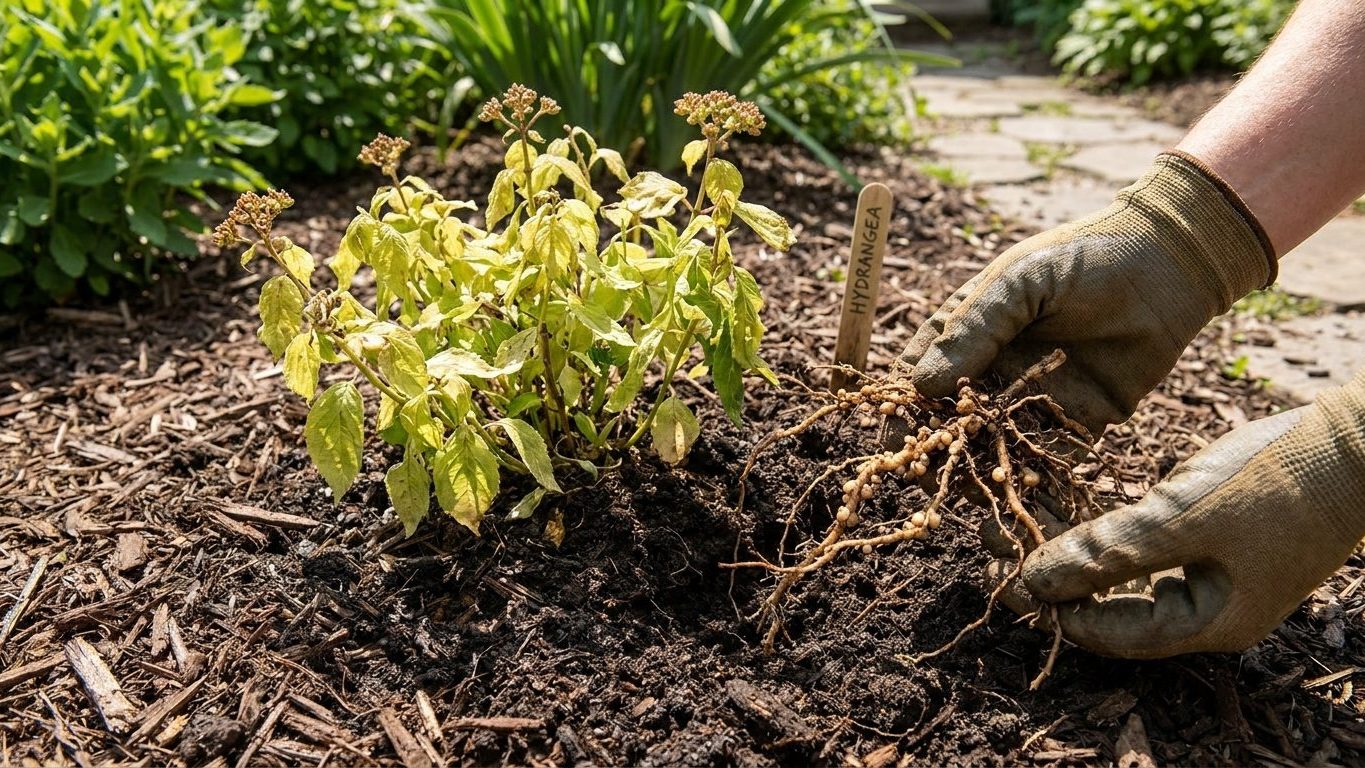

A hydrangea with root-knot nematode damage looks sick without an obvious reason: it wilts on hot afternoons even when the soil is damp, its leaves stay small and pale, and nothing is chewing, sucking, or webbing anywhere on it. The confirmation isn’t on the plant at all. It’s underground, in small bead-like swellings along the roots.
What the damage looks like
Every other insect on a hydrangea leaves a signature you can see with your eyes: aphids cluster on new growth, scales sit as bumps on stems, mites leave stippled or bronzed foliage. Root-knot nematode damage has none of that. The discriminating detail is the absence of a visible pest. Whatever is wrong is happening several inches below the mulch line, and the plant just looks generally unhappy in a way that’s hard to pin down.
What you’ll notice first is a hydrangea that isn’t growing the way it should. New shoots come in short and thin. Leaves are smaller than the previous season’s and often a washed-out yellow-green rather than the deep green of a healthy plant, sometimes with yellowing that shows up between the veins first. Blooms, if they come at all, are fewer and undersized. The plant may wilt visibly during the hottest stretch of the afternoon and then look fine again by evening, a pattern that repeats even when the soil underneath is moist to the touch.
None of that alone means nematodes. What separates this from ordinary stress is that feeding, watering, and even a soil pH correction don’t fix it. The plant just keeps limping along, sometimes for more than one season, because the roots doing the actual work of pulling in water and nutrients are damaged.
The confirming step is to dig, carefully, around a few feeder roots on the outer edge of the root zone, not right against the trunk. A healthy hydrangea root is thin, pale, and mostly smooth. A root carrying root-knot nematode damage shows small, firm swellings strung along its length, sometimes single knots, sometimes a beaded chain of several. Those galls are the nematode’s feeding site, and they’re the one piece of physical evidence that separates this problem from every other explanation for a hydrangea that won’t thrive.
This is worth saying plainly before going further: on an established, otherwise healthy hydrangea, a light nematode presence is often cosmetic and slow-moving rather than a plant emergency. It becomes a real problem on young plants, on stock recently moved into infested ground, or when the infestation is heavy enough that the root system can no longer keep up with the top growth.
Making sure it is this and not something else
Because nematode damage shows up as general decline rather than a visible mark, it gets confused with several other causes. Each one has a separate test.
Nutrient deficiency or soil pH problems
Poor fertility or an extreme pH can also produce pale, stunted growth. A basic soil test will show whether nutrients or pH are off, and correcting either one usually brings visible improvement within a season. A hydrangea with nematode-damaged roots doesn’t respond to feeding the way a nutrient-deficient plant does, because the roots taking up that fertilizer are the ones compromised.
Drought stress or poor drainage
Since hydrangeas are shallow-rooted, both drought and waterlogging show up fast as wilting and yellowing. The test is in the roots themselves: drought or standing water produces roots that are dry and brittle, or dark, mushy, and rotted, not the firm swollen knots caused by nematodes. If the soil has been consistently dry or wet and the roots look normal once you rinse the soil off, look at watering habits before blaming a pest.
Bacterial wilt
Bacterial wilt is a named disease on hydrangea and can cause sudden wilting that looks similar from a distance. The test here is at the base of the stem, not the roots: cut a stem near the soil line and look for discolored, streaked tissue inside, sometimes with a slimy ooze. Root-knot nematode damage doesn’t show that vascular discoloration; the problem stays in the root system itself.
Transplant shock or circling roots
A hydrangea planted within the last year that’s struggling may simply be adjusting, or its roots may still be circling from the nursery pot. Those roots look tangled or girdled but smooth, without the beaded knots that mark a nematode infestation.
When it shows up
Root-knot nematode symptoms aren’t tied to a date on the calendar. They show up when the plant is under stress that its damaged root system can’t compensate for, most often during a stretch of hot, dry weather when demand for water outpaces what the compromised roots can deliver. That’s why the wilting pattern looks like drought stress even in soil that’s been watered.
They’re also most visible on young hydrangeas and on plants recently set into ground that already carries a nematode population, since an establishing root system has less capacity to absorb damage than a mature one. Sandy soil favors nematode movement more than heavy clay, so a hydrangea in light, well-drained soil can show symptoms sooner than one in denser ground carrying the same infestation. On an established plant, none of this may be obvious for a full season or more before the decline becomes hard to ignore.
It’s also worth remembering the source that names nematodes as a hydrangea pest also describes them as rarely a problem for the genus as a whole. Most hydrangeas growing in ordinary garden soil never develop a visible infestation. This is a diagnosis worth reaching for when the usual explanations (water, feeding, pH, disease) have already been ruled out, not a first assumption for every underperforming plant.
What to do now
- Confirm before treating anything. Dig up a few feeder roots and check for the beaded galls described above. Nothing else on this list is worth doing until that’s confirmed, since the same symptoms have several other, easier fixes.
- Address basic stress first. Water deeply and consistently rather than lightly and often, and keep a layer of mulch over the root zone. Hydrangeas are shallow-rooted and benefit from mulch regardless of what’s causing decline, and reducing drought stress buys a damaged root system more room to function.
- Skip the insecticide. Nematodes are not insects, and a broad-spectrum spray does nothing to them while killing off the predatory insects that keep aphids and mites in check elsewhere on the plant. Spraying for a soil-dwelling pest above ground wastes effort and beneficial insect life for no benefit.
- Remove severely affected plants. If the root system is heavily galled and the plant is clearly failing despite good watering, dig it out along with as much of the surrounding root-zone soil as practical, rather than trying to nurse it through another season.
- Rest the bed before replanting. Avoid putting another hydrangea, or another susceptible plant, back into that same spot right away. If the bed will sit empty for a season, covering the soil with clear plastic through the hottest stretch of the year (soil solarization) helps knock back the nematode population before anything new goes in.
- Look at biological options as a last resort. Some garden centers carry soil products built around nematode-trapping fungi or bacteria, sold for home use rather than restricted to licensed applicators. These are a genuine last step, not a first response, and they work best as prevention in a bed with known history rather than a cure for an already-declining plant.
Chemical soil fumigants used for large-scale nematode control are restricted-use products in most states and aren’t something a home gardener can legally buy or apply. That’s not a gap in this advice, it’s simply the honest limit of what’s available at the garden center.
Stopping it coming back
- Buy nursery stock from a reputable source and check the roots before planting; galls on a container plant’s roots are visible if you take the pot off and look before it ever goes in the ground.
- Avoid replanting a hydrangea, or another nematode-susceptible plant, into a bed with a known history of decline without resting or solarizing the soil first.
- Keep the root zone mulched year-round. A healthy layer of organic matter supports the broader soil life, including organisms that naturally compete with and suppress nematode populations.
- Clean tools and avoid moving soil from a bed with confirmed nematode damage into a clean planting area.
- Keep new and established hydrangeas evenly watered rather than letting them swing between dry and soaked, since consistent moisture reduces the stress that turns a light infestation into visible decline.
- If a bed has a documented history of nematode damage, have the soil tested before investing in another hydrangea there.
Common questions
Do root-knot nematodes kill hydrangeas?
On an established plant, a light infestation is usually a slow drag on vigor rather than a death sentence. Heavy galling on a young or already-stressed plant can be serious enough that the plant never recovers without intervention.
Can I treat the soil myself once nematodes are confirmed?
Options for home gardeners are limited to cultural steps (soil solarization, resting the bed, mulching) and a few biological products sold for home use. The soil fumigants used in commercial nematode control are restricted-use and not something available over the counter.
Are some hydrangea types more resistant than others?
Nematode susceptibility isn’t documented by hydrangea type in reliable sources, and it’s a soil-borne, root-level problem rather than something tied to whether a variety flowers on old or new wood. The safer approach is checking roots on any new plant before it goes into a bed with known history, regardless of type.
Will cutting the plant back help?
Pruning affects top growth, not the root system where the damage is happening, so it won’t address a nematode infestation. Any pruning decision should follow the timing rules for that specific hydrangea type, since cutting at the wrong stage can remove an entire season’s flowers.