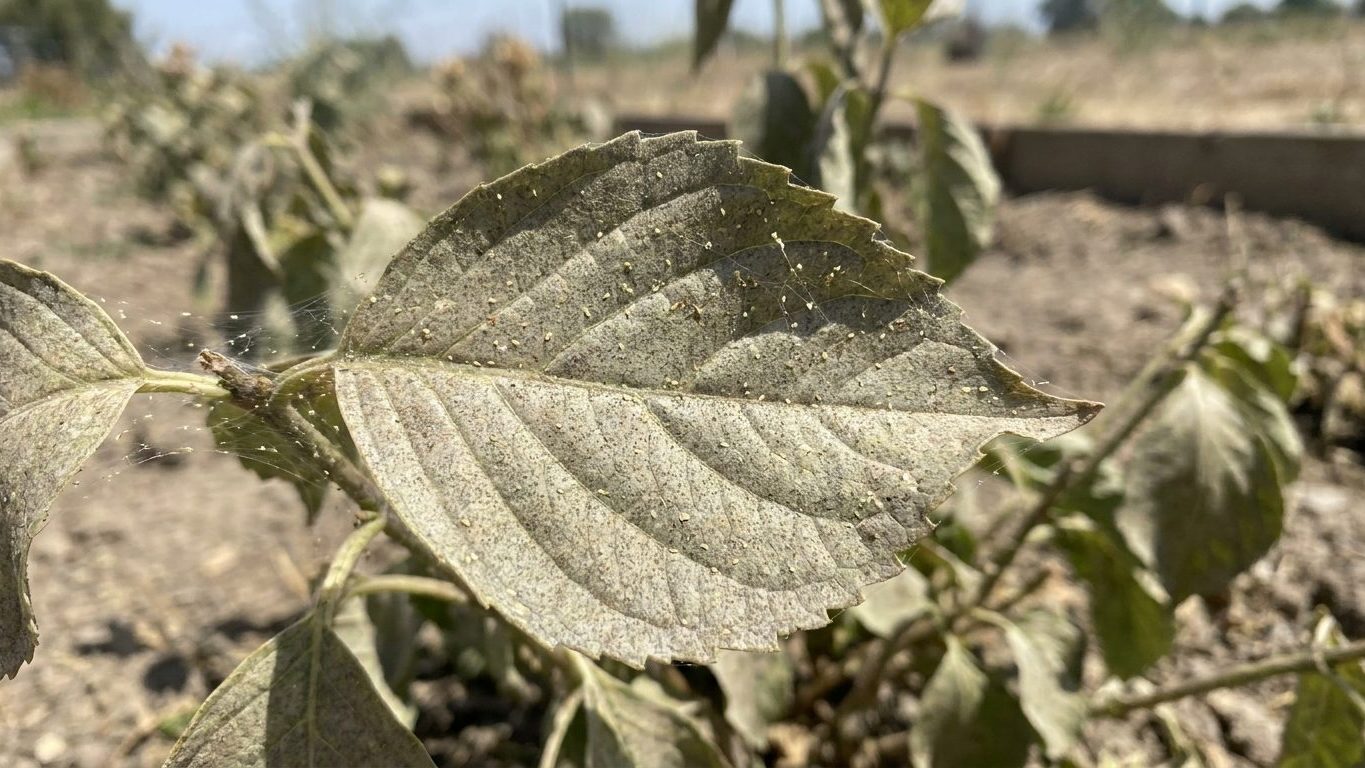

Fine gray-bronze stippling across the leaf surface, a dusty look you can’t wipe off with a thumb, and maybe a scrap of fine webbing tucked in a leaf axil: that combination points to two-spotted spider mites, not a disease and not a chewing insect. On an established hydrangea this is almost always cosmetic. NC State Extension’s own plant profile lists mites among hydrangea pests but calls the whole group “rarely a problem” for the genus.
What the damage looks like
Start with the texture, not the color. Run a finger across an affected leaf and it feels gritty, almost sandpapery, especially on the underside. That’s the tell that separates mite damage from most other hydrangea trouble on sight, before you even reach for a hand lens.
The stippling itself shows up as hundreds of tiny pale flecks, yellowish to almost white, scattered across the leaf rather than clustered in one spot. Left alone through a stretch of hot, dry weather, those flecks merge into a dull bronze or grayish cast that can make an entire branch look dusty or sun-scorched from a distance. Heavy infestations add fine silk webbing, thin strands stretched between the leaf underside and the stem, or across the junction where a leaf meets its petiole. That webbing is the single most reliable visual signal once populations build, because none of the other common hydrangea pests spin it.
Compare that to what you’d see with other feeding damage. Aphids and scale leave a sticky film of honeydew, often with sooty black mold growing on top of it, and you’ll usually spot the insects themselves clustered on new growth or along stems without needing magnification. Chewing damage from beetles or slugs shows up as ragged holes or missing leaf tissue, not stippling. Mite damage stays intact tissue-wise; the leaf surface is still there, just drained of its normal green.
Location on the plant matters too. Mite damage tends to start on the oldest, lowest leaves or on foliage getting reflected heat off a driveway, patio, or south-facing wall, then works upward and outward if conditions stay hot and dry. New growth at the tips is often the last to show symptoms. If you’re instead seeing damage concentrated on tender new shoots with curling or distortion, that pattern fits aphids better than mites, and belongs on a different page in this pest series rather than here.
Making sure it is this and not something else
The confirming test costs nothing: hold a sheet of white paper or a paper plate under a suspect leaf and tap the leaf sharply a few times. Two-spotted spider mites are barely visible to the naked eye, but on white paper they show up as tiny moving specks, almost like drifting pepper flakes. If nothing moves, or what you see are stationary bumps, you’re likely looking at something else.
Aphids
Aphids are soft-bodied and visible without a lens, usually massed on new growth and flower buds rather than spread across mature leaves. They produce the sticky honeydew and sooty mold that mites never leave behind. If your tap test turns up nothing crawling but the leaves feel tacky, that’s aphids or scale, not mites.
Scale
Scale insects sit still on stems and leaf undersides as small waxy or shell-like bumps that don’t move even under close watching. Scratch one off with a fingernail; if it comes away as a dead husk rather than crawling off, that confirms scale rather than mites.
Leaf spot and powdery mildew
Both diseases named for hydrangea by NC State Extension can be mistaken for pest stippling at a glance. Leaf spot produces distinct dark, defined lesions with clear borders, not the fine, uniform speckling of mite feeding. Powdery mildew leaves an actual white or gray powdery coating you can smear with a finger; mite stippling is a texture change within the leaf tissue itself, and there’s nothing to wipe off.
Drought or sun scorch
Plain heat stress, especially on bigleaf hydrangea planted where afternoon sun hits it directly, produces browning that starts at the leaf margins and moves inward, sometimes with a crisp, papery feel. Mite stippling stays interior to the leaf and doesn’t follow the leaf edge the way scorch does.
When it shows up
There’s no calendar date that applies everywhere, because the trigger is a condition, not a season. Two-spotted spider mites build fastest during a hot, dry stretch, particularly after several days without rain or supplemental watering, and particularly on plants already carrying some drought stress. That’s exactly the combination the title describes, and it’s worth taking literally: heat plus dryness, not a specific week on a calendar.
Shallow-rooted Hydrangeas are the most exposed to this pattern. NC State Extension notes that both bigleaf hydrangea and panicle hydrangea root shallowly, which means they dry out faster than deeper-rooted shrubs during any dry spell and benefit noticeably from mulch. A plant still establishing after transplant, or one growing in a container with limited soil volume, carries that same vulnerability even earlier in its life, regardless of what month it happens to be.
Sun exposure compounds the timing. Bigleaf and mountain hydrangea prefer dappled or partial shade and are supposed to be protected from afternoon sun; a plant pushed into more sun than it wants runs hotter and drier at the leaf surface even when the surrounding soil is adequately watered. Panicle hydrangea, the one type in this genus built to take full sun well, is comparatively more forgiving here, though it isn’t immune once drought stress sets in. Dusty conditions along a gravel drive or unpaved road edge also favor mite buildup, since dust on the leaf surface interferes with the predators that would otherwise keep populations in check.
What to do now
- Hose the leaves down, hard, focusing on the undersides. A strong jet of plain water knocks mites and their webbing right off the plant and is often the only intervention an established hydrangea needs. Repeat every few days during the hot spell.
- Fix the water deficit at the root, not just the leaf. Give the plant a deep, slow soak at the base rather than a light daily sprinkle, and check that mulch is in place over the root zone. Since both bigleaf and panicle hydrangea root shallowly, closing that moisture gap does more to end an outbreak than any spray will.
- Leave the predators alone. Predatory mites and other small beneficial insects are usually already working on a two-spotted spider mite population, and they’re more sensitive to broad-spectrum insecticides than the mites themselves are. Spraying something not labeled for mites can wipe out the predators and let the pest population rebound faster than before.
- Move to insecticidal soap or horticultural oil only if hosing and watering aren’t enough. These products work on contact, so thorough coverage of leaf undersides matters more than the product choice. They’re widely sold for home garden use and are considerably gentler on beneficial insects than a general-purpose insecticide.
- Reach for a labeled miticide only as a last resort. Genuine outbreaks bad enough to need one are uncommon on hydrangea, per the “rarely a problem” note in NC State’s own listing. If you do go this route, use a product specifically labeled for spider mites on ornamentals, follow the label rate, and check your state’s rules, since some miticides carry use restrictions that vary by location.
Stopping it coming back
- Keep a mulch layer over the root zone through the growing season, since bigleaf and panicle hydrangea are both shallow-rooted and dry out fastest without that buffer.
- Water deeply and less often rather than a light daily sprinkle, especially through any stretch of hot, dry weather.
- Match the hydrangea type to the site’s actual sun exposure. Bigleaf and mountain hydrangea want dappled or partial shade and protection from afternoon sun; panicle hydrangea is the one type in this genus that genuinely tolerates full sun.
- Hose foliage occasionally during hot spells even before you see any damage. It’s a cheap habit that disrupts mite buildup before webbing ever appears.
- Skip broad-spectrum insecticide unless there’s a confirmed reason for it, so the predatory mites and other beneficials already on the plant stay in place and keep doing their job.
- Check newly planted or container-grown hydrangeas most closely, since they’re still establishing roots and dry out faster than a mature shrub in the ground.
Common questions
Do spider mites kill hydrangeas? Rarely, and typically only when a young or already stressed plant goes untreated through repeated hot, dry stretches. On an established shrub, the damage is cosmetic and the plant usually pushes clean new growth once conditions improve.
Can I actually see two-spotted spider mites without a microscope? Barely. They’re tiny enough that most gardeners never spot them on the leaf itself. The tap test onto white paper, watching for moving specks, is the practical way to confirm them at home.
Will they spread to my other plants? Mites can move between nearby plants under hot, dry conditions, particularly to other stressed shrubs close by. Keeping surrounding plantings adequately watered lowers that risk more than any spray does.
Does spraying with plain water really do anything? Yes. It physically removes mites and disrupts the fine webbing they depend on, and for most home hydrangeas it’s enough on its own before any product is needed.