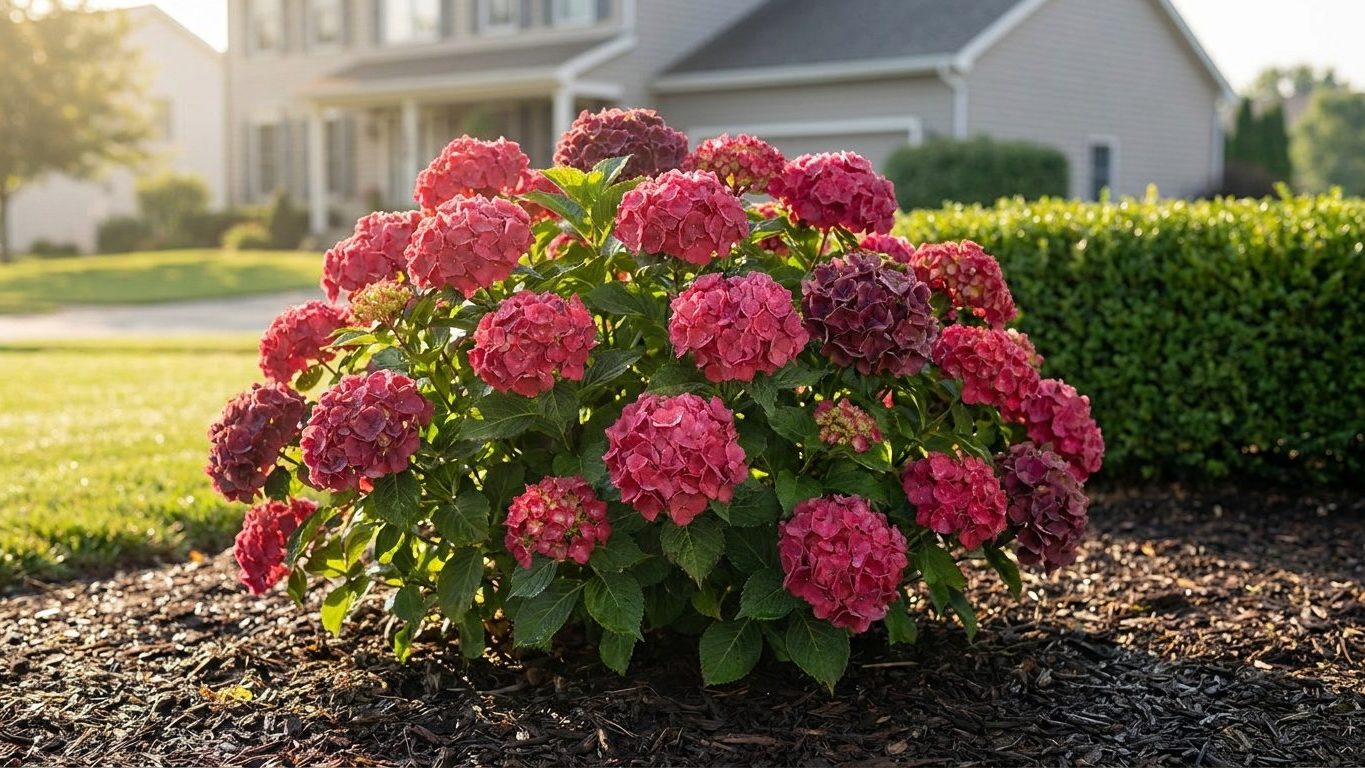

Cityline Paris is a compact bigleaf (mop-head) hydrangea hardy from USDA zone 6a through 11b, grown for dark rose-to-red flower heads that shift toward blue or pink depending on soil pH. Unlike a vegetable with a days-to-maturity clock, the timing question here is different: will the flower buds this shrub set last summer survive winter and a late spring frost long enough to open.
What Cityline Paris actually is
Cityline Paris belongs to Hydrangea macrophylla, the bigleaf or mop-head group, hardy in USDA zones 6a through 11b. The North Carolina Extension Gardener Plant Toolbox describes it as a compact plant with dark rose-to-red mop-head blooms, sold under the cultivar code ‘Paris Rapa’. Compact matters here more than a specific height figure: the source gives a general size range for bigleaf hydrangeas of 3 to 6 feet tall and wide, but doesn’t publish an exact dimension for this particular cultivar beyond calling it compact.
The detail that shapes everything else about growing it is where it flowers: on last year’s wood. The buds that will open this spring were formed the previous summer, sitting dormant through winter. That’s a different clock from an annual crop measured in days from transplant to harvest. There’s no published maturity figure for Cityline Paris because a perennial shrub doesn’t have one. What it has instead is a bud-survival window.
Growth rate for macrophylla runs rapid, and maintenance is rated low. It’s shallow-rooted, which means moisture swings at the soil surface affect it more than a deep-rooted shrub would notice, a detail that matters later when it comes to mulch and winter protection.
What Cityline Paris is good for

This is a flower shrub, not a food crop, so the “use” question is really a color question. Bigleaf and mountain hydrangeas are the only two types in the genus that shift color with soil pH, and Cityline Paris is bigleaf, so gardeners who plant it actually get some control over what shows up on the plant. Panicle, smooth, oakleaf and climbing hydrangeas don’t respond to soil chemistry this way; they go white, cream, pink or green as the season ages regardless of what’s in the dirt. Cityline Paris isn’t one of those.
How its color actually changes
Soil below about pH 5.5 pushes the flowers blue. Above about pH 6.5, they run pink. In between, expect purple. Aluminum sulfate is what acidifies the soil to get there; lime does the opposite and raises pH toward pink. The widely repeated trick of tossing coffee grounds or citrus peel around the base doesn’t hold up well in practice: the pH shift from kitchen scraps is small, and what actually moves the color is available aluminum in the soil, which acidity releases rather than kitchen waste supplying directly. Gardeners chasing blue who rely on coffee grounds alone are usually disappointed.
There’s a feeding trap here too. High-phosphorus fertilizer locks aluminum up in the soil, which pushes blue flowers toward pink even when the pH itself hasn’t moved. So a color problem that looks like a soil failure is sometimes a feeding decision instead, worth checking before reaching for more acidifier.
Beyond color, the compact habit is the other selling point: it fits foundation plantings, small beds and containers where a full-size mophead would crowd everything around it.
Where it ripens in time, and where it is a gamble
A hardiness range of 6a through 11b is wide, but the number that matters isn’t just whether the shrub survives winter, it’s whether the flower buds do. Those buds form the previous summer, ride out winter dormant, then swell and break in spring. A killing frost that lands after that swelling begins can burn the buds off entirely, costing that year’s bloom even though the shrub itself, being hardy to its zone, comes back fine.
What decides bud survival, zone by zone
At the cold edge of the range, roughly zone 6a, winter itself flirts with what the shrub can tolerate, and spring frosts arriving after bud break are the real threat to that year’s flowers. At the warm end, zones 9b through 11b, winters rarely produce a killing spring frost at all, so buds generally sail through untouched. For gardeners sitting in a marginal zone who want more reliability than Cityline Paris offers, it’s worth knowing that mountain hydrangea (H. serrata) tolerates late frost noticeably better than bigleaf types, a fact the source draws out specifically as a contrast.
None of this adds up to a single national verdict, because the exact frost pattern that determines bud survival depends on local geography, not just a USDA zone number.
What can be said here plainly: the wider the hardiness range a bigleaf cultivar carries, the more that range is describing winter cold tolerance, not spring frost timing. Those are two different risks, and Cityline Paris’s 6a-11b rating only answers the first one.
The two ways a season goes wrong
Because Cityline Paris flowers on old wood, its failures cluster around two specific mistakes rather than a long list of possibilities. The first is timing outside the gardener’s control: a late spring frost that hits after buds have already broken dormancy strips that year’s flowers, even on a shrub well within its hardy zone. There’s no fix for this once the frost has happened; the only lever is choosing a site and a zone where that risk is low to begin with.
The second failure is entirely within the gardener’s control, and it’s the more common one: pruning at the wrong time. Because next year’s flowers are set on wood grown this year, a routine fall cleanup that treats hydrangea stems like any other spent perennial can cut away the very buds that would have opened the following spring. The plant survives the pruning cut just fine; it simply doesn’t bloom on schedule the next year, and that reads to most gardeners as a health problem when it’s really a timing mistake.
Both risks trace back to the same quirk, old-wood flowering, which is why this cultivar rewards a gardener who understands that quirk more than one who treats it like a generic flowering shrub.
What it resists, and what it does not
The source names three diseases for bigleaf hydrangeas as a group: leaf spot, bacterial wilt, and powdery mildew. Rust and bud blight are listed for panicle hydrangeas specifically, not bigleaf, so they aren’t part of the picture for Cityline Paris. No cultivar-specific resistance grading is published for this variety, meaning there’s no documented distinction between high and intermediate resistance to draw on here, and the honest baseline is to treat susceptibility to those three diseases as the working assumption rather than assume any built-in protection.
Pests named for the genus are aphids, scales, nematodes and mites, all described as “rarely a problem,” so routine preventive spraying isn’t warranted based on this source. Deer are a different story. The same source lists deer damage on the genus page while also referencing hydrangeas under a broader resistance-to-challenges heading, and those two entries don’t agree. Where a source contradicts itself, the safer read is the one grounded in observed behavior: hydrangeas, including bigleaf types, get browsed by deer. Don’t plan a deer-pressure landscape around any assumed resistance from this cultivar.
One more fact worth stating plainly rather than dramatizing: bigleaf hydrangea, the group Cityline Paris belongs to, is documented toxic if large quantities are eaten, causing nausea, stomach pain, vomiting and sweating. The toxic compounds are hydracyanosides, found in bark, flowers, leaves and stems, and the same risk applies to cats, dogs and horses. It’s not a reason to avoid the plant, just a detail worth knowing in a yard shared with pets, livestock or small children who put things in their mouths.
Growing it without the usual mistakes
Bigleaf hydrangeas, Cityline Paris included, are shallow-rooted, which means a layer of mulch does more work here than on a deep-rooted shrub, buffering the root zone against moisture and temperature swings that a bare bed would pass straight through to the roots.
Pruning without losing next year’s flowers
The single biggest planning constraint for this cultivar is its old-wood flowering habit. Pruning right after the current bloom finishes, rather than waiting for a general fall cleanup, protects the buds that wood will carry into next year. The exact calendar cutoff shifts by climate, so the specific date to work from belongs on the state-level hydrangea page for a given region, not a national one; what stays true everywhere is the sequence, prune promptly after flowering and stop well before the shrub would normally be setting next year’s buds.
Growth rate is rapid for this type and maintenance is rated low, so a compact cultivar like this usually needs little corrective pruning for shape. Most of the pruning decisions that matter are really about protecting next year’s bloom rather than controlling size.
On feeding, anyone chasing a blue flower color should watch the phosphorus content of whatever fertilizer goes down, since high phosphorus locks up the aluminum the plant needs to hold that blue and nudges it toward pink instead. And when cutting the plant back at season’s end, leaving stems at 12 to 24 inches rather than cutting to the ground gives native bees that nest in dead hollow stems a place to overwinter, a small change that costs nothing and is easy to skip without knowing it matters.
Common questions
Does Cityline Paris flower the same year it’s planted?
Nursery specimens typically already carry the buds they set the previous summer at the grower’s, so many gardeners do see bloom the first year. But because it flowers on old wood, a late spring frost after those buds break can strip that first bloom even though the shrub itself survives fine.
Will it turn blue automatically in acidic soil?
Only if the soil is genuinely acidic and aluminum is available to the roots, roughly below pH 5.5 for blue and above pH 6.5 for pink, with purple in between. Coffee grounds alone rarely shift pH enough to matter; aluminum sulfate or a proper soil test is the reliable route.
Is Cityline Paris deer resistant?
No. The source itself contains conflicting entries on this point, but the observed behavior is that hydrangeas, including bigleaf types, get browsed by deer. Fence or use repellents where deer pressure is high rather than counting on any built-in resistance.
Can it be pruned in fall as part of general garden cleanup?
Not without risk. Because it flowers on last year’s wood, a routine fall cutback can remove the buds set for next spring’s bloom. The safer window is right after flowering finishes, and the exact cutoff for a given climate is covered on the relevant state hydrangea page within this site.