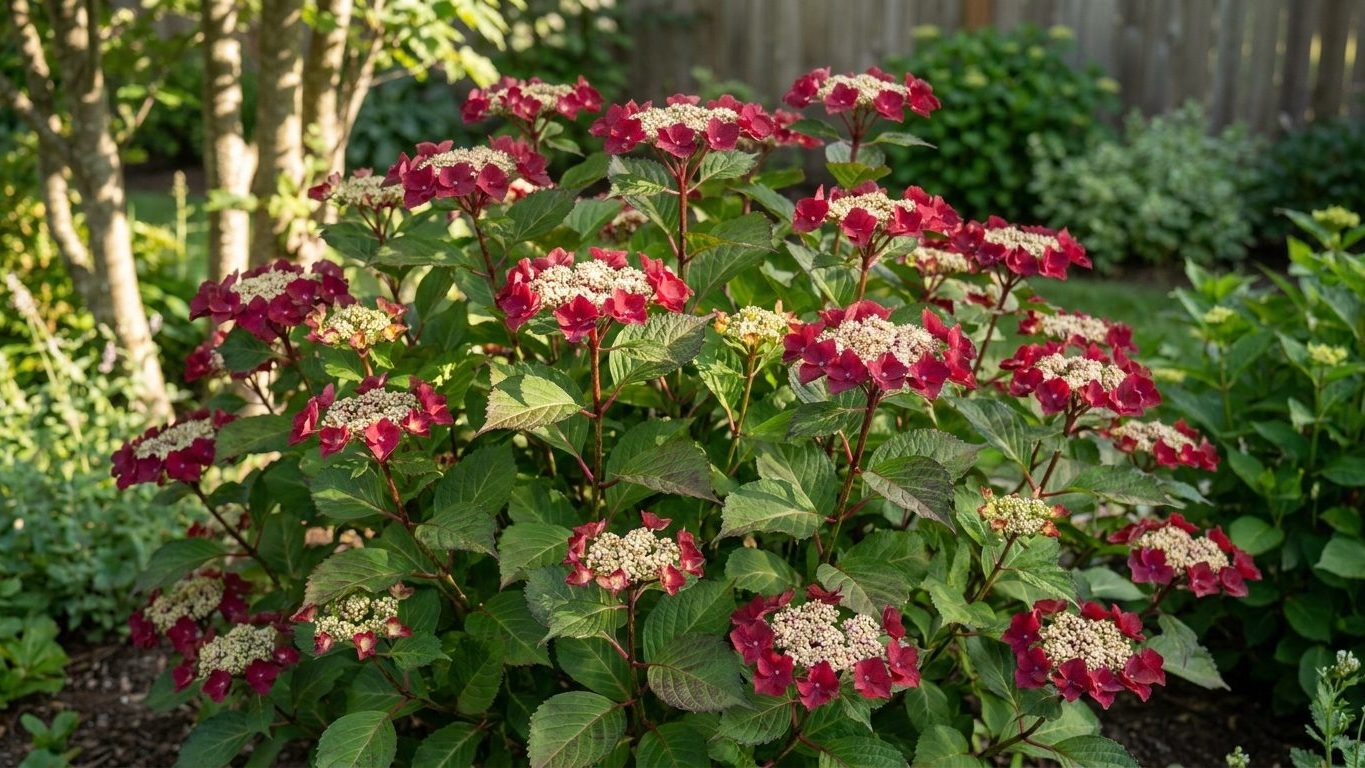

Lady in Red is a bigleaf hydrangea, the lacecap type, hardy in USDA zones 6a through 11b, and whether it blooms in a given yard comes down to one detail: it flowers on last year’s wood. The buds form the summer before, so a late frost or an ill-timed pruning cut takes the flowers out before they open. Its stems and leaf veins carry a reddish cast, and its flat lacecap heads shift between deep red and blue depending on what the soil does to the plant’s own chemistry.
What Lady in Red actually is
North Carolina Extension’s Plant Toolbox files Lady in Red under Hydrangea macrophylla, the bigleaf group, described as a lacecap with deep red or blue flowers and reddish stems and veins. That single line settles three practical questions. First, growth habit: bigleaf Hydrangeas run 3 to 6 feet tall and wide, a shrub-sized plant that sets the spacing question from day one. Second, light: they want dappled sun or partial to deep shade, and afternoon sun should be avoided, not just tolerated. Third, and most important, bigleaf Hydrangeas flower on last year’s wood. The flower buds form in the previous growing season, sit through winter, and open the following year. Any advice that ignores that will eventually cost a season’s flowers.
Hardiness for the bigleaf group runs USDA 6a through 11b, stretching from the mountains of Virginia and Tennessee down through the Gulf Coast and into Southern California and South Florida. That range is wide enough that the plant’s survival is rarely the question. Its bloom, given the old-wood habit, is a different matter, and that’s where the next section goes.
What Lady in Red is good for
This is an ornamental shrub, so the payoff is color and form, and the lacecap structure changes what it delivers compared with the rounder mophead types sold alongside it. A lacecap head carries a flat ring of showy sterile florets around a center of small, plain, fertile ones, reading as more open and naturalistic in a shade bed, and drawing pollinators to that fertile center in a way an all-sterile mophead doesn’t.
The color is the other draw, and it’s mechanical rather than a matter of taste. Bigleaf and mountain hydrangeas are the two types in the genus whose flower color answers to soil pH: blue below about pH 5.5, pink above about pH 6.5, purple in between. Aluminum sulfate acidifies soil to push color toward blue; garden lime raises pH to push it toward pink. What actually moves the color is available aluminum, which acid conditions release to the roots. That’s also why the old advice about coffee grounds or citrus peel turning hydrangeas blue disappoints more often than it works: the pH shift is too small to reliably unlock enough aluminum.
Deep shade tolerance is worth noting for placement : Lady in Red will take a spot under high tree canopy where a sun-bred mophead might sulk. And because native bees nest in dead hollow stems over winter, cutting the plant back to 12 to 24 inches in fall rather than clearing it to the ground gives them somewhere to overwinter.
Where it ripens in time, and where it is a gamble
The bigleaf group’s zone range, 6a through 11b, covers most of the country a home gardener would call temperate to subtropical. Survival isn’t the variable across that stretch; the variable is whether the buds that formed last summer make it to spring intact.
Bigleaf hydrangeas set their flower buds the previous growing season, and those buds start to swell as soon as the weather warms in spring, well before the last frost has passed. A shrub can be perfectly hardy for its zone and still lose the year’s flowers to a single late cold snap that catches the buds mid-swell. This isn’t a north-versus-south question so much as a timing-versus-microclimate one.
Cold pockets change the calculation more than the zone number does. A planting site where cold air pools, or on the north side of a building where soil warms late, pushes bud break later and can help by delaying the swell past the last hard frost. A spot against a south-facing wall does the opposite: it wakes buds early and exposes them to whatever cold snap follows. The exact month for pruning and the depth of winter protection a given yard needs depend on the reader’s specific USDA zone, a question for the state-level page in this series. What holds everywhere in the 6a-11b range is the principle: site the plant where bud swell lags the last freeze, and the zone number stops being the deciding factor.
The two ways a season goes wrong
A wide hardiness range hides two separate failure modes, and for a shrub that flowers on old wood, one matters far more than the other.
The first is the spring frost problem already described: a shrub survives winter perfectly well but the flower buds, already formed and swelling with the season’s first warmth, get nipped before they open. For Lady in Red, planted anywhere near the cooler edge of its range, this is the dominant risk, and it has nothing to do with summer heat. The plant can be alive and green all season and still produce no flowers, the single most common disappointment reported with bigleaf hydrangeas generally.
The second failure mode sits at the warm end of the range. Bigleaf hydrangeas need protection from afternoon sun, and in the hottest parts of zones 9 through 11b, direct afternoon exposure stresses the plant through leaf scorch and wilting even where winter cold was never a threat. It’s a siting problem rather than a hardiness problem, solved with shade cloth, tree canopy, or choosing the east or north side of a structure over the west side.
For this cultivar specifically, the frost-versus-bud-swell problem outranks the heat problem. Shade can be arranged after the fact. A frozen bud cannot be un-frozen.
What it resists, and what it does not
North Carolina Extension names three diseases for bigleaf hydrangea as a type: leaf spot, bacterial wilt, and powdery mildew. Rust and bud blight appear on the source’s listing too, but specifically for the paniculata group, not bigleaf, so there’s no reason to spray Lady in Red for either.
On pests, the source calls aphids, scales, nematodes, and mites rarely a problem for the genus, a low bar that helps explain why bigleaf hydrangeas are graded low-maintenance overall. Deer are the exception worth flagging. The same source lists deer as a damage agent on the genus, so nothing supports calling any type deer-resistant; a gardener in deer country should fence or repellent-treat rather than trust the plant to defend itself.
The toxicity note applies specifically to bigleaf hydrangea, Lady in Red’s type. Bark, flowers, leaves, and stems all carry hydracyanosides, cyanogenic compounds that can cause nausea, stomach pain, vomiting, and sweating if a large quantity is eaten. The same risk extends to cats, dogs, and horses. It takes a substantial amount to cause trouble, and the source doesn’t describe fatalities, but a household with a dog that chews landscaping is worth planning around.
Growing it without the usual mistakes
Because Lady in Red flowers on last year’s wood, the pruning window is narrow and the penalty for missing it is a lost season of flowers, not a damaged plant. The type-level rule is to prune right after flowering and finish before August 1, since anything cut later removes wood that would have carried next year’s buds. The exact month that translates to depends on when the local growing season lets the plant finish blooming, which varies enough across the 6a-11b range to belong on the state-specific page rather than here.
Color management is an ongoing project, not a one-time fix. Getting to blue means keeping the soil below roughly pH 5.5 and keeping aluminum available to the roots, typically with aluminum sulfate worked into the root zone. Pushing toward pink means raising the pH above roughly 6.5 with garden lime. A detail that trips up gardeners chasing blue: high-phosphorus fertilizer locks aluminum up in the soil chemically, nudging flowers toward pink even on acidic ground. If a shrub won’t turn blue despite acidified soil, check the fertilizer bag first.
Because bigleaf hydrangeas are shallow-rooted, a 2 to 3 inch mulch ring helps hold soil moisture and moderates root temperature swings. Give it its full 3 to 6 foot mature spread when siting it near a walkway or foundation planting, since crowding forces pruning that conflicts with the old-wood bloom timing described above.
Common questions
What USDA zones can grow Lady in Red hydrangea?
As a bigleaf hydrangea, it’s hardy in USDA zones 6a through 11b, per North Carolina Extension’s Plant Toolbox. Survival is rarely the issue across that range; reliable blooming, given its old-wood flowering habit, depends more on local frost timing than on the zone number alone.
Will Lady in Red hydrangea turn blue or pink?
Either, depending on soil pH and available aluminum. Below about pH 5.5 the flowers trend blue; above about pH 6.5 they trend pink, with purple in between. Aluminum sulfate acidifies soil for blue, garden lime raises pH for pink, and high-phosphorus fertilizer works against blue by locking up aluminum.
When should I prune Lady in Red hydrangea?
Right after it finishes flowering, and no later than August 1, since it sets next year’s buds on the current season’s wood shortly after bloom. The precise month depends on the local growing season and zone, a question for the state-specific guide in this series.
Is Lady in Red hydrangea toxic to pets?
Yes. As a bigleaf hydrangea, its bark, flowers, leaves, and stems contain cyanogenic compounds that can cause nausea, vomiting, and stomach upset in cats, dogs, and horses if a large quantity is eaten, according to North Carolina Extension’s Plant Toolbox.