
L.A. Dreamin isn’t a tomato. It’s a bigleaf hydrangea, and bigleaf Hydrangeas don’t ripen on a countdown from transplant, they bloom from buds set the previous summer. So the real question a gardener needs answered isn’t “when do the fruits come in,” it’s whether the coming winter leaves those buds intact long enough to open.
What L.A. Dreamin actually is
L.A. Dreamin is a bigleaf hydrangea (Hydrangea macrophylla), also sold as ‘Lindsey Anne,’ hardy in USDA zones 6a through 11b, per the North Carolina Extension Gardener Plant Toolbox. That range matters more than any bloom date, because bigleaf Hydrangeas flower on last year’s wood: buds form the previous summer, overwinter on the stem, and open the following spring. A hard late frost or a badly timed prune removes them before they get the chance.
The plant grows 3 to 6 feet tall and wide, a mounded mop-head shape. It wants dappled sun or partial to deep shade, with protection from direct afternoon sun, the same requirements NC State documents for the bigleaf type generally.
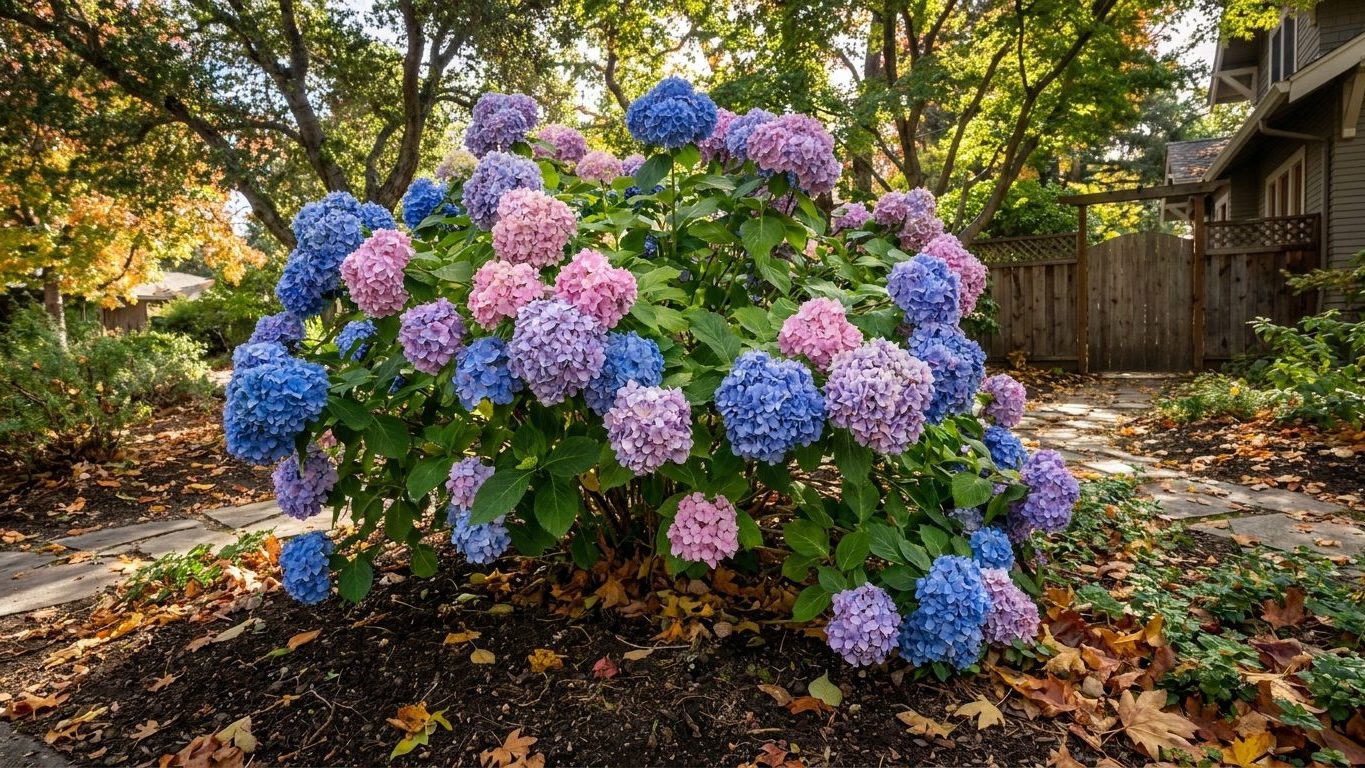
What sets L.A. Dreamin apart is its color behavior. Bigleaf and mountain hydrangeas normally shift from blue to pink depending on soil pH, blue below about 5.5, pink above about 6.5, purple in between. L.A. Dreamin breaks that rule: it carries blue, pink and lavender blooms at once, on the same plant, regardless of soil chemistry. That’s documented as a trait of the cultivar itself, not a soil trick, and it’s the fact that should shape how anyone plants and feeds it.
What L.A. Dreamin is good for
A gardener picks a hydrangea for what it does in the landscape, and here L.A. Dreamin has one clear job: it delivers a multicolor mop-head without any soil amendment work. Most blue-or-pink bigleaf cultivars ask the gardener to manage aluminum availability through pH, adding sulfur for blue or lime for pink, then waiting a season to see if it worked. L.A. Dreamin skips that entirely, so it fits a border where a gardener wants visual variety without a pH-management project alongside it.
That makes it a strong fit for mixed shrub borders, foundation plantings under eaves that give afternoon shade, and large containers on a shaded porch, since its mature size stays manageable without pruning for size control. Because bigleaf hydrangeas are rated low-maintenance once established, and this cultivar removes the color-tinkering step other bigleaf types invite, it’s a reasonable choice for a gardener who wants shrub structure and repeat color without a second job managing it.
It also works as a cut flower source. Mop-head clusters hold up well indoors, and because the blue, pink and lavender all show on one plant, a single stem can carry more visual range into a vase than a uniformly colored cultivar would. The NC Extension source doesn’t document a specific vase-life figure for this cultivar, but the multicolor trait itself is confirmed, and it’s the main reason to plant this one over a single-color bigleaf.
What it isn’t suited for is full sun. Unlike panicle hydrangeas, which the same source calls the only type that takes full sun well, bigleaf types including L.A. Dreamin need dappled light or partial shade and protection from afternoon sun, so a hot, exposed bed isn’t the right spot for it.
Where it ripens in time, and where it is a gamble
Since this cultivar flowers on old wood, the annual “will it bloom” question isn’t about a maturity countdown, it’s about whether buds set last summer survive winter and early spring intact. That’s a zone question first and a microclimate question second.
At the mild end of its range, zone 11b, found only in the warmest pockets of coastal Southern California and South Florida, winters rarely dip cold enough to threaten dormant buds at all. Moving inland or north through zones 9b and 8b, winter risk grows but stays manageable most years. It’s zone 6a, the cold edge of this cultivar’s range, where the margin gets thin. That zone shows up inland, in places like central Ohio, Kansas or the higher elevations of the mid-Atlantic, and that’s where a warm spell in late winter can trick the plant into breaking bud early, only for a frost a week or two later to kill the swelling buds before they open.
| Zone | Typical location | Main winter risk for L.A. Dreamin |
|---|---|---|
| 6a (cold edge) | Central Ohio, Kansas, higher mid-Atlantic elevations | Late frost after early bud break can kill the season’s flowers |
| 8b-9b (middle range) | Coastal Carolinas, Gulf Coast, inland Texas | Occasional cold snaps, but buds usually clear winter intact |
| 11b (mild edge) | Coastal Southern California, South Florida | Minimal winter bud loss; heat and drought become the concern instead |
Below zone 6a, this isn’t a gamble anymore, it’s a mismatch: the cultivar’s documented hardiness simply doesn’t extend there, and no amount of mulch or wall placement changes that. For a specific pruning calendar tied to a state’s actual frost pattern, that’s a call for a state-specific guide rather than a national one, since local timing varies too much to generalize here.
The two ways a season goes wrong
A wide hardiness range on paper doesn’t guarantee a good bloom year, and there are two separate failure modes worth knowing apart, because they call for different responses.
In the colder end of L.A. Dreamin’s range, the risk isn’t the coldest night of winter, it’s a warm stretch in late winter followed by a return to frost. Old-wood buds can start swelling during a mild spell, then get killed by a frost that would have done no damage a few weeks earlier while buds were still dormant. The shrub itself often survives fine; what’s lost is that year’s flowers, since new buds won’t form until the coming summer.
At the warm end of the range, the problem shifts from cold to drought stress. Bigleaf hydrangeas are shallow-rooted, a trait NC State notes applies to macrophylla specifically, so an extended hot, dry stretch pulls moisture away faster than from deep-rooted shrubs nearby. Buds usually aren’t at risk the way they are up north, but wilting and stress can reduce bloom quality over a season.
For L.A. Dreamin specifically, the frost-on-swelling-buds problem in the north matters more, because it can wipe out an entire year’s display in one bad week, while southern drought stress is manageable through mulch and consistent watering rather than a lost season.
What it resists, and what it does not
The NC Extension source names three diseases documented on bigleaf hydrangeas: leaf spot, bacterial wilt and powdery mildew. It doesn’t publish a resistance grading for this cultivar specifically, so nothing here should be read as L.A. Dreamin being protected against them. Normal disease-watching practices, good airflow, avoiding overhead watering late in the day, apply just as they would to any bigleaf hydrangea.
On the pest side, the source lists aphids, scales, nematodes and mites as genus-wide pests that are “rarely a problem,” a reassuring note but not a guarantee. Deer are a separate matter. The source lists deer as a damage agent while also referencing deer under general resistance elsewhere, and where a source contradicts itself like that, the honest statement is the observed one: hydrangeas, including bigleaf types, get browsed by deer. Fencing or repellent, not a resistance claim, is the practical response in deer-heavy areas.
One more fact worth stating plainly: bigleaf hydrangea is documented toxic if eaten in quantity, containing cyanogenic compounds called hydracyanosides in the bark, flowers, leaves and stems. Symptoms in people include nausea, stomach pain, vomiting and sweating, and the same risk extends to cats, dogs and horses. It takes a large quantity to cause a problem, so this isn’t a reason to avoid the plant, just a reason to keep it away from a dog that chews everything in reach.
Growing it without the usual mistakes
Because L.A. Dreamin flowers on old wood, the single mistake that costs a whole season is pruning at the wrong time. The documented rule for this bigleaf type is to prune right after flowering and before August 1, since anything cut later removes the buds that would have opened the following spring. Exact regional timing within that window depends on local frost pattern, a state-page question rather than a national one, but the wood-age rule itself doesn’t change by location.
Feeding deserves a second look here because of what makes this cultivar special. High-phosphorus fertilizer locks up aluminum in the soil, and aluminum availability drives blue coloring in bigleaf hydrangeas that respond to pH. L.A. Dreamin’s multicolor bloom isn’t pH-driven, but heavy phosphorus feeding is still worth avoiding, since it offers no benefit here and can throw off soil chemistry for neighboring plants that do respond to it.
Since this cultivar is shallow-rooted, a 2-to-3-inch mulch ring helps it hold moisture through hot stretches without competing with grass or nearby groundcover. Space plants to their full mature spread rather than crowding them for an immediate fuller look, since bigleaf hydrangeas don’t respond well to being moved once established.
Come late fall, resist the urge to cut everything to the ground. Trimming spent stems back to 12 to 24 inches and leaving them standing gives native bees hollow stems to nest in over winter, a documented benefit worth the slightly untidy look until the stems naturally break down.
Common questions
Is L.A. Dreamin hydrangea related to a tomato variety?
No. L.A. Dreamin is a cultivar of bigleaf hydrangea, an ornamental flowering shrub. Any resemblance to a tomato name is coincidental to how this article’s topic was framed.
Does L.A. Dreamin need acidic soil to turn blue?
No. Unlike most bigleaf hydrangeas, L.A. Dreamin shows blue, pink and lavender blooms at the same time regardless of soil pH, so adjusting soil acidity won’t change its color the way it would on a standard bigleaf cultivar.
When should I prune L.A. Dreamin hydrangea?
Right after it finishes flowering, and no later than August 1, since it sets next year’s buds on the current season’s old wood. The exact calendar window depends on your local frost timing, which your state-specific guide can narrow down further.
Is L.A. Dreamin hydrangea toxic to pets?
Yes, in the sense that all bigleaf hydrangeas are documented toxic if a large quantity is eaten, due to cyanogenic compounds in the bark, leaves, flowers and stems. It affects cats, dogs and horses as well as people, though it takes a substantial amount to cause symptoms like vomiting or stomach upset.