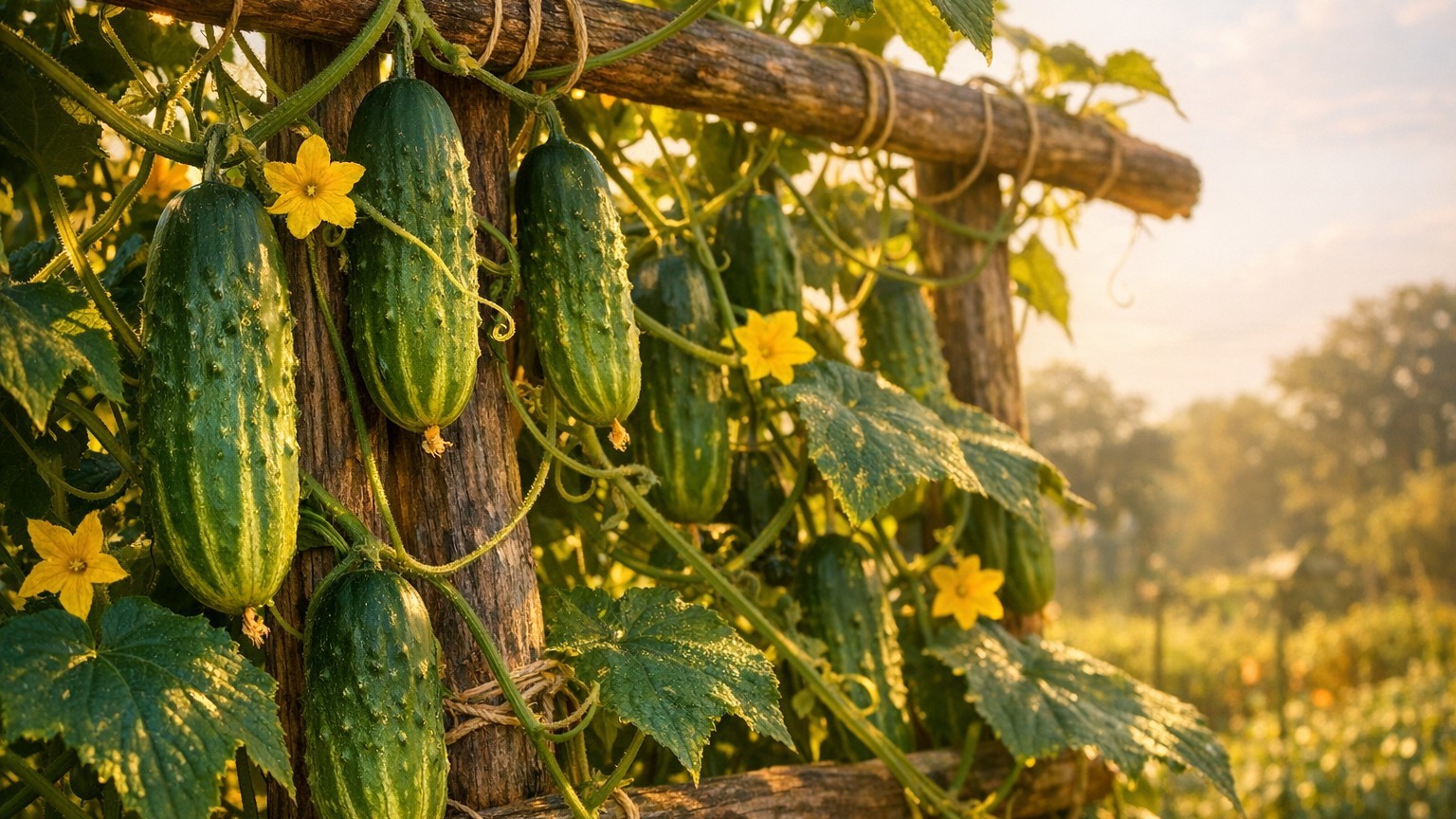

The best cucumber types for Nebraska gardens are heat-tolerant slicers and pickling varieties suited to a long, hot summer with a dry July. Given the state’s roughly six-month frost-free window and nearly a month of 90-degree-plus days, the choice comes down to water management and disease resistance more than days-to-maturity.
The short answer for Nebraska
Nebraska’s frost-free season runs from a last spring freeze between April 12 and April 23 to a first fall freeze between October 15 and October 26, at the reference station used for these normals. That’s a window of roughly 175 to 197 days depending on how the two ends line up in a given year. For cucumbers, which typically need only seven to ten weeks from seed to first harvest, that length is not the limiting factor. Heat and water are.
The reference station averages 28.1 days a year at 90 degrees or hotter. That’s the number that should drive variety choice more than anything printed on a seed packet’s maturity date. High heat pushes plants to shut down pollen viability and drop blossoms, and it accelerates water loss right when July rainfall is at its lowest of the summer, 3.55 inches at the reference station. A plant that depends on steady soil moisture to size fruit evenly will struggle in that stretch unless a gardener is watering.
That points toward a few practical categories rather than named cultivars. Parthenocarpic slicing types, which set fruit without needing insect pollination, hold up better through heat waves when bee activity drops and blossom drop becomes a problem. Burpless and Asian long types tend to carry heat stress with less bitterness in the fruit, a trait that matters more in a Nebraska July than it does in a milder coastal climate. Pickling types are worth growing specifically for gardeners planning to can, since they’re bred for a firmer flesh that holds up to brining, and they tend to produce a concentrated flush that’s easier to process in batches.
Bush types make sense for anyone gardening in a smaller bed or a large container, since they need less water per square foot of garden and are easier to keep evenly moist through a dry month. Vining types can outproduce bush types over a season, but they ask for a trellis and a consistent watering schedule, since a vine left to sprawl on bare soil during a hot, dry July is the fastest way to end up with bitter, misshapen fruit.
None of this points to a single variety name, because that decision depends on what’s actually been trialled in a given county, not on a statewide average. What the climate numbers do settle is the category: heat-tolerant, disease-resistant, and matched to how much water a gardener is realistically going to supply in July.
What will not work here

Vining slicing types left unstaked and unwatered through July are the most common failure. With only 3.55 inches of rain averaged for that month and 28 days a year pushing past 90 degrees, a sprawling vine on bare soil dries out unevenly, and the fruit responds with the classic pointed, bitter shape gardeners blame on the variety when the real cause is inconsistent moisture. A trellised plant with mulch under it handles the same rainfall total far better, because less water is lost to evaporation off open soil.
Cucumber types bred for cool, humid, low-heat regions, the sort of English or greenhouse-style cucumbers built for a mild maritime summer, are a poor match here. They tend to carry less natural heat tolerance, and Nebraska’s swing from a relatively dry July (3.55 inches) into a wetter August (4.6 inches) after weeks of 90-degree heat is exactly the combination that triggers powdery mildew on a plant that wasn’t bred with resistance to it. That fungus shows up as a gray-white film on the leaves and can take down a planting in under two weeks once the humidity spikes.
Direct-seeding too early is a second, quieter failure. The last spring frost at the reference station falls somewhere between April 12 and April 23, and cucumbers are frost-tender at every stage, seed included. Suburban and rural gardens away from the airport station where these numbers are collected typically see their own last frost even later, sometimes by one to two weeks, and more at elevation. Seed put in the ground on the early end of that window, or based on a neighboring state’s calendar, risks rot in cold soil rather than germination.
Long-season heirloom slicers bred for a mild, extended finish are a riskier bet in the parts of the state where the growing season runs shorter than the statewide average implies. They’re not impossible, but they leave less margin if a planting gets delayed by a wet spring or an early fall freeze.
Finally, dense, close spacing on the ground invites trouble anywhere the August rainfall (4.6 inches) lands as a heavy thunderstorm rather than a steady soak. Splashing water moves soil-borne disease onto lower leaves fast when plants are crowded, and a hot, humid August after a dry July is a near-ideal setup for that kind of spread.
What changes across Nebraska
Nebraska spans USDA hardiness zones 4a to 5b, a range built on average annual extreme minimum winter temperature, not on summer growing conditions directly. But that spread still matters for cucumber growers, because it tracks roughly with how much the frost-free season shifts from one end of the state to the other.
A zone 4a garden, generally in the western part of the state and at higher elevation, tends to see a later last spring frost and an earlier first fall frost than the reference station figures used above, which pull toward the milder end of the state’s range. That compresses the safe planting window and argues for quicker-maturing bush and pickling types over anything bred for a long, leisurely finish. Wind and lower humidity are also more of a factor out west, which can dry out young transplants faster than the same watering schedule would in the east.
A zone 5b garden, closer to the reference station and the state’s eastern and southeastern counties, generally gets more cushion on both ends of the season and can support a wider range of types, including vining slicers, as long as water and trellising are handled. The tradeoff is more humidity buildup in a wet August, which raises the stakes on disease resistance and airflow around the plants.
There is no single answer for “Nebraska” as a whole, because a 4a garden and a 5b garden are working with a meaningfully different season length and risk profile even though both fall inside the same state. Figuring out which end of it applies to a specific yard means checking the USDA Plant Hardiness Zone Map directly, not guessing from a county’s general reputation.
Where to check this for your own county
Everything above comes from one weather station and a statewide zone range, which means it describes Nebraska in general and no garden in particular. The next step for an actual planting decision is the University of Nebraska-Lincoln Extension service, at extension.unl.edu.
Two things are worth looking for there specifically. First, a county-level planting calendar, which will reflect the local frost dates more accurately than statewide figures. Airport stations tend to run warmer than the surrounding countryside, so a rural or suburban garden nearby often sees its last frost later in spring and its first frost earlier in fall than what shows up in the national climate normals. A county extension calendar accounts for that gap in a way a statewide figure can’t.
Second, look for the varieties that have actually been trialled by extension horticulturists in that specific county or region. Nebraska’s extension system runs demonstration gardens and variety trials aimed at exactly this question, testing cucumber types against local disease pressure, local heat, and local soil, and publishing which ones held up. That kind of trial data is worth more than any general recommendation about “heat-tolerant slicers,” because it’s been tested against the specific fungal and bacterial pressures found in that county’s soil and air, not a national average.
A county recommendation beats a state one every time, for the simple reason that it’s been tested closer to the actual garden in question.
Checking this against your own garden
Every date and figure here is an average pulled from decades of records at one weather station. A gardener’s own observations, taken right in the bed where the seeds are going in, will always outrank that average for timing decisions.
Soil warmth by feel is the first and most useful check. Cucumber seed wants soil that feels warm to the touch, not just frost-free air. Pushing a finger a couple of inches into the planting row on a sunny afternoon gives a rough read: cold, damp soil that feels closer to refrigerator temperature means waiting, even if the calendar says the average last frost has passed.
The first flush of male flowers is the second signal. Cucumber plants typically produce a run of male blossoms before the female flowers, the ones with a small swollen bulge behind the petals that will become fruit, show up. Watching for that sequence gives a sense of how far along a particular planting actually is, independent of what the seed packet’s maturity date predicts, and it flags whether hot weather is causing the plant to skip straight to stress-driven blossom drop instead.
The first true leaves, the ones that appear after the initial rounded seed leaves and actually look like a cucumber leaf, mark the point where a young plant has enough root and leaf area to start handling real garden conditions rather than needing the gentler care of a seedling. A garden that consistently pushes true leaves out faster or slower than a neighbor’s, a few blocks away, is a decent clue that its own microclimate, whether that’s a warmer south-facing wall or a low spot that holds cold air, runs ahead of or behind the averages cited here.