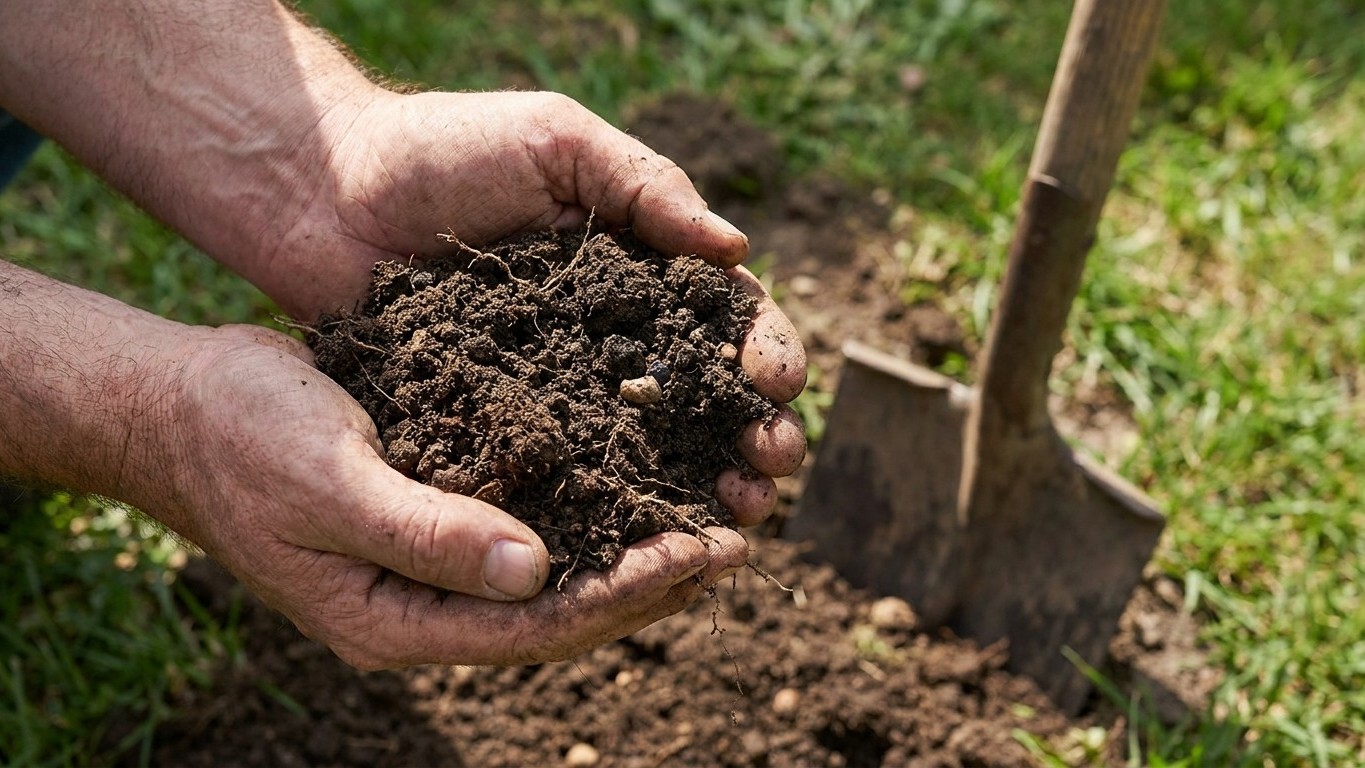

Dig a shovel into Nebraska ground and you’re most likely standing on the Holdrege series, the state’s official soil since 1979 and the dark, deep loam that built the Corn Belt. Its numbers are on record. Here’s what they mean for your own patch of dirt.
What is under your garden

Nebraska’s official state soil is the Holdrege series, a Mollisol, which is the technical name for the deep, dark, humus-rich prairie soil that turned the Great Plains into some of the most productive farmland on earth. The USDA’s Soil Data Access records give the surface horizon a pH of about 6.2 (slightly acid), a texture of 11 percent sand, 22 percent clay and 67 percent silt (a silt loam), and organic matter around 2.0 percent. It’s classified well drained. Those are the representative values across 248 mapped components of the series, not a lab result from any single backyard.
That distinction matters more than it sounds. Holdrege is the soil that represents Nebraska, not the soil in every Nebraska garden. River bottoms carry sandier, faster-draining ground. Hill country and pasture edges can run heavier or shallower. And if a builder ever scraped, graded or filled your lot before your house went up, the topsoil you’re working with may have nothing to do with the native series at all. It might be subsoil clay pushed up from three feet down, or a thin veneer of trucked-in loam over compacted fill.
Reading your own soil in five minutes
You don’t need a lab to get a rough read. Grab a handful of moist soil and try the ribbon test: squeeze it between thumb and forefinger and push it upward. Sandy soil won’t hold a ribbon at all. Loam forms a short ribbon, an inch or two, before breaking. Heavy clay stretches into a long, shiny ribbon that resists breaking. That single squeeze tells you more about texture than most gardeners ever bother to check.
The jar test fills in the rest. Pack a straight-sided jar about a third full of soil, top it off with water, shake it hard for a minute, then leave it alone overnight. Sand settles first and forms the bottom layer within minutes. Silt follows and settles within a few hours. Clay stays suspended longest and caps the layers by morning. Measure each band and you’ve got a rough texture percentage without spending a dime.
| Reading (Holdrege series surface) | Value |
|---|---|
| Surface pH | about 6.2 (slightly acid) |
| Sand | 11 percent |
| Silt | 67 percent |
| Clay | 22 percent |
| Organic matter | about 2.0 percent |
| Drainage class | well drained |
A reader who’s just done both tests should be able to say, out loud, roughly what they’re digging into: sandy, loamy, or clay-heavy, and whether it holds a ribbon or falls apart in your hand. That’s the starting point for everything else on this page.
Testing before you amend
Guessing at soil chemistry is how gardeners end up dumping lime on ground that didn’t need it, or pouring on nitrogen a soil test would have told them was already high. Your eyes can tell you texture. They can’t tell you pH, phosphorus, potassium or organic matter percentage, and those numbers decide whether an amendment helps or just costs you money.
Because the Holdrege series runs a surface pH near 6.2, a Nebraska gardener working native, undisturbed ground can reasonably expect something in that slightly-acid neighborhood. Expecting is not knowing. Fill, compost history, years of fertilizer, even the type of mulch you’ve used for a decade can all shift a garden bed’s actual number well away from the regional average.
How to pull a sample that actually means something
- Choose one planting area at a time. Don’t mix soil from the vegetable bed with soil from under the shrubs.
- Scrape away surface mulch or debris, then pull 8 to 10 small cores from that area, spaced evenly, down to about 6 to 8 inches, the depth most vegetable and flower roots actually work.
- Combine the cores in a clean bucket and mix them thoroughly.
- Let the composite sample air-dry on a tray or newspaper, away from direct sun.
- Bag about a pint of the dried, mixed soil and label it with the bed name and today’s date.
- Send or drop the sample at your county extension office, or follow their mailing instructions for the closest testing lab.
When the results come back, you’ll get an actual pH, plus levels for phosphorus, potassium and often organic matter, sometimes with plain-language fertilizer recommendations attached. That report, not the state average, is what should guide anything you add to the ground this season.
Amending it
At a surface pH of about 6.2, the Holdrege series sits close to the sweet spot most vegetables and lawns want, somewhere between 6.0 and 7.0. It’s slightly acid, but not acid enough to trigger the aggressive lime program that truly sour soils need, and nowhere near the alkaline range where lime would do harm. If your own soil test comes back close to that number, the honest answer is that broad pH correction probably isn’t your priority. But plenty of Nebraska gardens drift one way or the other, especially disturbed lots and heavily fertilized lawns, so it’s worth knowing which lever to pull in either direction.
Lime, if your test reads acid
If a soil test comes back well below 6.0, closer to 5.5 or lower, lime is the correct tool, not sulfur. Acid ground locks up phosphorus so plants can’t use it and makes life hard on brassicas like broccoli and cabbage, which sulk badly below pH 6.0. Lime works slowly, over a season or two of breaking down and moving through the root zone, not in weeks. Apply it based on the rate your soil test recommends, and don’t expect an overnight fix.
Sulfur, if your test reads alkaline
If your number instead comes back above roughly 7.3, lime should never touch that ground again. Elemental sulfur, worked in gradually along with regular additions of organic matter, is the slow, honest way to bring alkaline soil down. At high pH, iron becomes chemically unavailable to plants even when there’s plenty in the ground, which is exactly what’s behind the yellow leaves with dark green veins you sometimes see on maples, pin oaks and other iron-hungry plants in alkaline yards.
Organic matter, for texture and for everything else
Here the Holdrege numbers point somewhere useful regardless of pH. Organic matter sits around 2.0 percent, modest for a prairie soil that historically ran higher before a century of cultivation. With clay at 22 percent and sand at only 11 percent, this is a silt loam, medium-bodied, not the heavy, sticky clay that cracks in summer and drowns roots in spring. If your own soil leans heavier and clayier than that, organic matter (compost, aged manure, chopped leaves) is the fix, worked in over multiple seasons. Never mix sand into clay soil hoping to lighten it; that combination can set up almost like concrete. If your soil leans sandy instead, the same organic matter additions help it hold water and nutrients longer, paired with shorter, more frequent watering since sandy ground simply won’t hold moisture the way loam does. Texture fixes take three seasons or more of steady additions. pH correction, once you know which direction to push, can show measurable movement within a single season if you stay on schedule.
Drainage and compaction
The Holdrege series carries a well-drained rating, which in plain terms means water moves through it at a reasonable pace instead of pooling on the surface or vanishing straight through like it would in pure sand. If your yard is standing in water a day or more after a heavy rain, you’re likely not dealing with native Holdrege-type ground anymore, you’re dealing with compaction, fill, or a heavier clay pocket the survey doesn’t capture at your address.
A simple percolation test settles the question. Dig a hole about a foot deep and roughly a foot across, fill it with water, and let it drain completely once (this saturates the surrounding soil). Fill it a second time and time how far the water level drops in an hour. A drop of an inch or more per hour suggests good drainage. Well under an inch points to compaction or heavy clay that needs real attention before you plant anything that dislikes wet feet.
Compaction from foot traffic, mower wheels or construction equipment can undo good drainage even on decent ground, packing soil particles so tightly that roots and water both struggle to move through. Double digging, once the standard fix, has fallen out of favor because it disturbs soil structure and biology more than it helps, and the compaction often returns within a season or two anyway. On genuinely tight, poorly draining ground, a raised bed filled with good soil is frequently the smarter move than three years of amendment work with an uncertain payoff. That’s not a failure, it’s just working with what you’ve got instead of fighting it indefinitely.
- Well-drained, loamy ground: standard planting depths and normal watering schedules work fine.
- Slow-draining or compacted spots: avoid moisture-sensitive roots like carrots and asparagus there; route them to a raised bed or a better-draining corner of the yard instead.
- Any bed that still puddles a day after rain: skip further amendment attempts and build up rather than dig down.
Local help
Nebraska Extension, run through the University of Nebraska-Lincoln, offers soil testing through county offices statewide. You can find your local office and testing instructions at extension.unl.edu. Bring your composite sample in, and staff will walk through the results with you, translating raw numbers into what your specific bed actually needs next.
Common questions
Is my backyard automatically Holdrege soil if I live in Nebraska?
No. Holdrege is the state’s official soil series and covers a wide swath of Nebraska farmland, but it’s one series among hundreds mapped across the state. River valleys, sandhill regions and any lot that’s been graded or filled for construction can differ completely from it.
Do I need to add lime to my Nebraska garden every year?
Not automatically. The state soil’s surface pH runs about 6.2, close to neutral, so many gardens on native ground need little or no lime. Test before adding any, since lime on soil that’s already near neutral, or worse, alkaline, can push pH the wrong direction.
Why does my soil look dark and rich but still drain poorly?
Color reflects organic matter and mineral content, not drainage. Dark, silt-heavy soils like Holdrege can still compact under heavy foot traffic or equipment, and compaction, not color, is usually what’s slowing water movement.
How often should I retest my soil?
Every 2 to 3 years for an established garden is typical, or sooner if you’ve made major amendments, switched crops, or noticed plants struggling for no obvious reason.