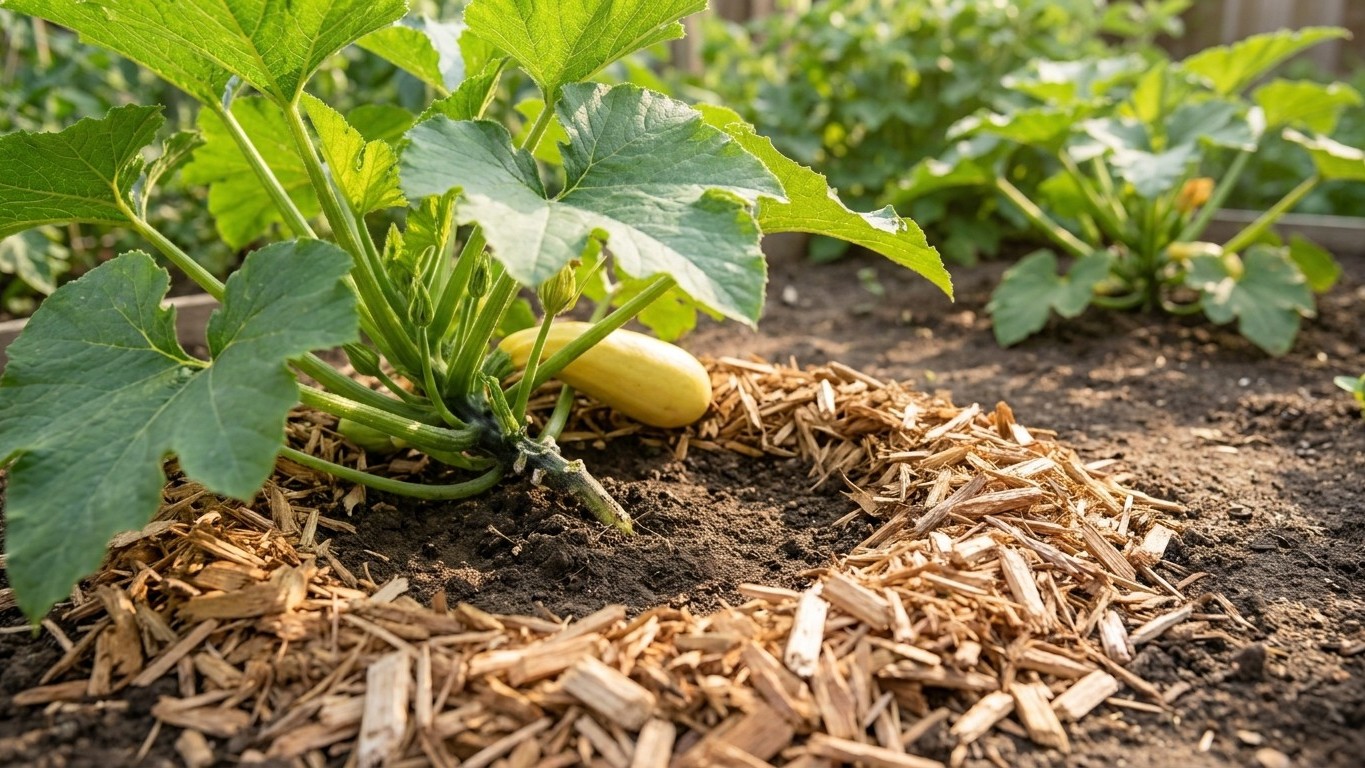

Mulch under summer squash holds soil moisture steady, blocks the fungal spores that splash up from bare dirt onto leaves, and keeps weeds from competing for water and nutrients. The tradeoff: mulch piled against the stem traps moisture where the plant is most vulnerable to rot. Get the gap right and the benefits outweigh the risk by a wide margin.
What is actually going on

Squash leaves are big, soft, and close to the ground, which makes them unusually good at catching splashed soil. Every time it rains or you water overhead, drops hit bare dirt and bounce upward, carrying fungal spores and bacteria onto the lowest leaves. That’s how a lot of common squash diseases get their start. A layer of mulch breaks that cycle by giving raindrops something to land on that isn’t loose soil.
The second job is water retention, and the numbers matter more than gardeners usually assume. Bare soil in full summer sun can lose a meaningful fraction of its surface moisture to evaporation within a single hot afternoon. Squash plants are heavy drinkers once they start setting fruit, with broad leaves that pull water out of the ground constantly. A mulched bed holds that moisture longer, which means less stress on the plant between waterings and fewer of the misshapen or bitter fruits that show up when a squash plant goes from drought to flood and back.
Third, mulch shades the soil surface just enough to slow weed germination. Weeds compete directly with squash roots for water and nitrogen, and in the first six weeks after transplanting, that competition can set a plant back in ways it never fully recovers from during a single growing season.
None of this is variety-specific. Whether someone is growing a bush-type plant or a vining one, the mechanism is the same: soil covered, less splash, less evaporation, fewer weeds. For which specific squash types perform best in a given region’s heat and rainfall pattern, a state extension service’s variety trial results are a far better source than any general guide, since those trials are run on local soil and local weather, not averages.
The one problem mulch introduces is rot risk at the stem. Squash stems, especially where they meet the soil, are already prone to collapse from vine borers and crown rot in wet conditions. Mulch that sits directly against that base holds moisture right where the plant can least afford it. That’s not a reason to skip mulching. It’s a reason to leave a gap, which the next section covers in practical terms.
In the garden
The choice of material matters less than most gardeners think, and the depth and placement matter more. Straw, shredded leaves, grass clippings, and untreated wood mulch all work by the same mechanism described above. What changes is how each one behaves when it’s applied wrong.
| Mulch type | Typical depth | What happens when applied wrong |
|---|---|---|
| Straw | 3 to 4 inches | Too thin, and it mats down and lets light through, so weeds punch right through it within weeks. |
| Shredded leaves | 2 to 3 inches | Piled too deep or too fresh, they compact into a soggy layer that suffocates the soil surface and can smell sour. |
| Grass clippings | 1 to 2 inches, applied thin and dried | Piled on thick and fresh, they heat up as they decompose and can scorch nearby stems and roots. |
| Untreated wood mulch | 2 to 3 inches | Pushed against the stem, it holds constant moisture there and becomes a direct path to crown rot. |
Every one of these needs the same gap: a clear ring of bare soil, roughly two to three inches wide, left open around the base of the stem. Skip that gap and even the best mulch material turns into a liability. Squash stems don’t tolerate standing moisture against their tissue the way roots tolerate moisture in soil. The stem base is where vine borers lay eggs and where fungal rot takes hold fastest, so keeping that ring clear isn’t a cosmetic detail. It’s the difference between mulch that protects the plant and mulch that quietly kills it over a few humid weeks.
Timing matters too. Mulch applied too early, right after transplanting into soil that’s still cool, slows the soil from warming up and can stall root development for a plant that needs warm soil to get going. The better sequence is to let the soil warm for a couple of weeks after transplanting, then mulch once the plant is established and the surface soil temperature has come up. That sequencing question is genuinely regional, since “a couple of weeks” means something different in a short-season northern garden than in a long, hot southern one, which is exactly why the next section separates what’s universal here from what depends on where the reader lives.
Reapplying mulch partway through the season is worth planning for. Straw and leaves break down and thin out over eight to ten weeks of summer sun and rain, and a bed that started with a solid four-inch layer can be down to a thin, patchy cover by midsummer, right when the plant needs the moisture protection most.
What it depends on where you are
The mechanism in this article, splash reduction, moisture retention, weed suppression, and the rot risk at the stem, holds true Everywhere summer squash is grown. What doesn’t hold true everywhere is the timing, the material choice, and how aggressively any of this matters in the first place.
In regions with heavy summer rainfall and high humidity, splash-borne disease pressure is a bigger threat than drought, so mulching for disease prevention deserves more weight than mulching purely for moisture. In dry, low-humidity regions with intense summer heat, evaporation is the dominant problem, and a thicker mulch layer that holds soil moisture matters more than the disease-prevention angle. Season length changes the timing question directly: gardeners in short-season climates often need to let soil warm quickly in spring and can’t afford to delay mulching too long without losing growing days, while gardeners in long, hot seasons have more flexibility to wait for the soil to warm before covering it.
Local soil type plays into this too. Heavy clay soils hold moisture longer on their own and can stay soggy under mulch longer than sandy soils, which drain fast and benefit more from the moisture retention mulch provides. None of that is something a general guide can specify accurately, because it depends on the actual soil in an actual garden.
This site’s state-level squash pages address season length, typical summer rainfall patterns, and regional disease pressure for specific parts of the country, and they’re the better next stop for anyone trying to match this guidance to their own conditions. Beyond that, a state’s cooperative extension service is the most reliable source for local frost dates, soil temperature guidance, and the squash types that have performed well in university variety trials nearby. Extension offices run soil testing services too, which answers the clay-versus-sandy question directly rather than by guesswork.
The mistake that costs the most
The single costliest mistake is piling mulch straight up against the stem instead of leaving that bare ring around the base. It’s an easy mistake to make, because it feels thorough. Gardeners see a small strip of exposed soil right at the plant’s base and instinctively want to cover it, the same way they’d cover any other bare patch in the bed. With squash, that instinct works against the plant.
The stem base is the single point of failure for the entire plant above ground. Mulch pressed against it holds moisture constantly, and that constant dampness softens the outer tissue, creates ideal conditions for stem rot pathogens, and gives vine borers an easier entry point since the moist, softened tissue is simpler for larvae to penetrate. A plant that’s been producing well for weeks can go from healthy to collapsed within days once rot sets in at the base, because the entire structure above that point depends on a stem that’s now compromised.
The fix costs nothing and takes thirty seconds per plant: pull mulch back from the stem so there’s a clear two-to-three-inch ring of bare soil visible around the base, then apply mulch normally everywhere beyond that ring. Check that ring periodically through the season, since mulch shifts after heavy rain or when a gardener adds a fresh layer without checking what’s happened to the original gap.
This applies regardless of squash type, bush or vining, and regardless of which mulch material is in use. It’s not a detail specific to one variety or one region. It’s the one piece of this practice that, done wrong, undoes most of the benefit mulch is supposed to provide in the first place.