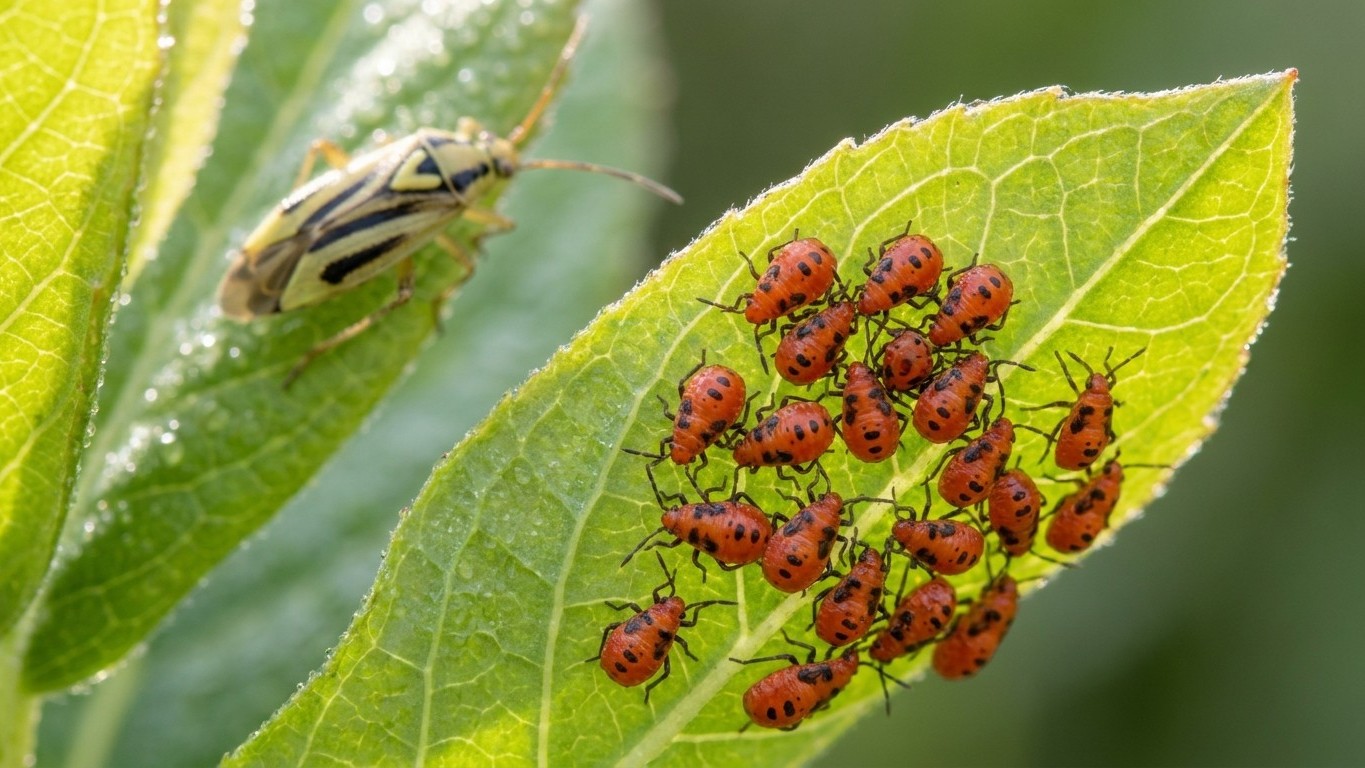

The fourlined plant bug (Poecilocapsus lineatus) becomes active in Ontario gardens in late April through May, when overwintered eggs hatch into bright orange-red nymphs. The insect stays active for only about six to eight weeks, feeding on more than 250 plant species before adults die off by mid-summer. Stopping it means acting fast in spring: hand removal of nymphs, insecticidal soap while they’re young, and pruning out egg-laying sites in fall to break next year’s cycle.
What This Bug Looks Like at Each Stage

Two very different-looking creatures share this one insect’s life cycle, and that confuses a lot of Ontario gardeners who assume they’re dealing with two separate pests.
The nymphs hatch out looking almost festive: bright red-orange bodies with black spots, wingless, and quick to scatter when disturbed. They’re roughly the size of a small ant at first, growing to about a quarter inch as they molt through several stages over three to four weeks. Because they can’t fly, this is the easiest window to control them by hand.
Adults tell a completely different story. Once they mature, usually by early June in southern Ontario, they turn pale yellow-green with four bold black stripes running the length of the wing covers, giving the species its name. Adults measure about 1/4 to 3/8 inch long, move fast, and can fly short distances when threatened, which makes them harder to catch than the nymphs. Both stages have the same piercing-sucking mouthparts and cause the same type of leaf damage, just at different rates depending on their size.
The Seasonal Timeline Across Ontario
Timing shifts by region, and that gap matters if you’re planning treatment around calendar dates rather than plant development.
In the Niagara Peninsula and the southwestern counties around Windsor and Chatham-Kent, where spring warms up earliest, egg hatch often starts in the last week of April. Move north toward Ottawa, Muskoka, or Sudbury, and hatch can lag two to three weeks behind, sometimes not starting until mid-May. The bug overwinters exclusively as eggs, inserted in neat rows into the pith of dead or dying plant stems the previous autumn. Those eggs need a period of cold before they’ll hatch, so a mild winter doesn’t necessarily mean an earlier emergence, but it does mean the eggs survive in higher numbers if temperatures never dropped low enough to kill a portion of the batch.
Once nymphs emerge, they feed for three to four weeks before molting into winged adults. Adults then feed and mate for another three to four weeks before females begin laying next year’s eggs, usually by mid to late July across most of southern and central Ontario. After egg-laying, adults die off within days to weeks. That’s the whole cycle: one generation per year, no second wave to worry about once summer heat sets in. This single-generation pattern is actually good news for control, because there’s no risk of a fall resurgence the way there is with pests that produce multiple broods.
A practical way to track this without checking a calendar: watch mint family plants and see when new leaf damage stops appearing. Once the last adults have died off, usually by early to mid-August depending on region, feeding damage for the season is done.
Which Plants Get Hit and What the Damage Looks Like
This insect isn’t picky, which is part of what makes it a recurring nuisance in Ontario yards rather than a problem limited to one type of garden.
Herb gardens take some of the worst hits. Mint, basil, sage, oregano, and other members of the mint family are favorites, along with dahlia, chrysanthemum, marigold, forsythia, hydrangea, and currant bushes. Vegetable gardeners sometimes see it on beans and squash as well, though damage there tends to be lighter. The feeding pattern is distinctive once you know what to look for: small circular or oval spots, often translucent or bleached-looking at first, that darken to brown or black as the tissue dies. On a badly infested basil plant, leaves can end up looking like they were peppered with tiny holes, sometimes described as a “shot hole” pattern.
The good news is that this damage, while unattractive, is almost never fatal to established plants. It’s cosmetic injury from saliva injected during feeding that kills small patches of leaf tissue, not a systemic disease or a pest that girdles stems. Herb harvests can take a hit in appearance and, for some crops, in flavor if enough leaf area is compromised, but the plant itself typically recovers once feeding stops for the season. Younger or stressed plants, and anything already weakened by drought or transplant shock, tend to show damage faster and more severely than mature, healthy specimens.
What Actually Stops Fourlined Plant Bug
Timing-Based Physical Control
Because there’s only one generation per year and nymphs can’t fly, the highest-leverage window for control in Ontario runs from late April through late May, before the population winges out. Checking susceptible plants every few days during this stretch and knocking nymphs into a jar of soapy water works well on a small to mid-size garden. They’re slow enough in the early instars that hand removal is genuinely practical, not just a token gesture.
Once adults appear, a fine mesh net or a quick early-morning check (when temperatures are cooler and the bugs are less active) improves success rates, since adults scatter fast once the sun warms the garden.
Sprays That Work Without Wrecking Beneficial Insects
Insecticidal soap and neem oil both perform reasonably well against nymphs when applied directly to the insect, since these products work on contact rather than through residual toxicity. Spraying in early morning or evening avoids leaf burn on sunny days and improves coverage since the bugs are less likely to have scattered.
Broad-spectrum insecticides will kill fourlined plant bugs, but they also wipe out the predatory insects and pollinators working the same garden, and given that this pest causes mostly cosmetic damage and disappears on its own by midsummer, that trade-off rarely makes sense for home gardens. Ontario’s own extension guidance for home gardeners consistently favors targeted, lower-impact controls for pests like this one precisely because the damage window is short and the insect doesn’t threaten plant survival.
Breaking the Cycle Before It Starts
The most overlooked control tactic happens in fall, not spring. Because eggs get laid into the pith of dead or weakened stem tips, cutting back and disposing of spent perennial stems, particularly on mint, dahlia, and other known host plants, after the growing season removes a portion of next year’s egg supply before it ever gets the chance to overwinter. This won’t eliminate the population single-handedly, since adults can fly in from neighboring properties and untended areas, but combined with spring monitoring it measurably reduces pressure year over year in a home garden.
Keeping garden edges and fence lines mowed or trimmed also helps, since overgrown weedy borders often host egg-laying sites that go unnoticed until nymphs show up en masse the following spring.
When to Actually Worry
Most Ontario gardeners deal with fourlined plant bug as an annual cosmetic annoyance rather than a genuine threat. The exception comes with young herb transplants or nursery stock, where concentrated feeding on a small number of leaves can set back growth more noticeably than it would on an established, leafy plant with room to spare. Commercial herb growers and market gardeners tend to take this pest more seriously for that reason, since blemished basil or mint doesn’t sell as well even if the plant itself is fine.
For a typical backyard herb bed or perennial border, though, the practical response is patience paired with a few weeks of active nymph removal in spring. The insect runs its entire cycle in about three months and then leaves the garden alone until next year, which is a shorter and more predictable window than most people expect when they first spot those orange nymphs crawling across a basil leaf.