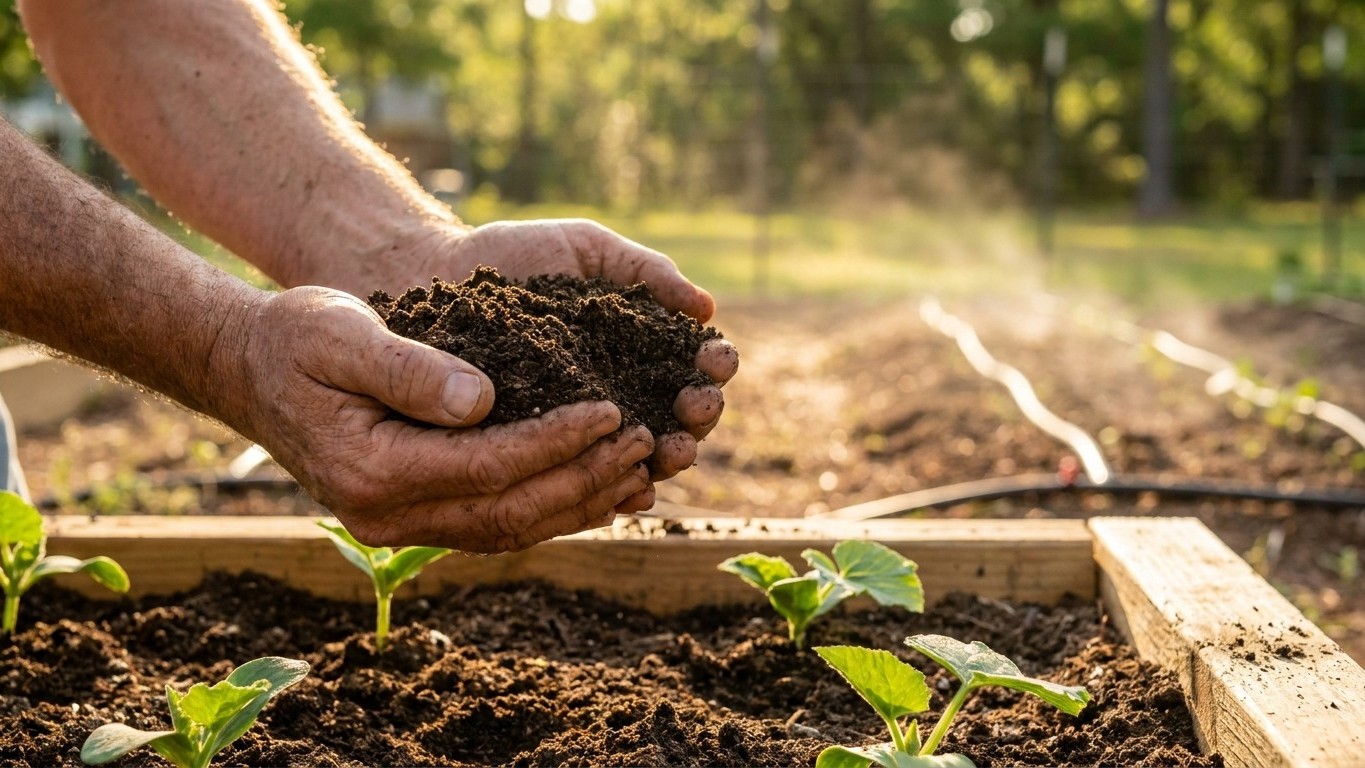

Summer squash goes into Arkansas ground once nighttime soil temperatures hold above 60F, which typically lines up with mid-to-late April across most of the state. But the calendar date matters less than what’s happening a few inches underground, and that’s where a lot of gardeners lose their first planting to a cold snap that never even touched frost.
When the soil is warm enough in Arkansas
The reflex is to circle the last spring frost date and plant the next morning. Resist that. NOAA’s 1991-2020 Climate Normals, drawn from station USW00013963, put Arkansas’s last spring 32F freeze somewhere between March 12 and March 28. That’s a 30-70% probability band, not a guarantee, and it covers a full 32-degree freeze, the kind that kills a squash seedling outright.
Here’s the catch most planting charts skip: summer squash doesn’t care about the freeze line at all. It cares about the 36F light-frost threshold, because a plant this tender can be knocked back by cold well above hard freezing. NWS Little Rock’s numbers for that lighter threshold run April 3 to October 31, which is a noticeably tighter window than the freeze dates above. If you’re transplanting or direct-seeding squash, plan around the April 3 mark for Little Rock’s area, not the earlier freeze date, and check your local NWS office if you’re well outside the central part of the state.
Even that date is a probability, not a promise. Some years the ground stays cold and wet into late April; other years a warm spurt in early April makes soil temperature the limiting factor days ahead of schedule. Squash seed germinates poorly in soil below 60F, and seedlings sulk or rot in cold, damp ground even without a frost touching them. A soil thermometer pushed four inches deep, checked over a few mornings, tells you more than any calendar page.
Skip the temptation to jump on a specific variety name from a seed catalog cover. Types trialed and recommended for Arkansas conditions change from year to year, and the University of Arkansas Division of Agriculture Cooperative Extension Service publishes current variety trial results and planting guides tailored to the state’s zones. That’s the source worth checking before buying seed, not a national blog’s shortlist.
How long the season lasts here
Stack the two frost windows against each other and Arkansas’s frost-free season runs from the last spring 32F freeze (March 12-28) to the first fall 32F freeze (November 7-20), both from the same NOAA station USW00013963. That’s a stretch of roughly seven and a half to eight months between hard freezes, depending on where in that band a given year lands. Even trimmed down to the tighter 36F light-frost window most squash growers should actually use, April 3 to October 31 leaves close to seven months of workable growing time.
A window that long changes the math on planting. It’s not just enough time for one crop of squash to mature and fade, it’s enough to plant twice. A first sowing in early-to-mid April can be spent and pulled by midsummer, when squash bugs and vine borers tend to catch up with older plants anyway, and a second sowing in July still has time to mature and produce before the fall frost risk climbs. That’s a real advantage over shorter-season territories, where growers get one shot and have to make it count.
The length of the window also affects whether starting seed indoors is worth the trouble. In a place with only ten or twelve frost-free weeks, a head start from transplants can be the difference between a harvest and none at all. In Arkansas, with six-plus months on the table, direct-seeding outdoors after the soil warms is usually simpler and avoids the transplant shock squash seedlings are notorious for, since their roots resent disturbance. Save the transplant tray for gardeners chasing the earliest possible harvest, not as a necessity.
For the specifics of staggering plantings, spacing successive sowings, and timing that second July planting so it beats the fall frost, the succession sowing guide on this site walks through the intervals that work.
Heat and water in Arkansas
Arkansas summers aren’t gentle. The reference station at Little Rock averages 69.2 days a year at or above 90F, per NOAA’s 1991-2020 Climate Normals. That’s over nine weeks of the year where daytime temperatures push into a range that starts working against squash rather than for it. Pollen on squash flowers is short-lived even in mild weather, and once afternoon highs push toward the high 90s and beyond, pollen viability drops fast, flowers open and close without setting fruit, and a plant that looked loaded with blossoms produces almost nothing for a stretch of weeks.
Water is the other half of that equation, and it doesn’t arrive generously. Summer rainfall across June, July and August averages about 10 inches at the same reference station, broken down as 3.55 inches in June, 3.33 in July, and just 3.16 in August, the driest of the three. Ten inches over three months sounds workable until you set it against those 69 days of 90-plus heat, because summer squash carries enormous leaves that lose water through transpiration far faster than its shallow, spreading root system can pull it back from the soil. On a hot afternoon, a squash plant can wilt visibly by 2 p.m. and look fine again by evening, drawing down soil moisture the whole time.
That combination, plenty of heat, average-to-thin rainfall concentrated unevenly across the summer, is exactly the setup where irrigation stops being optional. A soaking at the base of the plant two or three times a week during the hottest stretches, rather than a light daily sprinkle, encourages roots to grow deeper and gives the plant a buffer against those 90-degree afternoons. Afternoon shade, whether from a nearby taller crop or simple shade cloth during the worst heat spikes, also takes pressure off pollination during the hottest weeks of July and August.
None of this is a forecast for any single backyard. Rainfall behaves differently depending on whether the soil underneath is sandy or clay-heavy, and a thunderstorm that dumps an inch in twenty minutes mostly runs off rather than soaking in, especially on compacted ground. A rain gauge on the actual property tells a grower more about their own watering needs than any regional average, but the regional pattern, hot and moderately dry, is the one to plan around by default.
Which summer squash suit Arkansas
Given a season this long and this hot, a few general priorities matter more than any specific brand of seed. Types bred or selected for early maturity make the most of that first spring planting before the worst of the 90-degree stretch sets in, letting a grower harvest a good flush before pollination struggles begin in July. For a second, midsummer sowing meant to carry through to fall, disease resistance climbs to the top of the list, since Arkansas’s humidity and rainfall pattern favor powdery mildew and other fungal issues on older, stressed plants late in the season.
Airflow matters as much as variety selection. Spacing plants generously, rather than packing them in, cuts down on the still, damp microclimate around the leaves where mildew thrives, and it also helps pollinators actually reach the flowers during the hottest hours when bee activity itself drops off. Mulching around the base helps the shallow root system retain moisture between waterings without needing to guess at a schedule.
- Earlier-maturing types for the first spring sowing, to beat peak summer heat
- Disease-resistant types for a July second sowing meant to run into fall
- Generous spacing and mulch over any specific brand or name
What this page won’t do is hand over a cultivar name, because the varieties that actually perform well in Arkansas conditions are the ones tested locally, year after year, by people who track results across the state’s different zones (Arkansas spans USDA Hardiness Zones 6b to 8a, per the USDA’s 2023 Plant Hardiness Zone Map, itself built on average extreme minimum winter temperatures rather than summer performance). A name that does well in a trial garden in one state can underperform badly in another state’s heat and rainfall pattern, and repeating a national bestseller here without local data behind it isn’t a recommendation, it’s a guess dressed up as one.
The University of Arkansas Division of Agriculture Cooperative Extension Service publishes current variety trial results, disease-resistance notes, and planting calendars specific to the state’s growing conditions, and that’s the resource worth checking before buying seed for either the spring or the July planting.