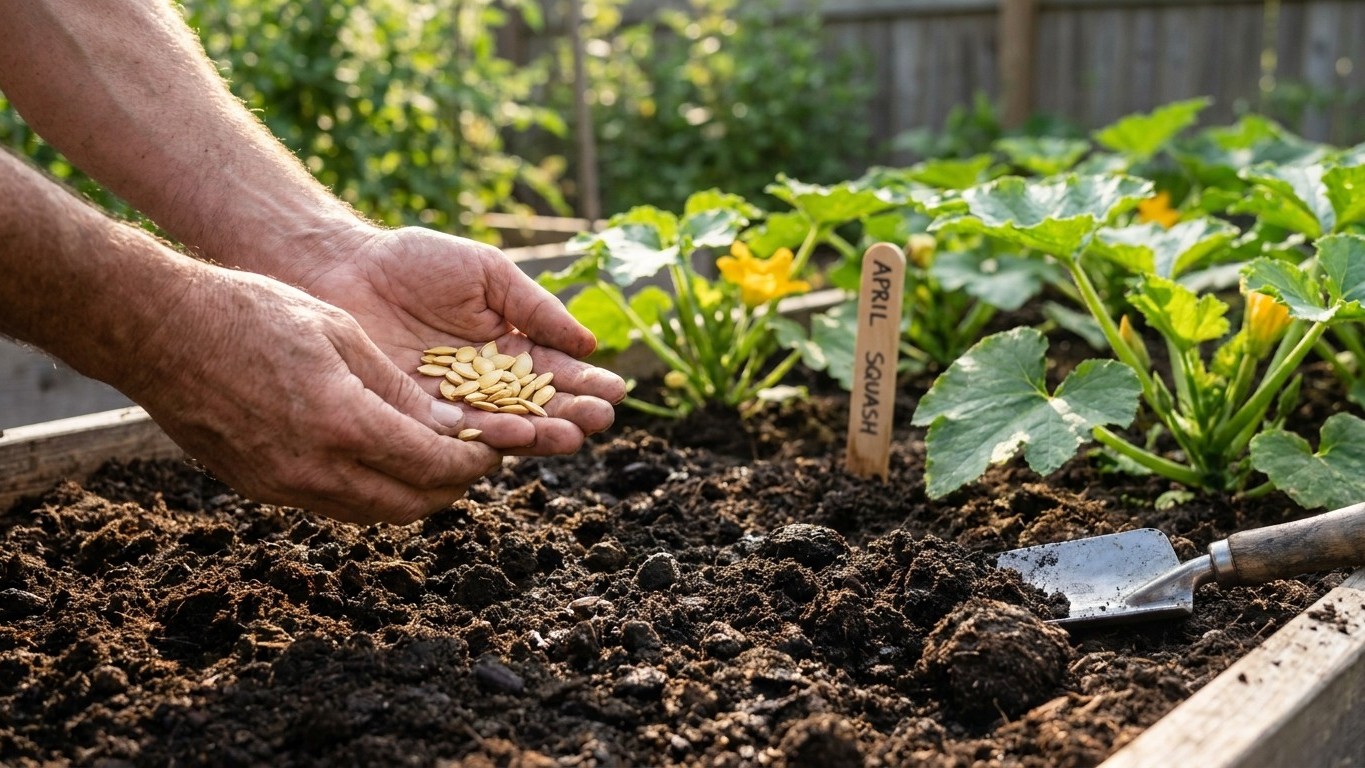

Plant Summer Squash in Alabama by direct-seeding outdoors after the last spring frost window closes, roughly early-to-mid April at the reference station, then keep sowing through early July for a second harvest before the first fall frost arrives in November. That’s the state-level target. Your county, your soil, and your own yard will move that window by a week or two in either direction.
The short answer for Alabama
The reference station for these normals, USW00003856 near Huntsville, shows a last spring frost falling somewhere between March 19 and April 3, and a first fall frost landing between November 2 and November 16. Those aren’t fixed calendar days. They’re a 30 to 70 percent probability band for a 32F freeze, built from 1991-2020 climate normals. Read that plainly: even within that window, there’s a real chance of frost on the early end and a real chance the ground has already warmed past risk on the late end.
Summer squash has zero frost tolerance and germinates poorly in cold soil, so the practical move is to treat April 3, the late end of that spring window, as your target rather than the early end. Seeds sown into soil that’s still cool from a lingering frost risk will sit and rot before they sprout. Waiting those extra two weeks costs you almost nothing, since squash grows fast once it starts.
Summer squash matures in roughly 45 to 55 days from seed depending on variety, which gives Alabama gardeners something most northern states don’t get: room for a second planting. Working backward from the early end of the fall frost window, November 2, a squash sown in mid-July still has time to mature before frost risk climbs. That means the real planting calendar here isn’t one date, it’s two: an April sowing for an early-summer harvest, and a follow-up sowing in late June through mid-July to beat the squash vine borer and powdery mildew that usually take down the spring planting by midsummer, and to catch a fresh harvest into October.
Between those two windows sits the hottest stretch of the year, and that’s where a lot of Alabama squash plantings quietly fail, which the next section covers directly.
What will not work here
Season length isn’t what trips up Summer Squash in Alabama. With roughly seven months between the two frost windows, there’s more than enough time for two full plantings. Heat is what does the damage, and the numbers back that up: the reference station averages 58.5 days a year at or above 90F. That’s not an occasional hot spell, it’s nearly two months of the calendar where blossoms drop, pollen goes sterile, and fruit set slows or stops even on healthy plants. Squash sown right in the middle of that stretch, say early June, spends its critical flowering weeks fighting heat stress it can’t win.
Watering on a fixed weekly schedule fails for the same reason. Summer rainfall averages about 12.1 inches across June, July, and August, but it doesn’t arrive evenly. August, the driest of the three months, averages just 3.55 inches, and much of what does fall comes as a single afternoon thunderstorm that runs off a dry, crusted bed rather than soaking down to the root zone. Combine that with 90-plus-degree days pulling moisture out of the soil, and a squash bed watered once a week can go bone-dry for days at a stretch. Sandy soil makes this worse, since it drains within hours; clay holds water longer but can also crust over and shed a hard summer rain the same way.
Close spacing is the third failure point, and it’s a humidity problem more than a heat problem. Alabama’s combination of warm nights and regular summer moisture is close to ideal for powdery mildew and downy mildew on squash leaves. Planting rows or hills tight together, the way a gardener in a drier climate might get away with, traps humid air around the foliage and speeds up mildew spread. Wider spacing with real airflow between plants matters more here than the seed packet’s minimum distance suggests.
What changes across Alabama
Alabama spans USDA Hardiness Zones 7a through 9a, and that’s the average annual extreme minimum temperature, not a stand-in for frost dates, but the two track together closely enough to matter. A three-zone spread inside one state means there is no single frost calendar that fits both ends of Alabama, and this page can’t hand you one. The reference figures above come from a station near Huntsville, which sits toward the cooler, more northern end of that range.
Gardeners farther south, toward the Gulf Coast and the warmer 8b-9a end of the zone range, typically see their last spring frost earlier than the Huntsville normals and their first fall frost later, stretching the safe planting season on both ends. Gardeners at higher elevation in the northern part of the state, or simply farther from the reference station, often see the opposite: a later last frost in spring and an earlier first frost in fall, tightening the window from both directions.
| Region tendency | Relative to the Huntsville reference normals |
|---|---|
| Warmer, southern zones (closer to 9a) | Last spring frost typically earlier; first fall frost typically later |
| Cooler, northern or higher-elevation zones (closer to 7a) | Last spring frost typically later; first fall frost typically earlier |
None of that tells you which zone your own address falls into. For that, use the USDA Plant Hardiness Zone Map and look up your zip code directly rather than guessing from a regional description.
Where to check this for your own county
This page gives you the state-level picture, built from one reference station’s climate normals. That’s useful for understanding the pattern, but it’s not a substitute for a county-specific recommendation, and the Alabama Cooperative Extension System exists specifically to close that gap.
Start at aces.edu and look for two things. First, the local vegetable planting calendar for your county or region, which adjusts the state-level frost window using data closer to your actual garden rather than an airport weather station that might sit fifty or more miles away. Second, the variety trial results and county-level recommendations for summer squash specifically, since Extension agents track which varieties held up against squash vine borer, powdery mildew, and heat stress in local conditions in a given growing season, information a national seed catalog simply doesn’t have.
A county Extension office recommendation will beat this page every time, because it’s built on soil, humidity, and pest pressure specific to where you actually garden. Treat what’s above as the frame, and the county office as the fine print that fills it in. If you’re near a county line, or your yard sits at a noticeably different elevation than the surrounding area, a phone call to the Extension office is worth more than any state map.
Checking this against your own garden
Every date in this article is a normal, an average built from thirty years of weather. Your garden this year is not an average, and three simple checks will tell you more about your own microclimate than any calendar.
Feel the soil before you plant, not just the calendar. Push a finger a couple of inches into the bed in mid-morning; squash seed wants soil that feels warm and not damp-cold, roughly the temperature you’d want for a barefoot walk. Cold, clammy soil means wait, regardless of what the date says.
Watch for the first male flowers once plants are established. Summer squash produces male blooms before female ones, sometimes for a week or two with no fruit set at all. That’s normal, not a sign of failure, but if male flowers show up unusually early or late relative to a typical season in your yard, it’s telling you something about how your particular bed is running warm or cool compared to the regional pattern.
Track how fast true leaves appear after the first seed leaves. Quick, vigorous true-leaf growth signals a bed that’s warm and fertile enough to support an early planting; slow, stalled growth is the plant telling you the soil hasn’t caught up with the calendar yet, and a week’s delay on your next round of seed will likely pay off.