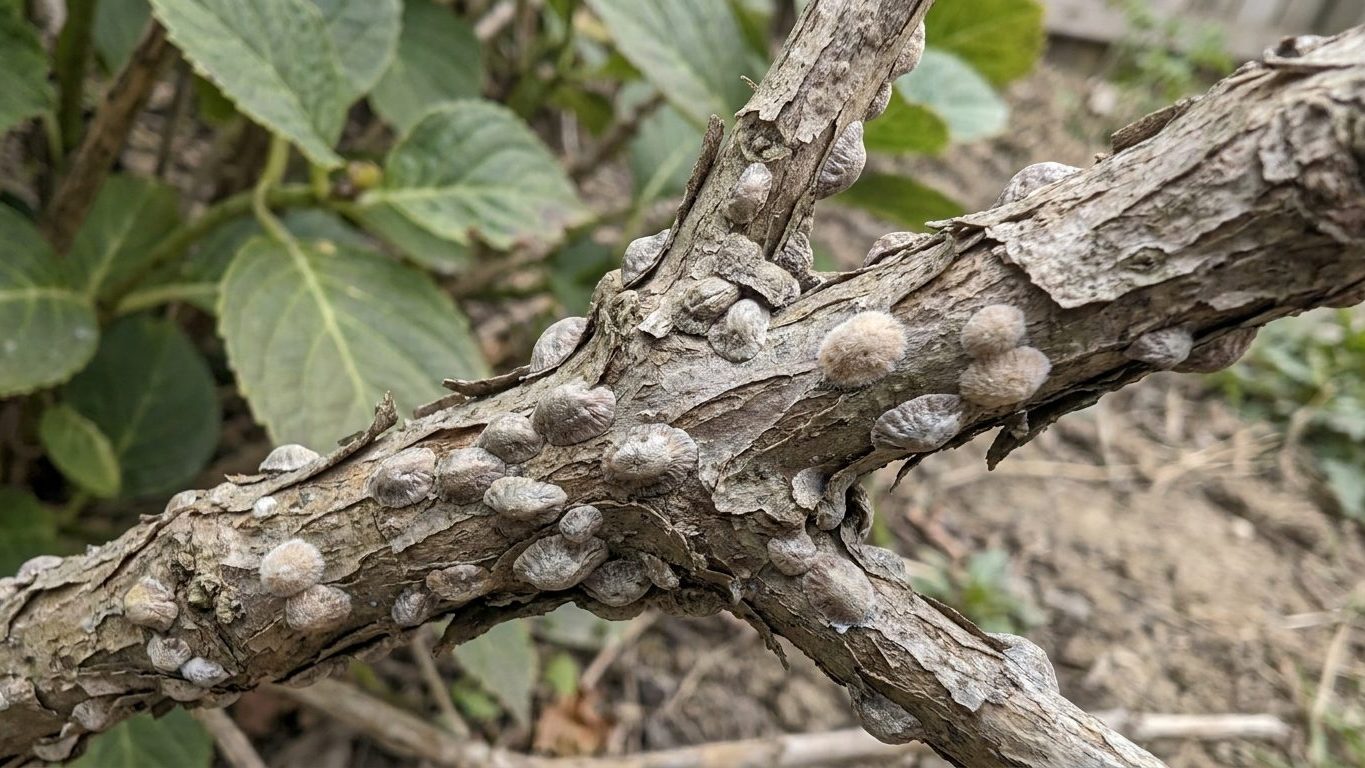

Hard, white to grayish-tan bumps clinging along hydrangea stems, or fuzzy oval masses that don’t wipe off with a finger, are scale insects. On a mature, established hydrangea this is almost always cosmetic and worth monitoring rather than panicking over. It becomes a real problem mainly on a young plant, a container specimen, or one already stressed by drought or poor drainage.
What the damage looks like
The detail that separates scale from every other hydrangea pest is simple: it doesn’t move. Aphids crawl. Mealybugs, slow as they are, shift position. Scale insects settle on a stem once, insert their mouthparts, and stay there for the rest of their lives. What you’re seeing isn’t an egg mass in the literal sense for most species, it’s the insect’s own waxy or armored covering, built to protect a soft body underneath while it feeds.
Two versions show up on hydrangeas. Armored scale looks like small, dry, oyster-shell or circular bumps, gray to tan, scattered along the woody stems and sometimes on leaf undersides. Scrape one off with a fingernail and there’s no sticky residue, just a hard shell over a tiny amber-colored insect. Soft scale looks fuzzier and more rounded, often paler or whitish, and it does leave a mess: a sugary honeydew that drips onto leaves below and attracts black sooty mold, turning stems and foliage dull and grimy over a season.
Either way, the insects cluster along stems rather than leaf tissue, which is the second clue. A heavy colony can cause individual stems to weaken, leaves above the infestation to yellow, and, on a badly hit young plant, dieback of that section. On an established shrub with plenty of healthy wood elsewhere, that same colony is usually a cosmetic nuisance rather than a threat to the plant’s survival.
Because scale settles on woody stems and stays put for years, hydrangea types that carry old wood season after season, like bigleaf and panicle hydrangea before a hard cutback, tend to accumulate more visible scale over time than a shrub like smooth hydrangea, which is routinely cut back to new growth. That’s not a reason to avoid old-wood types, just context for why an older mop-head sometimes shows more scale than a young Annabelle planted the same year.
Making sure it is this and not something else
Three other things get mistaken for scale on hydrangea stems, and each has one test that settles it fast.
Aphids
Aphids cluster on new, tender growth and buds rather than mature stems, and they’re soft-bodied and mobile, visible moving under a hand lens or even the naked eye. Touch a colony and they’ll scatter or drop off. Scale doesn’t react at all when touched.
Mealybugs
Mealybugs produce a cottony, powdery wax rather than a hard shell or smooth waxy dome, and they tend to gather in leaf axils and at stem joints rather than spreading evenly along a length of stem. They also move, slowly, if disturbed. Scale, once settled, is fixed in place for good.
Natural stem lenticels and scars
Every hydrangea stem has lenticels, the small raised pores that let the plant exchange gases, plus leftover scars from where leaves or side shoots dropped. These are uniform, correspond to the plant’s own growth pattern, and never scrape off to reveal an insect body. If a fingernail lifts the bump cleanly away and there’s something underneath, it’s scale. If it’s just part of the bark’s texture, it’s the plant.
When it shows up
Scale is easiest to spot once the shrub has dropped its leaves and the bare stems are fully exposed, since the bumps stand out clearly against smooth wood with nothing else competing for attention. That’s an observation window, not a cause: the insects have usually been there through the growing season, just hidden by foliage.
The insects themselves are most vulnerable during their brief mobile stage, right after eggs hatch, when the young crawlers move a short distance before settling permanently and building their protective covering. Once settled, they’re largely immune to contact sprays, which is the single most useful thing to know about timing any treatment.
Stress is the other trigger worth watching for. A hydrangea fighting drought, planted too deep, or struggling in compacted soil is more likely to carry a heavier scale population than a shrub with steady moisture and reasonable drainage. Shallow-rooted types like bigleaf and panicle hydrangea, which rely on mulch to buffer moisture swings, are particularly prone to showing pest pressure when that mulch layer is missing or too thin. A plant under stress simply has less energy to push out vigorous growth that outpaces a slow-moving pest like scale.
What to do now
- Scrape or prune out the worst of it by hand. For light to moderate infestations, a soft brush, an old toothbrush, or even a fingernail run along the stem will remove a surprising number of settled scale. For heavily colonized stems, cut them out entirely and dispose of the trimmings away from the garden, following the pruning timing appropriate to your hydrangea type (old-wood bloomers and current-season bloomers have different windows, so check the guidance for your specific type before cutting).
- Protect the predators already on the job. Lady beetles and small parasitic wasps feed on scale and often keep populations in check without any intervention at all. A broad-spectrum insecticide wipes out those predators along with the scale, which frequently makes the problem worse the following season because nothing is left to control the survivors.
- Apply horticultural oil while the plant is dormant and leafless. Oil sprays work by smothering the insects under their waxy covering rather than by poisoning them, which is why they’re effective against a pest that contact insecticides often can’t reach. This is one of the few treatments genuinely available and practical for a home gardener, sold widely as dormant or horticultural oil.
- Use insecticidal soap only during the crawler stage. Once scale has settled and hardened its covering, soap sprays have little effect. Timed to the brief mobile period after eggs hatch, they can reduce the population without the collateral damage of a stronger product.
- Reach for a systemic insecticide only as a last resort. Products labeled for scale on ornamental shrubs exist, but restrictions and availability vary by state, and systemics move through the whole plant, including into flowers where pollinators feed. Read the label fully, confirm the product is legal to use in your state, and treat this as the final option after the steps above, not the first move.
Stopping it coming back
- Inspect stems each dormant season, when bare wood makes scale easy to spot, and remove light infestations before they build up over a winter.
- Keep mulch in place, especially for shallow-rooted bigleaf and panicle hydrangeas, so the plant isn’t pushed into drought stress that invites pest pressure.
- Avoid heavy nitrogen feeding. Soft, lush growth pushed by too much nitrogen is more attractive to sap-feeding pests generally, and it does nothing to help with scale specifically since scale prefers mature wood anyway.
- Space and prune shrubs so air moves freely through the canopy. Crowded, still air favors both scale buildup and the sooty mold that follows soft scale’s honeydew.
- Skip preventive broad-spectrum sprays. Since lady beetles and parasitic wasps do much of the control work for free, spraying a healthy plant “just in case” tends to remove the very insects keeping scale in check.
- Check new hydrangeas closely at the nursery or before planting. Scale travels on stems, and a single infested cutting or containerized plant is the most common way it enters a garden that never had it before.
Common questions
Will scale kill my hydrangea?
Rarely, on an established plant. Serious dieback from scale alone is uncommon; it’s a bigger risk for young shrubs, container plants, or ones already weakened by drought or poor siting.
Does scale affect flower color?
No. Scale is a stem-feeding pest and has nothing to do with the soil chemistry that shifts bigleaf and mountain hydrangea between blue and pink.
Can I just wash scale off with water?
A strong water spray can dislodge some crawlers during their brief mobile stage, but settled adults are fixed in place under their covering and won’t budge from water pressure alone.
Is the sticky residue on my hydrangea leaves related to scale?
Often yes, if it’s soft scale. The honeydew they excrete drips onto lower leaves and attracts black sooty mold, which is a strong hint to check the stems above for scale before assuming it’s a separate disease.