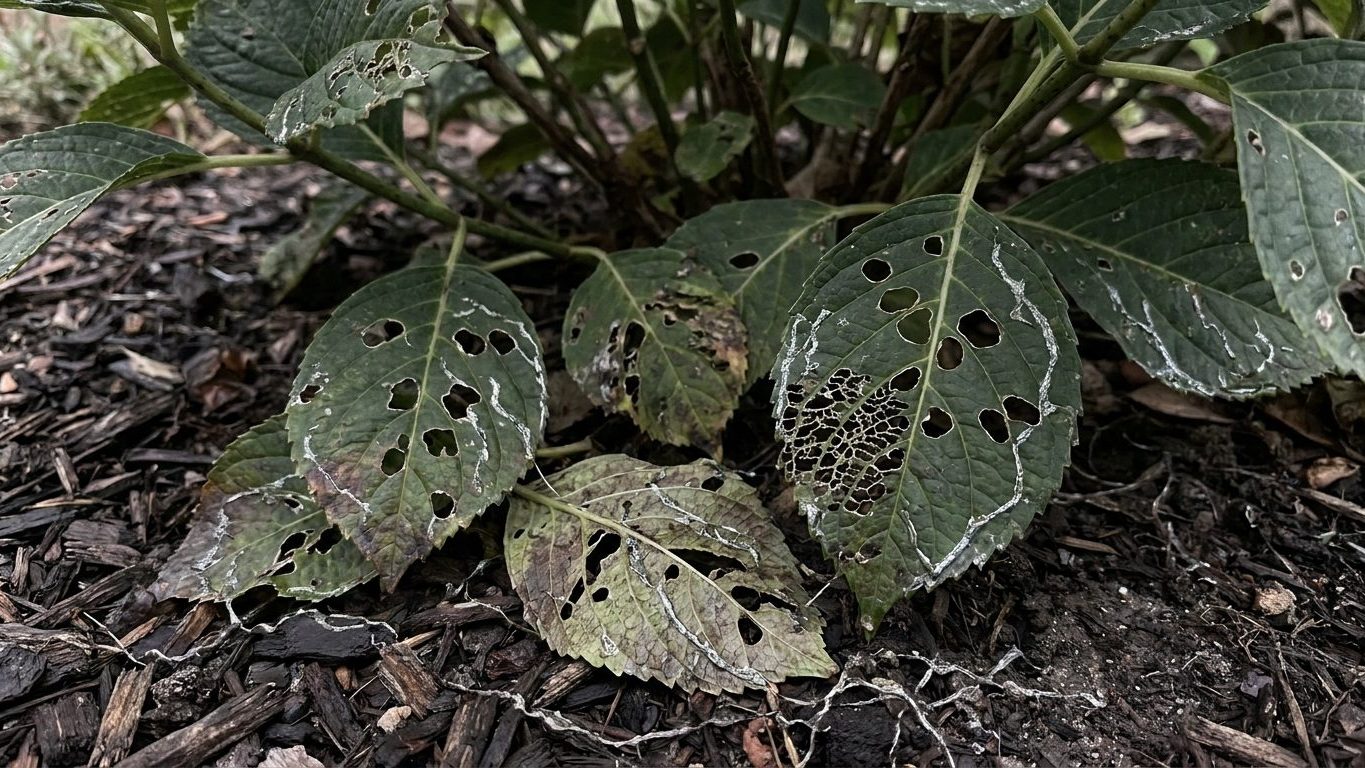

Slugs and snails chew irregular holes with smooth, rounded edges into hydrangea leaves, and they almost always start at the bottom of the plant. The silvery slime trail left behind is the single detail that separates them from every other leaf-chewing pest on this plant. On an established shrub, the damage is cosmetic. On a seedling or a fresh transplant, it can slow the plant down enough to matter.
What the damage looks like
Look at the lowest leaves first, the ones closest to the soil or mulch line. That is where slugs and snails do almost all of their feeding, because they rarely climb far from the damp, sheltered ground they hide in during the day. The holes themselves are irregular in shape, not neat circles, and the edges are smooth rather than jagged or torn. Some leaves end up with just a few scattered holes; others, especially on young plants, get chewed down to lace-like remnants along the veins.
The tell that separates this damage from insect feeding is the slime. A dried, silvery trail crossing the leaf surface, sometimes leading right up to the hole itself, is the fingerprint of a mollusk rather than a beetle or caterpillar. Check in early morning, before dew evaporates or before you have watered, and the trail is usually still visible. On overcast or rainy mornings it shows up even more clearly.
Severity depends heavily on the plant’s stage. A mature bigleaf, panicle, oakleaf, smooth, mountain, or climbing hydrangea has enough leaf area and enough distance between the ground and its lower canopy that a few slugs barely register. A newly planted specimen or a rooted cutting, by contrast, has very little foliage to spare, and heavy feeding on its first-season leaves can set the whole plant back. This is worth knowing before reaching for any control: the same amount of chewing means very different things depending on what you are looking at.
Feeding tends to concentrate near the crown, where humidity stays highest and hiding spots (mulch, dense groundcover, the underside of low-hanging leaves) are closest. As the season goes on and the lower canopy gets larger, some of the oldest, most-chewed leaves may simply be shaded out or shed, which is normal and not a sign the problem is spreading upward.
Making sure it is this and not something else
Three other culprits leave chewed hydrangea foliage, and each has a giveaway that a slime trail settles instantly.
Japanese beetles
These feed during the day, in full view, and they skeletonize leaf tissue between the veins rather than punching through holes. If you see the beetles themselves clustered on upper leaves in daylight, and the damage looks like lace with intact veins, this is not a mollusk problem.
Caterpillars
Caterpillar feeding leaves chewed margins and notches rather than holes in the middle of the leaf, and it comes with a signature clue: small, dark, pellet-shaped frass on the leaf surface or on the soil below. No slime, no smooth-edged holes in the leaf interior.
Earwigs
This is the closest look-alike. Earwigs also feed at night and also leave irregular holes. The difference is the absence of slime trails, since earwigs are insects, not mollusks. A flashlight check after dark settles it: earwigs are fast-moving, reddish-brown, and pincer-tailed, while slugs and snails move slowly and are unmistakable once spotted.
The reliable test, in every case, is the same: go out at night with a flashlight, an hour or two after dark, and look at the lowest leaves directly. If you see the animal, you have your answer. If you only see damage, the dried slime trail the next morning is the next-best confirmation.
When it shows up
Slug and snail feeding tracks moisture and tender new growth, not a date on the calendar. It shows up heaviest whenever the plant is pushing new leaves and the soil surface stays damp, whether that is because of rain, irrigation, or heavy mulch. A hydrangea coming out of dormancy with soft, expanding foliage is at its most vulnerable stage, since that tissue is easier to chew than mature, toughened leaves.
Newly planted stock and rooted cuttings are at risk for longer, simply because every leaf they have is young and tender until the plant builds real size. An established shrub, once its lower leaves have hardened off through a full growing season, becomes far less appealing to slugs even though it sits in the exact same bed.
Conditions matter more than timing. Dense mulch, thick groundcover, overcrowded plantings, and a habit of watering in the evening all extend the hours of surface moisture that slugs and snails need to move around and feed. A bed that dries out by midday, even in a warm and humid region, sees far less feeding than a shaded, consistently damp one. Since both bigleaf and panicle hydrangeas are shallow-rooted and genuinely benefit from a mulch layer, gardeners in humid climates end up managing a real trade-off between root protection and pest harborage, addressed directly in the next section.
Whether your hydrangea is one that flowers on old wood or on the current season’s growth has no bearing on slug behavior. What matters is simply whether the plant currently has soft new leaves near a moist soil surface.
What to do now
- Hand removal at night. Go out with a flashlight an hour or two after dark, when slugs and snails are actively feeding, and pick them off by hand into a bucket of soapy water. This costs nothing and, repeated over several nights, noticeably reduces the population on a small planting.
- Traps and shelters. A board, an overturned flowerpot, or a shallow container laid on the soil near the hydrangea gives slugs a daytime hiding spot. Check under it each morning and remove what you find. This works because it exploits the exact behavior that makes them hard to spot during the day.
- Dry out the surface. Pull mulch back a few inches from the crown and lower stems, water in the morning rather than the evening, and thin overcrowded lower growth to let air move through. Less overnight surface moisture means less slug activity without touching a single product.
- Physical barriers. A band of diatomaceous earth or copper tape around the base of vulnerable young plants is a widely used barrier method. Diatomaceous earth needs reapplying after rain or heavy watering, since it works by abrasion and stops functioning once wet.
- Encourage natural predators. Ground beetles, birds, and toads all feed on slugs and snails, and a broad-spectrum insecticide aimed at some other hydrangea pest can wipe out these predators along with it. Avoiding unnecessary spraying is itself a form of slug control.
- Iron phosphate bait, as a last resort. This is the bait most readily available to home gardeners and is generally considered safer around pets and wildlife than older metaldehyde-based products, which carry real pet-toxicity concerns and are restricted in some states. Use it sparingly, scattered rather than piled, and only where hand removal and habitat changes have not been enough.
Stopping it coming back
- Keep mulch a few inches back from the stems and crown, thick enough to protect the shallow roots of bigleaf and panicle types but not banked up against the plant itself.
- Water hydrangeas in the morning instead of the evening, so the soil surface has all day to dry before nightfall, when slugs are active.
- Clear away boards, dense debris, and thick fallen leaf litter near the base of the plant, since these are exactly the daytime hiding spots that let populations build up unnoticed.
- Inspect new transplants and nursery pots before planting; slugs and their eggs travel easily in root balls and potting mix.
- Leave some open, sunnier ground nearby rather than solid groundcover right up to the hydrangea, so the bed as a whole dries out faster after rain.
- Leave dead hollow hydrangea stems standing at 12 to 24 inches over winter for native bees, and rely on the ground beetles and birds this kind of undisturbed habitat also supports, rather than reaching for a broad-spectrum spray at the first sign of a hole.
Common questions
Do slugs and snails kill hydrangeas?
Rarely. On an established shrub the damage stays limited to lower leaves and is cosmetic. It becomes a real threat only on seedlings, rooted cuttings, or very young transplants that have little foliage to spare.
Does the type of hydrangea matter for slug damage?
No. Bigleaf, panicle, smooth, oakleaf, mountain, and climbing hydrangeas are all fed on the same way, since slugs respond to moisture and tender new growth rather than to species. Type only matters for pruning timing and cold hardiness, not for this particular pest.
Are coffee grounds or eggshells a real slug control?
They are a widely repeated home remedy, not a proven barrier. Diatomaceous earth and copper tape have a more consistent track record as physical deterrents, and both need to be reapplied or checked after rain.
Is hydrangea toxicity to pets connected to slug damage?
No, that is a separate issue. Only bigleaf hydrangea (H. macrophylla) is documented as toxic if eaten in quantity, causing nausea, stomach pain, vomiting, and sweating in pets and horses. This has nothing to do with slug or snail feeding, but it is worth knowing when choosing which bait or barrier product to use near pets in the same bed.