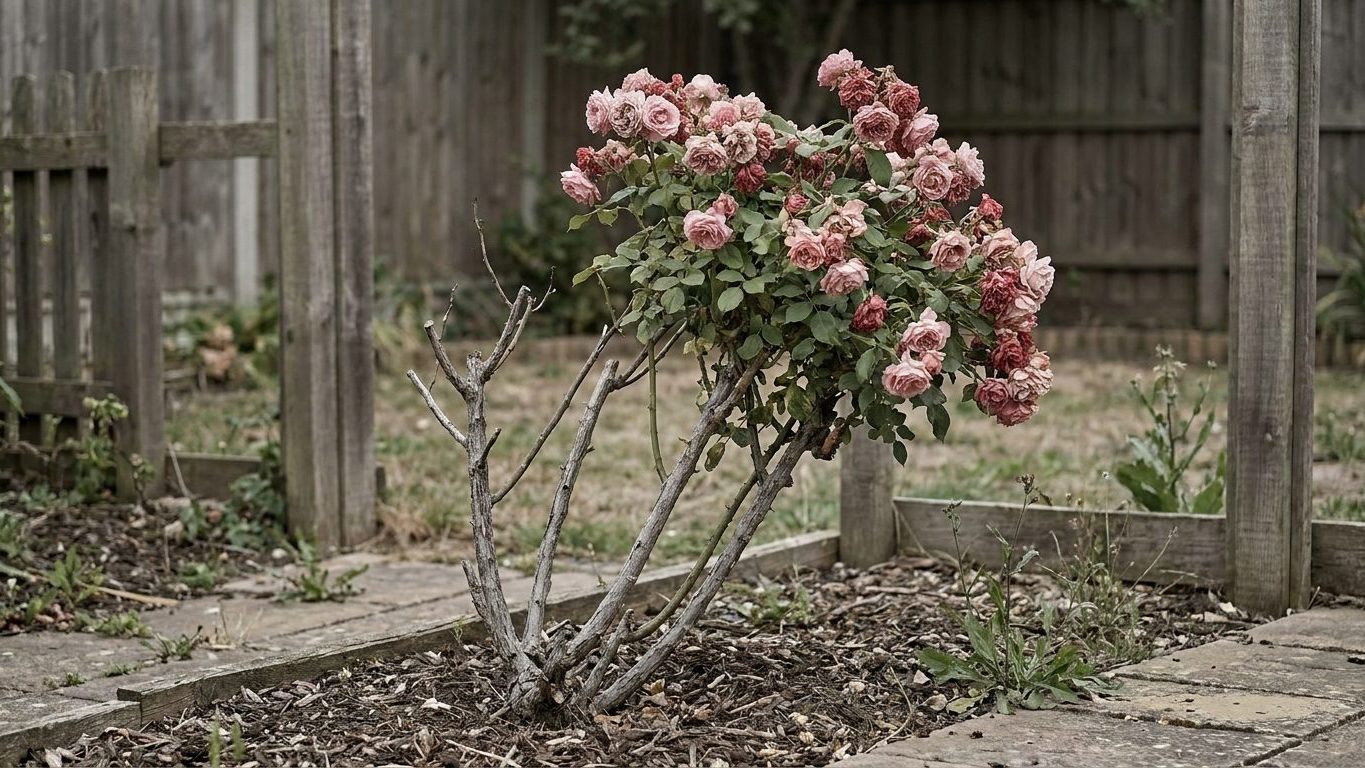

A leggy rose has thick, bare canes at the bottom and all its leaves and flowers crowded near the top, like a shrub standing on stilts. It is not a disease, and it will not kill the plant, but left uncorrected it gets worse every year and eventually the bloom show suffers because the plant is putting energy into height instead of branching.
What you are looking at
Look at the lower 12 to 24 inches of the canes. If they are woody, thick, and completely bare of leaves while everything green and flowering sits above that line, that is classic legginess. The bare wood is usually tan to gray-brown and firm, not black or shriveled. Buds along that bare section, the small swollen nodes where new shoots should emerge, look dormant or flattened rather than dead.
The progression is gradual. In the first year, a rose that is going leggy just looks a little thin at the bottom, with fewer leaves low down than up top. By the second year without correction, the lower leaves drop entirely and the inner canes start shading each other out. By the third year, the base is fully bare and the plant has taken on a top-heavy, almost tree-like shape, with blooms nodding on long stems far above eye level.
Do not confuse this with cane dieback, where the wood itself turns black or dark brown and feels soft or papery. Dieback signals frost damage, cane borers, or fungal canker, and it is a different problem with a different fix. Also distinguish it from rose replant disease, where the whole plant is stunted and pale, not just bare at the base while thriving up top. A leggy rose is otherwise healthy. It flowers, it grows, it just grows in the wrong place.
What actually causes it
The mechanism is apical dominance. A rose cane produces a hormone called auxin at its growing tip, and that hormone travels down the stem suppressing the buds below it. As long as a cane is never cut back, the tip keeps winning and the lower buds stay dormant indefinitely. This is a hormonal effect, not a trait certain rose types are simply born with, and that is where the common explanation goes wrong.
Gardeners often blame the variety, saying hybrid teas or climbers are “naturally leggy.” That is a myth built on a real pattern: those types are also the ones most often left unpruned or lightly pruned, so the apical dominance effect has years to compound. A hybrid tea that gets hard-pruned every dormant season branches low. One that only gets deadheaded does not.
Several other factors produce the same bare-bottom look, and it helps to know which one you are dealing with because the fix differs slightly.
| Cause | Where legginess shows | Companion clue |
|---|---|---|
| No annual hard pruning | Bare on all sides, bottom third | Canes over 1 inch thick, never cut low |
| Shade competition | Bare on one side only | Fence, shrub, or wall blocking that side |
| High-nitrogen fertilizer | Lush thin growth up top, weak lower stems | Recent lawn feed runoff or heavy spring feeding |
| Overcrowding | Bare where it touches a neighboring plant | Roses spaced closer than 3 feet apart |
Old canes make it worse regardless of cause. Once a cane passes about three years of age, its wood lignifies and its capacity to push new basal shoots drops sharply, which is exactly why renewal pruning targets the oldest canes first.
What to do now
Nothing will bring foliage back to this season’s bare lower canes. Those nodes are dormant, not injured, so the fix is not a rescue treatment, it is a pruning schedule that starts at the next dormant season. If you are looking at this mid-growing season, resist the urge to hack the plant back now. A hard cut during active growth stresses the plant and can trigger weak, frost-tender regrowth late in the season.
What you can do right now is a light corrective pass: remove no more than a third of the canopy, cut out any crossing or inward-growing canes to open up the center, and let more light reach the lower part of the plant. This will not force new basal shoots this year, but it sets the plant up better for the dormant prune.
Let this season’s flowers finish at the top. Deadheading them will not push bloom lower down since those lower nodes are already suppressed, so deadhead mainly to keep the plant tidy and to redirect a little energy into cane and root development rather than seed production.
The real correction happens over the next one to two dormant seasons. Each winter, cut roughly a third of the oldest, thickest canes down to 6 to 12 inches from the base. This removes the apical dominance those canes were exerting and forces the crown to push new shoots from low buds. Repeat this rotation for two to three years and the bare zone fills in from the bottom up, cane by cane, rather than all at once.
What does not work
Pinching just the top growth tips does not solve this. It temporarily interrupts one cane’s dominance, but the plant simply shifts apical growth to the next highest bud, and the bare lower section stays exactly as bare. To break dormancy at the base, the cut has to go low, not just off the tip.
Extra fertilizer to “push new growth” is one of the most common mistakes, and it actively makes things worse. Nitrogen feeds whichever growth is already dominant, which is the top of the plant, so a heavy feeding schedule on a leggy rose tends to produce even more top growth and does nothing for the base. Fertilizer cannot override a hormonal signal.
Staking or bending lower canes to expose them to more light sounds logical but does not restore bud viability once those nodes have gone fully dormant. Light helps a plant that already has some basal activity, but it cannot wake up a bud that stopped responding years ago.
Mounding mulch or soil around the base to physically hide the bare canes is a cosmetic fix some gardeners try, sometimes called hilling. It does not change the plant’s growth pattern, and piling material against the crown raises the risk of crown rot, particularly in wet climates. Planting low shrubs in front of the bare legs disguises the problem rather than correcting it, and if those companion plants shade the rose’s lower canes further, they can make future legginess worse, not better.
Preventing it next time
The single most effective habit is a dormant-season hard prune done every year without skipping, cutting a rotating third of the oldest canes down to 6 to 12 inches from the base. This repeatedly interrupts apical dominance before it has years to compound, and it outperforms every other prevention step combined, including fertilizing schedules and spacing adjustments.
Spacing matters next. Give hybrid teas and floribundas at least 3 to 4 feet of separation, and give climbers and larger shrub roses more, so that direct sun reaches at least half the lower cane length each day. A rose shaded on one side by a fence or a bigger shrub will go leggy on that side no matter how well you prune.
Hold off on heavy nitrogen feeding in early spring, before the first pruning cut. Feed after the first bloom flush instead, when the plant has already committed to lower branching for the season. In colder growing zones, own-root roses have an advantage over grafted ones for this specific problem: an own-root plant can push new basal canes directly from the crown even after a hard winter, while a grafted rose depends on the graft union staying healthy to regenerate low growth at all.
Common questions
Can a leggy rose be cut all the way to the ground?
Cutting to ground level is more severe than needed and risks killing a grafted rose if the cut goes below the graft union. The standard renewal approach cuts the oldest third of canes to 6 to 12 inches from the base each dormant season, not the whole plant at once.
How long does it take a leggy rose to fill back in?
Expect a gradual fill over two to three dormant-pruning cycles rather than a single-season fix, since each cycle only targets a third of the old canes at a time.
Are climbing roses supposed to be leggy at the base?
No. Climbers get blamed for natural legginess, but the bare base comes from the same apical dominance mechanism as any other rose, worsened by the fact that climbers are often trained upward and rarely pruned low.
Does deadheading help with legginess?
Deadheading keeps the plant tidy and redirects some energy from seed production, but it does not reach the dormant lower buds, so it will not correct a bare base on its own.