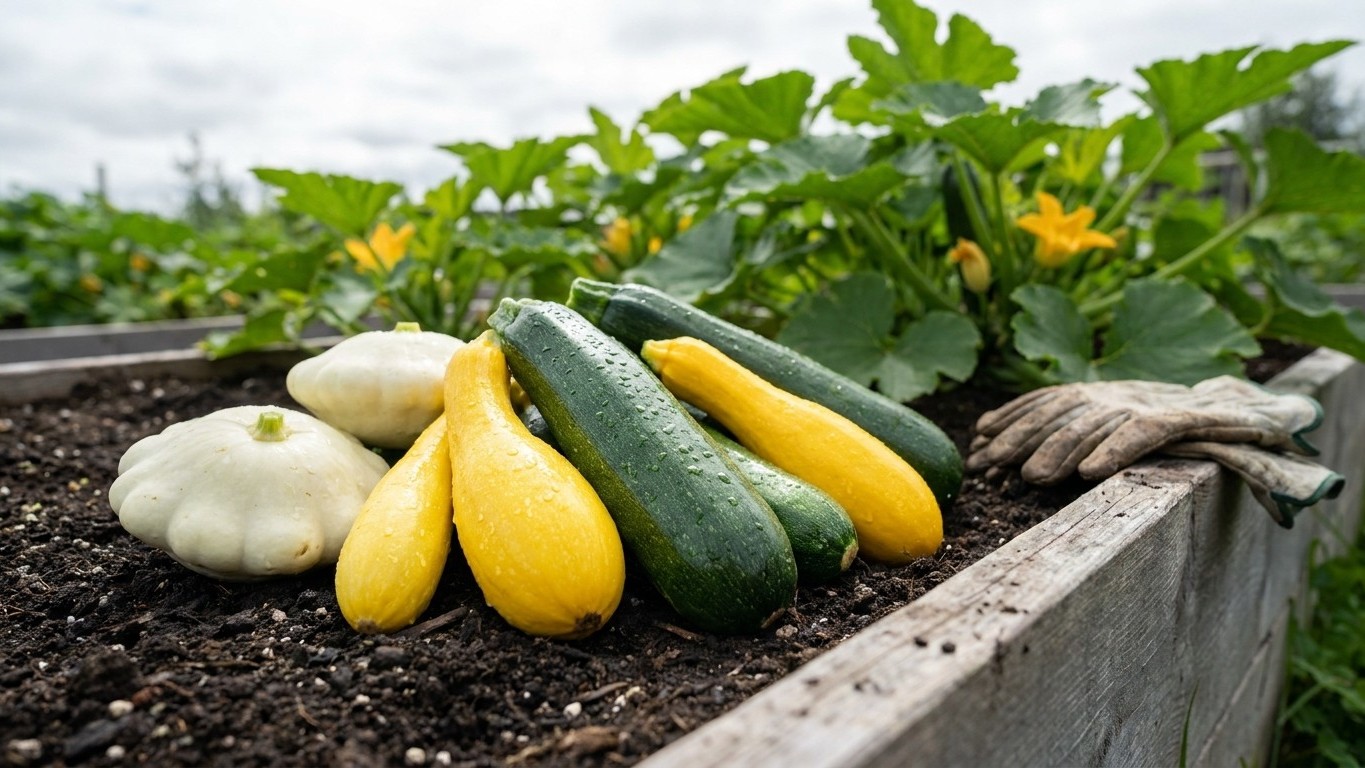

Bush-type zucchini, yellow straightneck and crookneck, and pattypan squash all mature comfortably within Minnesota’s growing window. The state’s season length isn’t the limiting factor for summer squash the way it is for melons or long-season winter squash. What actually separates a good harvest from a disappointing one here is disease pressure and watering timing, not the calendar.
The short answer for Minnesota
Start with the window itself. Minnesota’s last spring frost falls between April 17 and April 30, and the first fall frost arrives between October 11 and October 23, depending on where in the state you garden. Take the tightest combination, a late spring frost and an early fall frost, and you still get roughly 164 frost-free days. In the mildest stretch, that number climbs closer to 189 days. Either way, it’s a wide margin for a crop that typically fruits within six to eight weeks of sowing.
That’s the piece worth sitting with: summer squash isn’t fighting the clock in Minnesota. A gardener could direct-sow, wait for a poor germination stretch, replant, and still bring in a full crop before the first hard freeze. This changes the decision entirely. Instead of asking “which variety matures fastest,” the better question for this state is “which variety holds up through a Minnesota summer’s specific conditions.”
Those conditions are moderate heat and a humid, front-loaded rain pattern. The reference station near Minneapolis averages just 10.6 days a year at or above 90°F, a mild heat load compared to states further south. Heat-tolerant varieties bred for scorching, dry climates aren’t buying much here. What matters more is the roughly 13 inches of rain that falls across June, July, and August, arriving unevenly and often as thunderstorms rather than steady soakings.
Put those two pieces together and the type-level decision becomes clear: bush varieties with some bred resistance to powdery mildew are the safer statewide bet, over vining or trailing types that sprawl into denser, less ventilated foliage. Zucchini, straightneck, crookneck, and scallop-type pattypan squash all fall into the bush category and all fit Minnesota’s season with room to spare.
What will not work here
Direct-sowing too early is the most common way a Minnesota gardener loses a squash crop before it starts. Squash seed needs warm soil to germinate reliably, and with the last frost running as late as April 30 in parts of the state, soil temperatures in early May are still cold enough to rot seed rather than sprout it. Waiting until mid-May, even with the frost date technically past, gives the soil time to catch up.
Long-season vining or trailing summer squash types, the kind that need extra weeks to sprawl and set a full crop, cut the margin closer than they need to in the northern part of the state. Northern Minnesota’s frost dates run two to three weeks tighter at both ends than the Twin Cities reference point. A variety that’s comfortable in a 189-day season can lose real harvest time in a 140-day one further north.
Watering on a fixed weekly schedule doesn’t match how rain actually falls here. July, the driest summer month, averages only 4.06 inches, and much of what does fall arrives as a single storm that runs off a dry surface rather than soaking into the root zone. Combine that with 10.6 days a year pushing past 90°F, driving faster evaporation, and a once-a-week watering habit leaves squash roots dry for stretches even in a summer that looks wet on paper.
Close spacing, sometimes suggested for gardeners short on room, works against the humidity load rather than with it. Tight plantings trap moisture around the leaves longer after a rain, and that’s exactly the environment powdery and downy mildew need to take hold, especially as August nights cool and dew lingers longer on foliage. Wide spacing and airflow do more for a Minnesota squash patch than any single variety choice.
What changes across Minnesota
Minnesota spans USDA hardiness zones 3a to 5a, a range built on average annual extreme minimum temperature. That’s a two-zone spread inside one state, and it means there’s no single planting answer that fits a garden in International Falls the same way it fits one in the Twin Cities.
| Zone band | General position | Practical shift for squash |
|---|---|---|
| 3a | Far northern Minnesota | Frost window runs two to three weeks tighter both ends; favor the fastest bush varieties and consider starting seed indoors three to four weeks before transplant |
| 4a-4b | Central Minnesota | Middle ground; standard bush varieties direct-sown once soil warms should finish comfortably |
| 5a | Twin Cities and southern Minnesota (reference point for the frost dates above) | Widest margin; room for succession sowings of any bush type through midsummer |
A gardener in the northern third of the state should shift toward transplants rather than direct seed, since it buys back the weeks a tighter frost window takes away. Black plastic mulch or row cover early in the season also helps push soil temperature up faster, which matters more in a zone 3a garden than in a 5a one where the ground warms on its own by mid-May.
None of this replaces knowing your actual zone. The USDA Plant Hardiness Zone Map is the tool built for that, and it’s worth checking directly rather than guessing from a regional description, since the difference between 3a and 5a changes both the planting date and the variety type worth prioritizing.
Where to check this for your own county
This page describes Minnesota as a whole, built from statewide climate normals. A county sits inside one of those zone bands, not across all of them, and that’s a meaningful difference for anyone planning an actual planting date.
The University of Minnesota Extension, at extension.umn.edu, is the source built for that narrower answer. Two things are worth looking for once there: a county-level or regional planting calendar, which will translate the statewide frost range into dates specific to that area, and any variety trial results for summer squash conducted in Minnesota conditions. Extension trials test how varieties actually perform against local disease pressure and rainfall patterns, which is more useful than a seed catalog description written for a national audience.
A county recommendation will always outrank a state one. This page can tell a reader that bush varieties with mildew resistance make sense given Minnesota’s rainfall pattern and moderate heat; it can’t tell a reader in Cook County the exact week to put seed in the ground, because that week differs from the exact week that works in Winona County. That gap is what county extension data is for.
Checking this against your own garden
Every date and range on this page is a normal built from 1991-2020 averages at one reference station. A reader’s own garden, on its own soil, in its own microclimate, will confirm or contradict those normals faster than any recalculation can.
Soil warmth by feel is the first check. Squash seed wants soil that feels warm to bare skin at a couple inches deep, not just air temperature that’s cleared the frost line. If the soil still feels cool in mid-May despite a mild forecast, that’s a local signal worth trusting over the calendar date.
The first flush of male flowers is the second. Squash plants typically produce male flowers before female ones, and a strong early flush tells a gardener the plant has moved past establishment and into active growth, which is a better sign of readiness for full sun and regular watering than counting days since sowing.
The first true leaves, the ones that appear after the initial seed leaves and actually look like squash foliage, mark the point where a plant’s water needs jump. That’s the moment to start watching soil moisture closely rather than watering on a fixed schedule, since a plant with true leaves pulls water at a different rate than a seedling does.