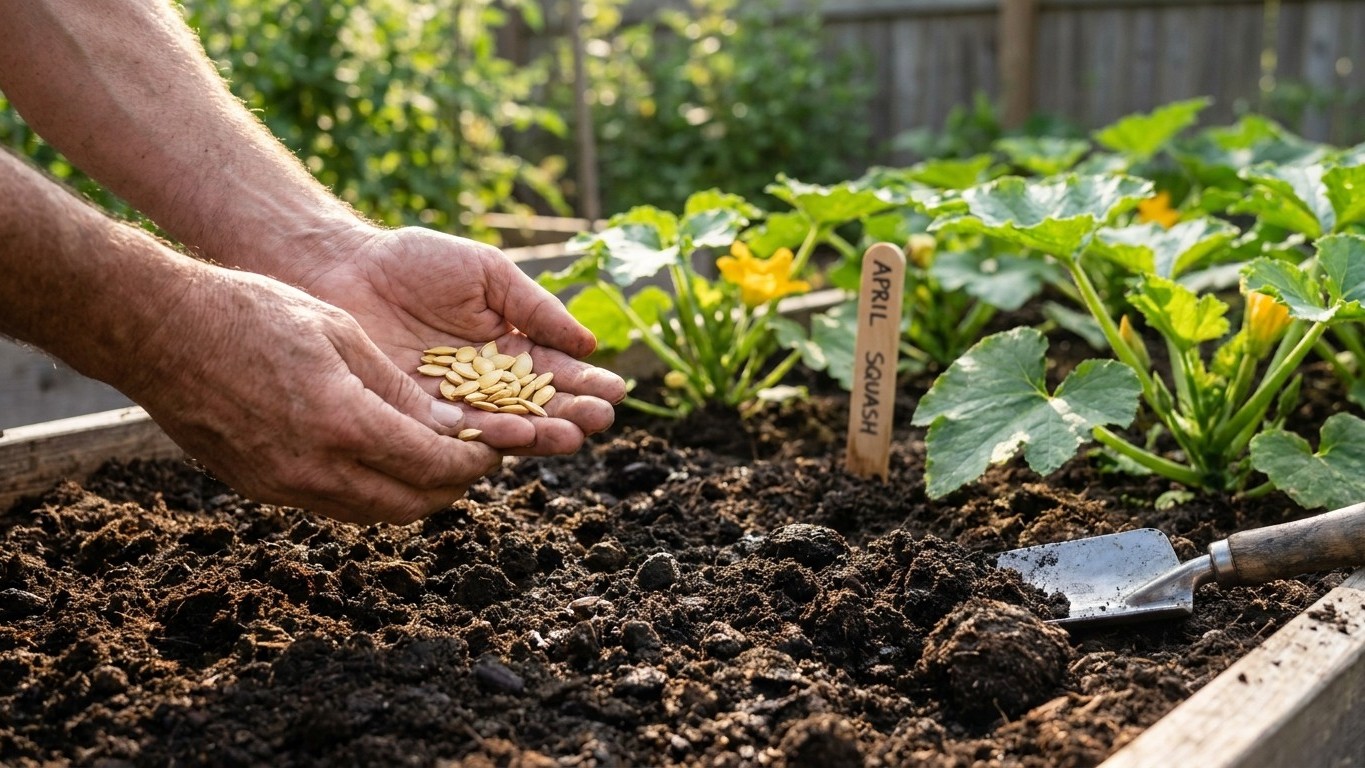

Sow summer squash outdoors in Minnesota once the soil has warmed past the last spring frost window of April 17 to April 30, and stop counting on new plantings by early-to-mid July to leave enough time before the first fall frost, which lands between October 11 and October 23. Those frost dates are probabilities, not fixed calendar lines, and that distinction matters more than the dates themselves.
The short answer for Minnesota
The April 17 to April 30 window and the October 11 to October 23 window both come from NOAA’s 1991-2020 Climate Normals, and they describe a 30-70% probability band for a 32F freeze at the reference station near the Twin Cities. That means a frost has a meaningful chance of happening on either side of those dates too. A gardener who plants squash on April 18 because it falls inside the “last frost” window is still gambling against roughly a coin-flip or worse of a freeze that would kill young seedlings outright.
Summer squash is one of the least frost-tolerant crops in a Minnesota garden. A single night at or near 32F sets back or kills seedlings, and cold soil below the mid-50s Fahrenheit rots seed before it germinates. Because of that, most Minnesota gardeners treat the last-frost window as a floor, not a target, and wait until soil has had a week or two of real warmth before direct sowing or transplanting.
On the fall side, the October 11 to October 23 window sets the other boundary. Squash plants stop producing usable fruit once nights turn cold and growth slows well before an actual freeze, so the practical cutoff for a final sowing sits weeks earlier than the frost date itself. Counting backward from mid-October, a last direct sowing in early-to-mid July gives a planting enough of the growing season to reach a harvestable size before the cold shuts things down.
Between those two windows, Minnesota’s summer heat load matters as much as the frost dates. The reference station averages 10.6 days a year at or above 90F, concentrated in July, which happens to be the driest of the three summer months at 4.06 inches of rain against 4.58 in June and 4.34 in August. That combination, a short run of intense heat days landing in the driest month, is the detail that separates a planting calendar that works on paper from one that survives an actual Minnesota July.
This page gives the state-level picture built from a single reference station. It is not a substitute for a county-level recommendation, and the sections below explain both why the state figures move around inside Minnesota’s borders and where to find the number that applies to a specific county.
What will not work here
Treating the last-frost window as a green light is the first failure. April 17 still carries real frost risk in a 30-70% probability band, and squash seed planted into soil that hasn’t cleared the mid-50s Fahrenheit will sit and rot rather than germinate. Waiting an extra one to two weeks past the window’s start costs almost nothing against the season length available, and it avoids the replant that colder, earlier sowings usually force anyway.
Watering on a weekly schedule
A once-a-week watering habit, common advice in gardening guides written for milder or wetter regions, does not hold up against 10.6 average days a year at 90F or hotter concentrated in Minnesota’s driest month. Squash has shallow, wide-spreading roots that dry out fast under sustained heat, and July’s 4.06 inches of rain, the lowest of the three summer months, arrives more often as short thunderstorms than as steady soaking rain. A single storm cell can drop half an inch in twenty minutes and run straight off a dry, compacted surface instead of reaching the root zone. A weekly check-in rather than a weekly watering is the safer habit here: water when the soil actually calls for it, not on a fixed schedule.
Tight spacing built for a drier climate
Minnesota summers combine real heat with real humidity, and that pairing favors powdery mildew and other fungal pressure on squash leaves. Spacing recommendations copied from a drier western state, where wide-open plants can sit closer without consequence, tend to trap moisture and slow airflow here. Wider spacing than a seed packet’s minimum, and watering at the soil line rather than overhead, both cost little and matter more in a state with this rainfall and heat profile.
Pushing a final sowing past early-to-mid July into the space that looks open before the October frost window is the last common misstep. The plant may germinate and grow, but it runs out of warm, productive days before it reaches useful harvest size, and a frost arriving anywhere in the October 11-23 range ends it regardless. The calendar has room on paper for a later planting; the actual growing conditions do not.
What changes across Minnesota
Minnesota’s USDA hardiness zone range, 3a to 5a under the USDA Plant Hardiness Zone Map’s 2023 edition, spans nearly the full width of the system’s cold-hardiness scale used across the northern United States. That is not a small spread. It reflects a state where a garden near the Iowa border and a garden near the Canadian border can experience genuinely different growing seasons, even though both fall under the same state-level planting guidance.
The frost windows cited above, April 17-30 for the last spring frost and October 11-23 for the first fall frost, come from a reference station representing the milder southern part of the state, near the Twin Cities. Northern Minnesota runs measurably tighter at both ends of the season, with spring frost risk lingering two to three weeks longer into the calendar and fall frost arriving two to three weeks sooner. A gardener working land near the northern part of the state should expect a growing season that closes on both ends compared to the dates given here, not just a slightly cooler version of the same window.
That squeeze compounds against summer squash’s already tight fall cutoff. A planting schedule built entirely around the Twin Cities dates in this article could leave a northern garden with too little time between a delayed safe sowing date and an earlier real frost, even though both gardens are technically “Minnesota.”
| Factor | Southern MN (reference station) | Northern MN (general pattern) |
|---|---|---|
| Last spring frost | April 17-30 | Roughly 2-3 weeks later |
| First fall frost | October 11-23 | Roughly 2-3 weeks earlier |
| Hardiness zone range | Upper end of state range | Lower end of state range |
This page cannot say which zone or which frost pattern applies to any individual reader’s own address; that requires a location lookup on the USDA’s zone map, not a guess based on which end of the state feels closer. What it can say is that a single state-wide planting date, treated as gospel from the Iowa line to the Canadian border, will be wrong for a meaningful share of Minnesota gardeners in one direction or the other.
Where to check this for your own county
The University of Minnesota Extension, at extension.umn.edu, is the source that turns this state-level picture into something usable on an actual property. A state figure, built from one reference station, is a starting point. A county-level recommendation, built from local extension staff and county master gardener trial data, is the number that actually accounts for the local soil, elevation and microclimate a state page can’t see.
Two things on that site are worth searching out specifically. The first is a local or regional planting calendar, if the county or nearby county office publishes one, since these usually adjust the general state guidance for the specific frost pattern and season length of that part of Minnesota rather than defaulting to the Twin Cities dates used here. The second is any list of squash varieties trialled through University of Minnesota research or county master gardener programs, since a variety proven to perform in that county’s actual growing season carries more weight than a generic seed-catalog description written for a national audience.
A county extension office can also answer the question this page structurally cannot: which hardiness zone, which frost dates and which local rainfall pattern apply to one specific address, rather than to the state as a whole. That’s a difference worth taking seriously rather than treating as a formality. A gardener near the North Shore and a gardener near Rochester are both reading the same state guidance, but their actual planting windows, drawn from the range described in the section above, can differ by a matter of weeks in both directions. The state page, this one included, gives the average; the county contact gives the number that applies to an actual plot of ground.
Some gardeners also time this by the Moon: when to plant zucchini by the moon, as almanac tradition rather than fact.
Checking this against your own garden
Every date in this article describes an average built from three decades of weather records at one station. A reader’s own garden, on its own soil, in its own microclimate, will sometimes run ahead of that average and sometimes behind it, and three simple observations settle the question better than any calendar entry.
Soil warmth by feel is the first and most direct check. Squash seed wants soil that feels warm and dry to the hand, not cool and damp, when pressed a couple of inches down; a garden that still feels cold at the state’s suggested sowing time is telling the gardener to wait regardless of what the calendar says, and a garden that already feels warm ahead of schedule, common on raised beds or south-facing slopes, is signaling it’s safe to move earlier.
The first flush of male flowers is the second marker. Squash plants typically produce male flowers before female ones, and their appearance is a sign the plant has settled into active growth rather than still recovering from transplant shock or cool weather. A garden that reaches this stage well ahead of or behind the general seasonal pattern is revealing something about its own particular warmth, exposure or soil drainage that no regional average could predict.
The first true leaves, the second set that appears after the rounded seed leaves, mark the point where a young plant has real root and leaf structure established. Slow, stalled growth to this stage under otherwise normal spring weather usually points to soil that’s still colder or wetter than it looks on the surface, which is often a more useful piece of information for next year’s timing than any date printed on a page.