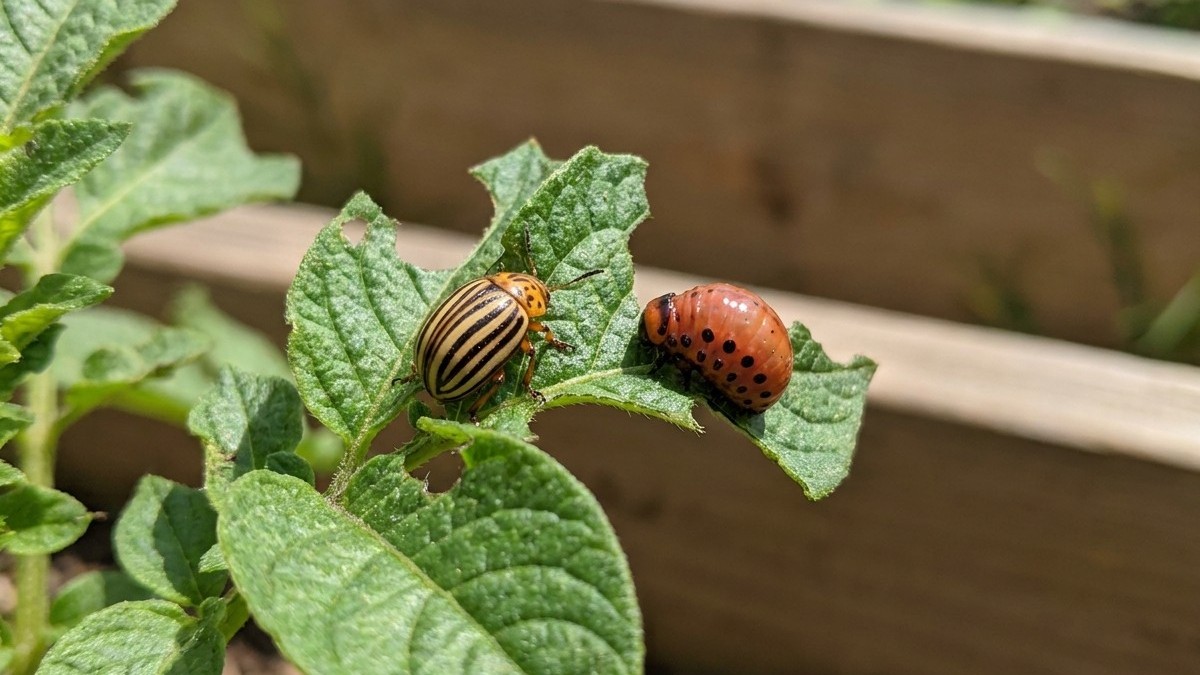

University of Hawaii CTAHR Extension documents eight pests on vegetable crops in the islands, but only some of them actually feed on potato. Aphids, beet armyworm, Chinese rose beetle, leafminers, southern green stinkbug, mites, and whiteflies all show up on potato foliage at some point in the season. The rest on that list belong to other crops entirely, and knowing which is which saves you from spraying for a bug that was never going to touch your potato patch.
Which pests attack potato in Hawaii
The University of Hawaii CTAHR Extension lists eight pests for vegetable growers across the state: Aphids, beet armyworm, cabbage webworm, Chinese rose beetle, leafminers and bean fly, melon fly, southern green stinkbug and mites, and whiteflies. That’s the full documented set for this territory, and it isn’t a long one. No leaf beetle, no wireworm, no scab organism appears on it, so this page won’t invent one either.
Not every name on that list belongs on a potato plant, though. Cabbage webworm feeds on cole crops, the cabbage family, and has no business on a Solanaceous crop like potato. Melon fly targets cucurbits, meaning melons, cucumbers, and squash, so a potato grower can cross that one off. Bean fly, paired with leafminers on the CTAHR list, is specific to legumes and doesn’t attack potato foliage the way its listmate leafminers do.
What’s left for potato growers is Aphids, beet armyworm, Chinese rose beetle, leafminers, southern green stinkbug, mites, and whiteflies. Aphids and whiteflies are sap feeders that cluster on the undersides of young leaves and can spread plant viruses between plants as they move. Beet armyworm and Chinese rose beetle chew through leaf tissue, the armyworm as a caterpillar working from the edges inward, the rose beetle as an adult beetle that feeds mostly after dark. Southern green stinkbug pierces stems and developing tissue to feed, and mites scrape at leaf surfaces, leaving a stippled, dusty look behind.
That’s six pests worth watching on a Hawaii potato bed, out of the eight CTAHR documents statewide. It’s a short list, and it stays that way here rather than getting padded with pests that belong to somebody else’s crop.
When each one shows up, and what it does first
Hawaii doesn’t run on a frost calendar the way most of the mainland does. NOAA’s 1991-2020 climate normals for station USW00022521 show zero days per year at or below 32°F, with every frost percentile marked not-computable. There is no frost season in lowland Hawaii at all; frost only happens on the high volcanic summits of Mauna Kea, Mauna Loa, and Haleakala, nowhere near a home garden. That means the timing of pest pressure here tracks rainfall, elevation, and whether a plot sits on the windward or leeward side of an island, not a spring thaw date.
Aphids and whiteflies tend to be the first sign of trouble on young potato plants, showing up on the undersides of new leaves not long after the plants are established. The first visible clue is usually curled or slightly puckered new growth, sometimes with a shiny, sticky residue on the leaf surface underneath the colony. Leafminers follow a similar early pattern but leave a different signature: thin, winding pale trails tunneled through the leaf tissue itself rather than a cluster of insects on the surface.
Chinese rose beetle damage tends to appear as the plant fills out its canopy, and it looks like someone took a hole punch to the leaves, rounded chewed-out gaps scattered across otherwise healthy foliage, worst at night when the beetles are active. Beet armyworm caterpillars leave ragged, larger feeding holes and can strip a leaf down to its veins if a population builds unchecked, usually starting on lower, older leaves before moving up the plant.
Southern green stinkbug and mites tend to show later, once the plant has more mature tissue and, for stinkbugs, developing structures to feed on. Stinkbug feeding leaves small discolored or sunken spots at the feeding site, while mite damage shows up as a fine, dusty stippling across the leaf surface that can eventually give the whole leaf a bronzed look under heavy pressure.
Telling the damage apart from everything else
Insect feeding gets blamed for a lot of symptoms that have nothing to do with an insect. The decisive sign is where the damage sits on the plant: uniform yellowing across the whole leaf, or across every leaf at once, almost always points away from insects and toward water or nutrient stress instead. Insect feeding tends to be patchy, concentrated on new growth, or tied to a visible hole, trail, or stippled patch you can point to.
A quick comparison
| What you see | Likely cause | What tells them apart |
|---|---|---|
| Curled, puckered new leaves with sticky residue | Aphids or whiteflies feeding | Insects visible on leaf undersides; residue is sticky, not dusty |
| Winding pale trails inside the leaf | Leafminer tunneling | Trail is inside the leaf tissue, not on the surface |
| Uniform yellowing across whole plant | Water or nutrient stress | No visible holes, trails, or insects; affects entire plant evenly |
| Round, punched-out holes in leaves | Chinese rose beetle | Damage worsens overnight; beetle rarely seen by day |
| Ragged, larger holes stripping leaf tissue | Beet armyworm | Caterpillars often visible on lower leaves |
| Fine bronze stippling across leaves | Mites | Dusty, not sticky; worse in dry, dusty conditions |
| Wilting despite moist soil | Root or disease issue, not insect | No above-ground chewing or sap-feeding signs present |
Mechanical damage, a nicked stem from a hoe or a tear from wind, tends to have a clean or torn edge rather than the chewed or punctured pattern insects leave. When the cause isn’t obvious from the leaf itself, that’s the point to send a photo or sample to your local extension office rather than guess.
What actually works here, and what is a waste of time
On a short, rain-driven growing window, timing beats almost everything else. Row covers or fine mesh installed at planting, before aphids or whiteflies find the young plants, keep populations from ever establishing, which is far easier than knocking one back after it’s built up. Removing volunteer plants and weedy hosts nearby matters too, since aphids, whiteflies, and mites all move in from surrounding vegetation rather than appearing out of nowhere.
Handpicking works surprisingly well against Chinese rose beetle and beet armyworm caterpillars on a home garden scale, especially checking at night when the rose beetle is active and easiest to catch. Encouraging natural predators, ladybugs and lacewings for aphids, parasitic wasps for armyworm eggs, does real work over a season if the garden isn’t stripped of them by broad treatments early on.
What tends to waste effort is treating on a fixed schedule instead of in response to what’s actually on the plant. Southern green stinkbug and mites in particular build up fast in dry, dusty conditions, so consistent watering and reducing dust around plants does more than a one-time treatment applied after damage already shows. This page doesn’t name products, rates, or active ingredients: what’s legally labeled for use on potato changes, and your county extension office is the only source that knows what’s currently approved for use in Hawaii.
Rotating away from Solanaceous crops, tomato, eggplant, pepper, potato, in the same bed season to season also reduces the aphid and whitefly populations that carry over on plant debris, which matters more here than any single spray decision.
Where to check this for your own county
The list above comes from University of Hawaii CTAHR Extension at the statewide level, and that’s the important caveat. What’s documented for Hawaii as a whole isn’t a guarantee of what’s in any one garden, since pest pressure shifts with elevation, rainfall, and whether a plot sits windward or leeward, sometimes within the same county.
The next step is contacting the CTAHR extension office for your county directly. They can confirm which of these pests are actually active in your area right now, look at a sample or photo if something on your potato plants doesn’t match the descriptions here, and point you to what’s currently approved for treatment in Hawaii specifically.
Bring a leaf or two showing the damage, and a rough sense of when it started relative to when you planted, when you reach out. That’s more useful to them than a description alone, and it’s the fastest way to get a straight answer instead of a guess.
Common questions
Do potatoes grow year-round in Hawaii?
There’s no frost season to work around at low elevations, since NOAA’s climate normals for station USW00022521 show zero freeze days per year in the region. Growing decisions here follow rainfall and elevation rather than a frost-free window, and your county extension office can speak to timing specific to your area.
Are aphids the most common potato pest in Hawaii?
Aphids appear early and often on young potato foliage, but CTAHR’s documented list includes several other pests, whiteflies, mites, and Chinese rose beetle among them, that show up at different points in the plant’s growth. No single pest dominates across every location.
Can I use the same pest list for tomatoes and potatoes?
Both crops are Solanaceous and share some pests, aphids and whiteflies especially, but not every pest that attacks one attacks the other equally. Check with your county extension office for crop-specific guidance rather than assuming a full overlap.
What should I do if I can’t identify the damage on my potato plants?
Take a photo or a leaf sample showing the damage and contact your county’s CTAHR extension office. They can identify what’s causing it and tell you whether it matches a documented pest or points to something like water stress or a nutrient issue instead.