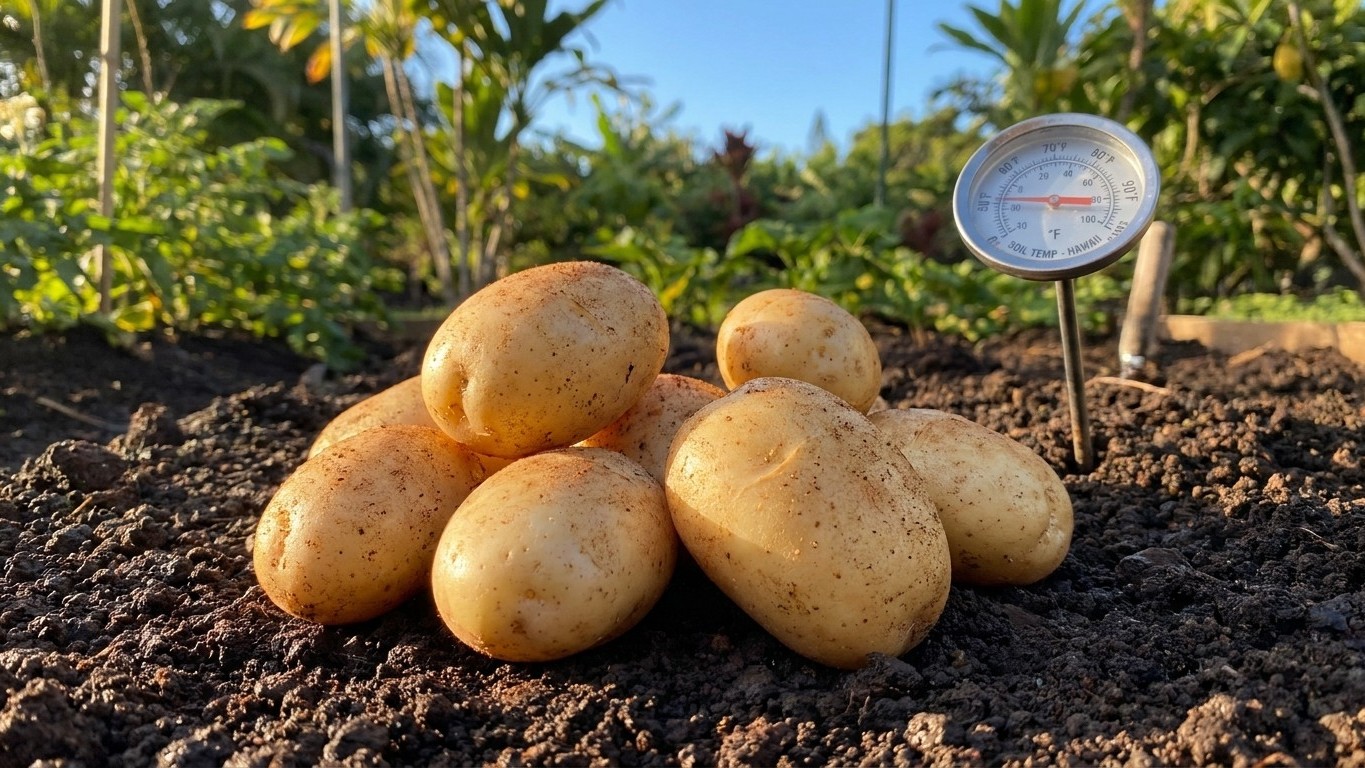

Hawaii has no frost-based potato calendar, because inhabited elevations never freeze. The variety that fits a Hawaii garden isn’t chosen from a days-to-maturity chart or a spring frost date. It’s chosen by season class and by how fast the soil crosses the heat ceiling that stops tubers from sizing, a threshold both Utah State University Extension and the University of Maine Cooperative Extension document at 90°F. Early and mid-season classes, dug in spring, fit lowland Hawaii far better than a variety bred to bulk through a long, hot summer.
The short answer
Start with the number that changes everything: zero. NOAA NCEI’s 1991-2020 Climate Normals for station USW00022521, referenced to Honolulu, show every freeze percentile at 32°F flagged as not computable, with zero days per year at or below 32°F. There is no last-spring-frost date to plan around anywhere gardeners actually live in Hawaii. Frost exists only on the summits of Mauna Kea, Mauna Loa and Haleakala, thousands of feet above any planted row.
That single fact removes the tool most mainland gardeners use to pick a potato variety. Without a frost date, you can’t count backward or forward from it, and neither can a seed catalog written for a temperate climate. What replaces it is a ceiling, not a floor. Utah State University Extension and the University of Maine Cooperative Extension both document that soils above 90°F inhibit tuber set and fill, and that potatoes are planted as soon as soil reaches 50°F. In a place with no cold season, the 50°F trigger is rarely the limiting factor at low elevation. The 90°F ceiling is.
So the short answer is this: choose an early-season or mid-season class, not a late-season one, and plan the crop to bulk and finish before soil temperatures climb into the 90s. That favors a spring planting timed to the cooler, wetter months rather than a crop pushed into the hottest stretch of the year. Reference city data matters here too. A figure measured at Honolulu, at sea level on leeward Oahu, does not describe a garden at 2,000 feet on windward Hawaii Island, where cloud cover and rainfall keep soil temperatures lower for longer. The season-class decision is the same everywhere in the state, but the calendar window for making it work shifts with elevation and exposure.
Neither source publishes a specific variety-by-variety maturity count, and neither calls a variety waxy or floury. What they do publish is the use each class is grown for, baking or boiling, and the season class itself, early, mid-season or late. That’s the vocabulary a Hawaii gardener should actually shop with, rather than a maturity number that was never designed for a frost-free climate.
What actually decides it
Three mechanisms decide whether a potato variety performs in a Hawaii garden, and none of them is frost.
Soil temperature crossing 90°F
Tuber set and fill are physiological processes that slow and stop once soil runs hot, according to Utah State University Extension and the University of Maine Cooperative Extension. This isn’t a watering problem. Once soil passes 90°F, more irrigation does not restart sizing. The mechanism that matters is how many weeks of sub-90°F soil a variety gets between planting and harvest. A late-season class needs more of those weeks than a lowland Hawaii planting window reliably offers, which is why an early or mid-season class carries less risk.
Elevation, windward and leeward exposure
Because there’s no frost season to organize around, elevation and rainfall exposure do the work a frost date does elsewhere. Windward slopes catch more cloud cover and rain, which moderates soil temperature; leeward, lower-elevation ground heats faster and dries out between showers. Two gardens on the same island, a few miles apart, can sit on opposite sides of the 90°F threshold at the same time of year. That’s the reasoning a gardener needs to carry to a plot this page never mentions: check whether the ground is windward or leeward, and how high above sea level it sits, before assuming a season class that works in one yard works in the next.
Seed source and virus-free certification
Uncertified seed potatoes, including grocery-store potatoes or tubers saved from a prior crop without certification, carry virus that builds up season over season and drags yield down regardless of variety or climate. Certified seed is inspected and tested to keep that virus load out of the planting. This mechanism has nothing to do with heat or elevation, but it decides outcomes just as much: a well-matched early-season variety planted from infected seed will still underperform.
How to do it
- Judge the planting window by elevation and rainfall exposure, not frost, since inhabited Hawaii records zero days at or below 32°F (NOAA NCEI, station USW00022521).
- Check that soil temperature has reached at least 50°F before planting, the trigger point used by Utah State University Extension and the University of Maine Cooperative Extension.
- Buy certified seed potatoes rather than grocery potatoes or uninspected saved tubers, since uncertified stock carries virus.
- Choose an early-season or mid-season class so the crop has the best chance of setting and filling tubers before soil crosses 90°F.
- Favor higher-elevation or windward ground when it’s available, since cooler, cloudier sites buy extra weeks below the heat ceiling compared with hot leeward lowlands.
- Track soil temperature through the growing weeks rather than counting toward a fixed date, and dig once vines die back.
- Cure and store the harvested crop out of continued heat, since the same high temperatures that stop tuber fill in the ground will also degrade quality in storage.
What goes wrong
- Planting a late-season class and expecting a full summer to finish it. Once soil crosses 90°F, tuber set and fill stop, according to Utah State University Extension and the University of Maine Cooperative Extension. The remedy is picking an early-season or mid-season class and digging in spring instead of pushing a crop through the hottest months.
- Using uncertified seed, including grocery potatoes or last season’s leftovers. Virus builds up in uninspected stock and reduces yield no matter how well the variety suits the climate. The remedy is buying certified seed potatoes each planting.
- Applying a mainland frost-date planting chart to a Hawaii garden. Inhabited Hawaii records zero days per year at or below 32°F at the NOAA station referenced to Honolulu (USW00022521), so a frost-based schedule simply doesn’t exist here. The remedy is planning around soil temperature and the 90°F ceiling instead.
- Treating one island-wide date as valid for the whole state. Windward and leeward sites, and low versus high elevation, run different soil temperatures at the same time of year. The remedy is checking local exposure and elevation rather than copying a date from a different part of the state.
- Watering harder once tubers stop sizing in hot soil. The limiting factor is heat, not moisture, once soil passes 90°F. The remedy is accepting the ceiling and shifting the whole planting earlier the following season, rather than trying to irrigate past it.
Common questions
Does Hawaii have a spring frost date for planting potatoes?
No. NOAA NCEI’s 1991-2020 Climate Normals for the station referenced to Honolulu (USW00022521) show zero days per year at or below 32°F and flag every freeze percentile as not computable. Frost only occurs on the high volcanic summits, never where gardens are planted.
Can potatoes handle a Hawaii summer?
Not well, according to the mechanism Utah State University Extension and the University of Maine Cooperative Extension document: soils above 90°F inhibit tuber set and fill. A summer-long crop in lowland Hawaii risks spending much of its growing period above that ceiling, which is why an early or mid-season class dug in spring is the safer choice.
What’s the real difference between early, mid-season and late potato varieties?
The season class describes how much time a variety needs to set and fill its tubers, without either source publishing an exact day count. Early and mid-season classes need fewer weeks of favorable soil temperature to finish than late-season classes do, which matters directly in a climate with a limited window below 90°F.
Where should a Hawaii gardener get certified seed potatoes?
Certified, virus-tested seed potatoes, not grocery-store potatoes and not tubers saved from a previous uncertified crop, are the standard both extension sources point to for avoiding virus buildup. Checking with a local agricultural supplier or extension office for certified stock is the practical route, since neither source publishes a Hawaii-specific retailer list.