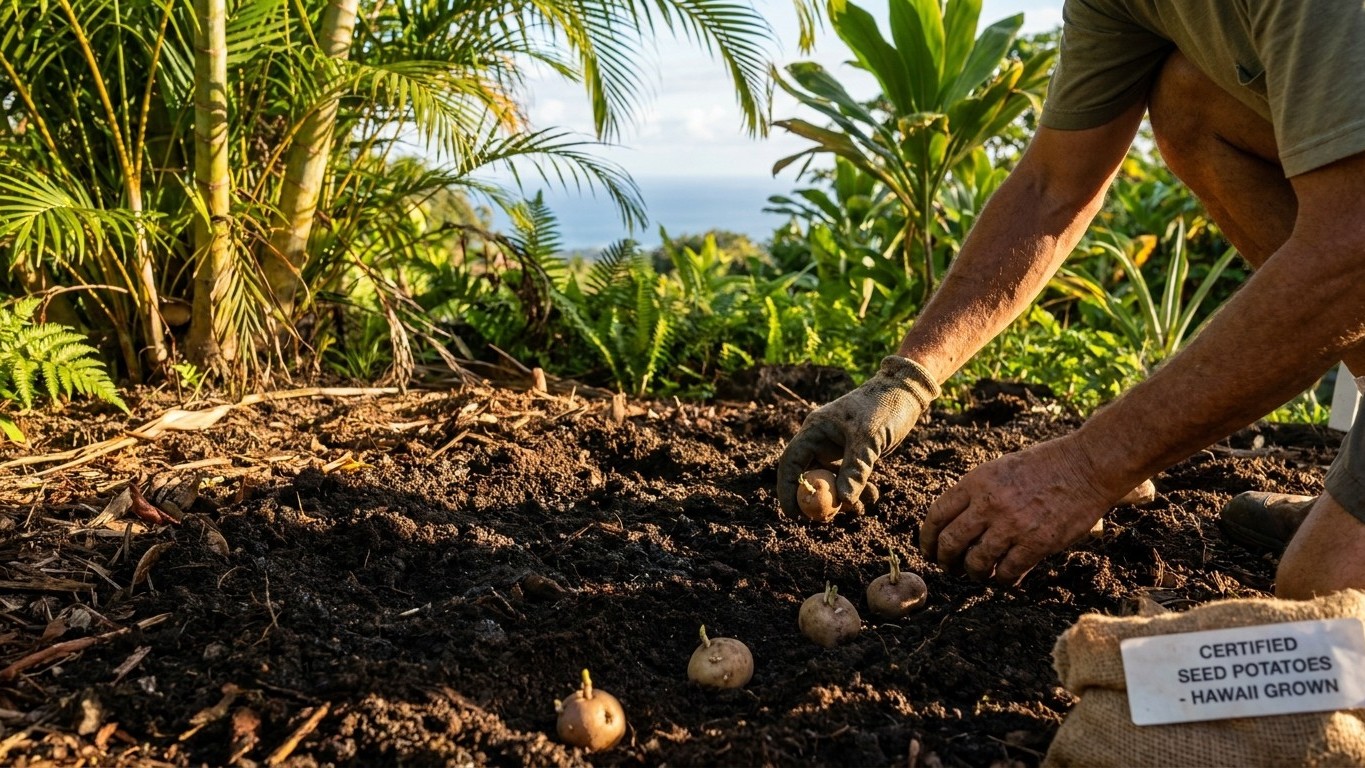

Hawaii has no last-frost date to count back from. NOAA’s 1991-2020 Climate Normals for the Honolulu station (USW00022521) list every freeze percentile at 32°F and 36°F as not computable, because the station recorded zero days at or below 32°F. That single fact changes everything about how you time a potato planting here: instead of counting back from frost, you plant around soil temperature and the season’s heat curve.
The short answer
Plant potatoes in Hawaii’s lowland gardens as soon as you can get certified seed in the ground during the cooler, rainier months, because the mainland’s “14 to 21 days before the last frost” rule from Utah State University Extension and the University of Maine Cooperative Extension has nothing to count back from at sea level here. NOAA NCEI’s climate normals for the Honolulu reference station show zero freeze days a year in every year of the 1991-2020 record, which is why the agency flagged the freeze-date percentiles as not computable rather than publishing a number close to zero. There simply isn’t a frost season to build a calendar around.
What replaces the frost date is a heat ceiling. Utah State and the University of Maine both note that tuber set and fill shut down once soil temperature climbs above 90°F, and that watering doesn’t reverse the stall once it starts. In a place where frost never arrives but heat does, that ceiling becomes the boundary that actually matters. The mainland gardener plants toward warming soil after a cold winter; the Hawaii gardener plants toward a window of soil that hasn’t yet climbed into the 90s and won’t get there before the tubers finish sizing.
That window isn’t the same everywhere on the islands. A leeward, low-elevation plot near Honolulu warms into the danger zone faster than a windward or upcountry site at higher elevation, where cooler air and more consistent cloud cover keep soil temperatures lower for longer. So the practical answer isn’t a date on a calendar at all. It’s a soil thermometer, a look at your site’s elevation and exposure, and a decision to get the crop planted and finished before the heat arrives, not a countdown from a frost that this territory doesn’t experience.
None of this means Hawaii can’t grow potatoes well. It means the entire premise of “counting back from frost” needs to be swapped for “counting forward from cool, workable soil toward the heat ceiling,” and that the reference point is a thermometer reading, not a date on the NOAA freeze table.
What actually decides it
Three separate mechanisms replace the frost calculation, and a gardener who understands them can reason through a site this page never names.
The heat ceiling that replaces frost
Utah State University Extension and the University of Maine Cooperative Extension both describe the same physiological limit: once soil temperature passes 90°F, tuber set and bulking slow or stop, and irrigation doesn’t undo the damage. In a temperate climate that ceiling is a late-season concern, something that shows up after a long, productive spring. In lowland Hawaii, where soil can sit in the 80s for much of the year, that ceiling can arrive early enough that it defines the whole growing window rather than closing it out. The question isn’t “when is it safe to plant,” it’s “how many weeks of sub-90°F soil do I actually have.”
Elevation is Hawaii’s actual calendar
Soil temperature in Hawaii tracks elevation more closely than it tracks the calendar month. A garden a few hundred feet higher, or one in an upcountry area with regular cloud cover, runs measurably cooler than a coastal plot exposed to full sun most of the day. That difference in soil temperature is what functionally does the job a frost date does elsewhere: it tells the gardener how much runway exists before the 90°F ceiling closes the tuber-fill window. A gardener evaluating an unfamiliar site should think in terms of “how high up is this, and how much shade or cloud does it get,” not “what week does spring start here.”
Windward and leeward change the rainfall math
The other variable is exposure. Windward slopes catch consistent moisture and tend to run cooler and damper; leeward areas dry out and heat up faster under more direct sun. That split affects both when soil is workable and how quickly it climbs toward the heat ceiling once planted. A windward garden might offer a longer cool window even at a similar elevation to a leeward one, simply because the rainfall pattern keeps soil temperatures more moderate. None of the source material assigns a number to this effect, but the direction is consistent: windward buys time, leeward shortens it.
How to do it
- Check soil temperature at planting depth with a soil thermometer rather than watching for a frost date that Hawaii’s lowlands don’t experience.
- Evaluate your site’s elevation and exposure, favoring higher, windward, or cloud-covered ground if you have a choice, since that soil stays below the 90°F ceiling longer.
- Buy certified seed potatoes rather than grocery-store tubers; uncertified seed can carry virus that a home gardener has no way to detect before it spreads through the patch.
- Cut larger seed pieces so each has at least one eye, and let cut surfaces callus for a day or two before planting, following standard seed-potato handling from Extension guidance.
- Plant as soon as the seed is ready and soil is workable, prioritizing an early start over waiting for a particular month, since the goal is to finish tuber fill before soil heat climbs.
- Hill soil around the developing plants as they grow, both to protect tubers from light and to keep the root zone slightly cooler.
- Monitor soil temperature through the season and treat any approach toward 90°F as a signal that bulking is slowing, not a problem irrigation will fix.
- Choose an early or mid-season class for lowland plantings, since Utah State and the University of Maine both describe these classes as reaching harvest readiness before a late-season variety would, giving the crop a better chance of finishing inside the cool window.
What goes wrong
- Waiting for a “last frost” that never comes. A gardener who imports a mainland planting calendar and waits for a frost cue will simply miss the cool window entirely. The remedy is to plant by soil temperature and site conditions instead of a frost date, since NOAA’s own data shows no freeze days to wait out.
- Planting in leeward, low-elevation soil that’s already near the heat ceiling. Once soil sits close to 90°F, tuber set stalls before it starts. The remedy is to choose a higher-elevation or windward site, or to accept a shorter, earlier planting window on the original site.
- Using uncertified seed potatoes. Seed from a grocery bin can carry virus invisibly, and there’s no way to catch it once it’s in the ground. The remedy is straightforward: buy certified seed potatoes every time, with no exceptions for convenience.
- Trying to water past a heat stall. Once soil crosses the 90°F threshold, extra irrigation doesn’t restart tuber bulking, according to both Extension sources. The remedy is prevention, not correction: plant early enough, or high enough, that the crop finishes before the ceiling is reached.
- Choosing a late-season class for a short lowland window. A variety bred for a longer season may not finish sizing before soil heat shuts tuber growth down. The remedy is to select an early or mid-season class suited to a compressed, heat-limited window.
Common questions
Does Hawaii have any last-frost date at all?
Not in inhabited areas. NOAA NCEI’s Climate Normals for the Honolulu station list every freeze-related percentile as not computable because the station recorded zero days at or below 32°F across the 1991-2020 period. Frost occurs only on the high volcanic summits, not in gardens.
What temperature should I look for before planting?
Look for workable, cool soil well below the 90°F ceiling that Utah State University Extension and the University of Maine Cooperative Extension identify as the point where tuber set and fill stop. No specific low-end soil temperature figure for Hawaii planting is published in this source material, so rely on site elevation and exposure rather than a single number.
Can I use potatoes from the grocery store as seed?
No. Uncertified seed potatoes can carry virus that isn’t visible at planting time. Both Extension sources treat certified seed as the standard, and skipping it risks the whole crop for the sake of convenience.
Should I plant a baking variety or a boiling variety?
That depends on how you plan to use the harvest, not on the climate. Extension guidance describes potato varieties by their culinary use, baking or boiling, rather than by a waxy-or-floury label, so choose based on what’s on the menu once the crop is in.