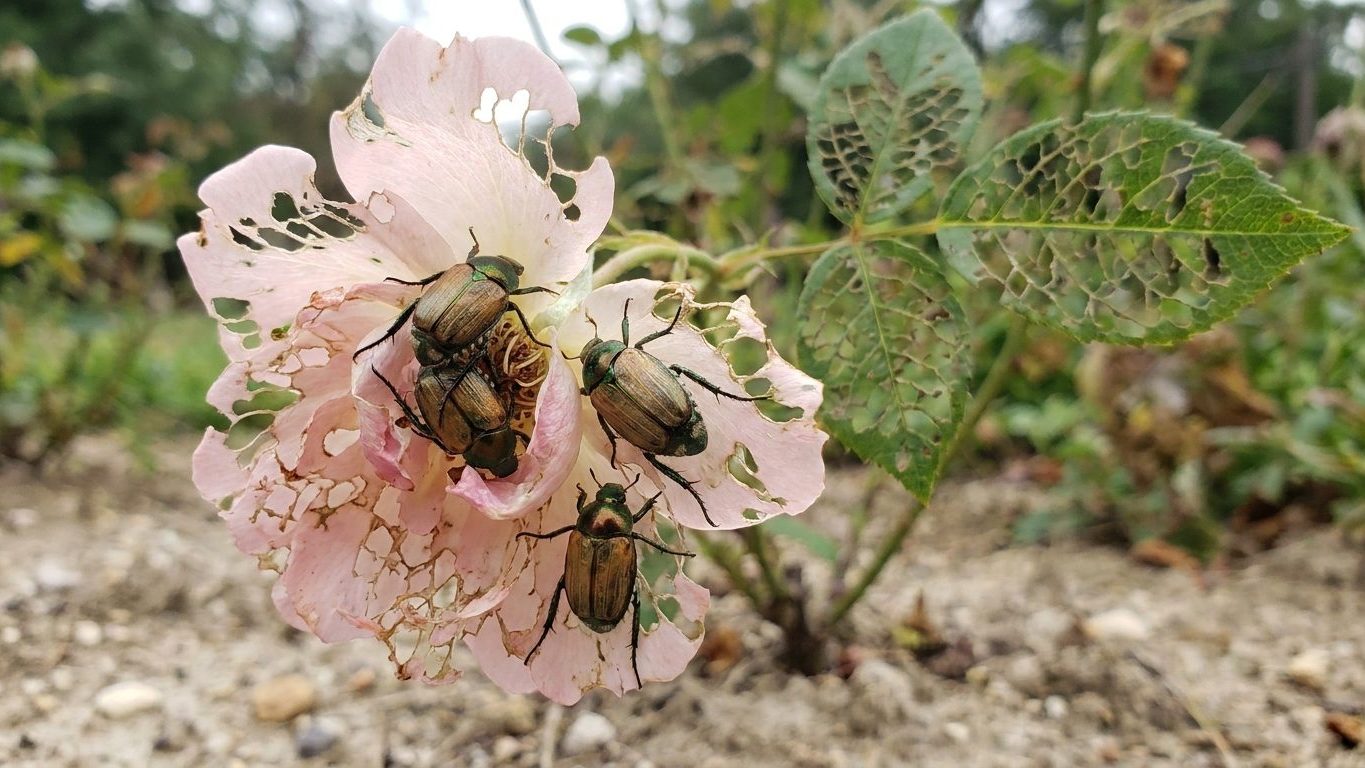

Rose chafers are tan, long-legged beetles about a half-inch long that strip petals and leaves down to a lacy skeleton, feeding in loose clusters on open blooms. They favor sandy or light, well-drained soil, which is why gardens near the coast, in pine barrens, or on old riverbank ground see them season after season while heavier clay-soil yards rarely do. On an established rose bush, the damage is cosmetic. On a young seedling stripped of most of its leaves, it can matter.
What the damage looks like
Look at the flower first, not the leaf. Rose chafers gather on open blossoms, especially pale or white ones, and chew the petals into ragged, translucent scraps within a day or two. That’s the detail that separates them from almost everything else on this site: most rose pests go after foliage or buds, but chafers have a documented preference for petals already unfurled, sometimes leaving a bloom looking like torn tissue paper by the time they move on.
Leaves get the same treatment, just slightly less enthusiastically. The beetles eat the soft tissue between the veins and leave the veins themselves standing, so a damaged leaf looks like a miniature window screen held up to the sun. Gardeners often describe it as “lace,” and that word is accurate. Unlike caterpillar damage, there’s no frass (droppings) left behind on the leaf surface, and unlike a chewing beetle that eats notches from the leaf edge, chafers work from the middle outward.
The beetles themselves are easy to spot once you know to look. They’re a dull tan or fawn color, roughly the size of a June bug but noticeably slimmer, with unusually long, spindly legs that give them an awkward, almost gangly look in flight. They tend to show up in numbers rather than alone, sometimes a dozen or more clustered on a single bloom cluster, mating and feeding at the same time. Shake a branch gently and they often just drop rather than fly, which is a habit worth remembering later.
One more identifying clue: check the soil nearby, if it’s sandy, loose, and well-drained, that’s their preferred nursery ground. Rose chafer grubs need light soil to tunnel through, and adult females fly only short distances to lay eggs, so an infestation is almost always tied to a specific patch of sandy turf or exposed soil within a few hundred feet of the damaged rose.
Making sure it is this and not something else
Three other beetles get mistaken for rose chafers, and each has one feature that settles the question fast.
Japanese beetle
Japanese beetles are more compact and noticeably metallic, a shiny green body with coppery-bronze wing covers, versus the flat, dull tan of a rose chafer. Both skeletonize leaves, but Japanese beetles also have small tufts of white hair along the sides of the abdomen, visible with a hand lens. If the beetle gleams in sunlight, it’s not a chafer.
June bug or May beetle
June bugs are chunkier and reddish-brown to nearly black, active mainly at night, and they tend to chew ragged holes rather than produce the fine lace pattern chafers leave. They’re also considerably clumsier fliers that bump into windows and porch lights after dark, a habit rose chafers, which are active by day, don’t share.
Spotted cucumber beetle
This one is smaller and yellow-green with black spots down the back, closer in size to a ladybug than to a chafer. It feeds on a wider range of garden plants beyond roses and doesn’t cluster on blooms the way chafers do. Size and color together rule it out quickly.
The single fastest confirmation, though, is the leg length. Rose chafers have legs that look almost too long for their body, giving them a spindly, spider-like stance other rose beetles simply don’t have.
When it shows up
Rose chafers appear once roses reach full, open bloom, not before. The adults emerge from the soil as grubs finish pupating, and their arrival lines up almost exactly with the first flush of open flowers rather than with any calendar date, which is why the same yard can see them a week or two earlier or later depending on how warm the soil has been running.
Once they arrive, the feeding window is short by pest standards, typically running three to four weeks before the adults mate, lay eggs in nearby sandy soil, and die off for the season. There’s only one generation per year, so a bad chafer season doesn’t mean a second wave is coming once that window closes.
Sandy, dry conditions during the preceding weeks tend to produce heavier emergences, since the grubs overwinter and pupate more successfully in loose, well-drained soil that doesn’t stay waterlogged. A yard that had a dry spring on sandy ground is a much better candidate for a chafer outbreak than one on heavy clay that stayed damp. That soil-and-bloom combination, rather than any date on a calendar, is the real trigger to watch for.
What to do now
- Hand-pick in the cool morning hours. Chafers are sluggish before the day warms up and often drop straight off the plant when the branch is jostled. Hold a bucket of soapy water underneath and shake; this single habit, repeated daily for the few weeks they’re active, controls light to moderate infestations without any product at all.
- Cover blooms with fine mesh or row cover during peak feeding. Lightweight garden fabric draped over rose bushes during the bloom window keeps adults off the flowers entirely. Remove it once the beetles thin out so pollinators can get back to work.
- Skip the milky spore. That biological control targets Japanese beetle grubs specifically and does little against rose chafer larvae, so spending money on it for this pest is a waste.
- Try kaolin clay as a physical deterrent. A spray-on kaolin clay product, available at most garden centers, coats leaves and petals in a fine white film that beetles find unappealing to feed on. It washes off in rain and needs reapplication, but it doesn’t harm bees or other visitors.
- Reach for a pyrethrin-based spray only if the infestation is heavy. Pyrethrin products, sold at hardware and garden stores, break down quickly in sunlight and are among the least persistent options available to a home gardener. Even so, they’re broad-spectrum and will kill the parasitic wasps and other predators that naturally keep chafer numbers down, so treat this as a last step rather than a first response, and spray in the evening after pollinators have left the blooms.
- Avoid systemic insecticides on roses grown for cut flowers or near vegetable beds. Several systemic products carry state-level restrictions on ornamental plants that flower, precisely because they’re toxic to bees; check the label and your state’s cooperative extension guidance before buying anything systemic.
Stopping it coming back
- Overseed or thicken thin, sandy turf near the rose bed. Rose chafer grubs prefer sparse grass over sandy soil to lay eggs and tunnel through; a denser lawn is less inviting.
- Keep sandy soil consistently a little moist through late spring if practical. Grubs and pupae do better in dry, loose ground, so regular light watering of exposed sandy patches can reduce next year’s emergence.
- Rotate where you plant pale and white roses if chafers have hit the same bed two years running, since these beetles show a documented preference for lighter-colored blooms.
- Have row cover fabric ready before bloom, not after damage starts. Beetles that already found the flowers won’t be stopped by covering the bush a week later.
- Let ground beetles and birds do their part. Both prey on rose chafer adults and grubs, and a broad-spectrum insecticide applied out of habit rather than necessity removes that free labor along with the pest.
- Avoid heavy fall tilling of sandy beds near roses, since disturbing the soil can expose overwintering grubs to birds, which actually helps, but repeated tilling also breaks up beneficial ground beetle populations if overdone.
Common questions
Will rose chafers kill an established rose bush?
No. The damage is almost always cosmetic on a mature, established plant, even when it looks dramatic on the flowers themselves. A young rose with only a few leaves is the one case where heavy defoliation can set the plant back seriously.
Are rose chafers poisonous to pets or livestock?
The beetles themselves aren’t a hazard to touch or handle, but they contain a compound that has been linked to poisoning in birds, particularly poultry, if eaten in quantity. Dogs and cats aren’t typically at risk from incidental contact.
Do rose chafers attack other plants besides roses?
Yes, grapes and peonies are frequent secondary targets, along with some vegetable crops growing in sandy soil nearby. If you’re seeing chafer damage on roses, check nearby grapevines or peonies too.
Why do I only get rose chafers some years and not others?
Emergence numbers track closely with how dry the soil ran the previous season. A dry stretch on sandy ground favors grub survival and pupation, so a light year often follows a wetter spring, and a heavy year often follows a dry one.