
Waltham Washington asparagus is an open-pollinated variety recommended by Clemson Cooperative Extension, and the label matters more than most gardeners realize. It sets seed, it needs two to three years before you cut a single spear, and it goes into the ground in a trench that starts shallow and fills in slowly. None of that shows up on a seed packet.
Open-Pollinated Means Something Specific: What Waltham Washington Actually Costs You
Clemson Cooperative Extension lists Waltham Washington as one of its recommended asparagus cultivars, and it flags the type plainly: open-pollinated. That single word decides how much weeding you’ll do five years from now.
An all-male hybrid asparagus sets no seed at all. Every bit of energy the plant has goes into producing spears, and the bed never reseeds itself, so the rows stay clean and predictable year after year. Open-pollinated varieties like Waltham Washington work differently. Roughly half the plants that come up will be female, and those female plants will set berries. The berries drop. The seeds inside them sprout the following spring, right in the row, and what comes up is a volunteer seedling that has to be identified and pulled before it competes with the crowns you actually planted.
That’s not a flaw in the variety. It’s the trade-off that comes with growing one of the older Washington-line varieties instead of a modern all-male hybrid, and it’s a trade a lot of home gardeners still make on purpose, because these open-pollinated types have a long track record in home beds and are still widely grown. What you won’t find, anywhere, is a published yield figure or a days-to-maturity number for Waltham Washington. No such figure exists in Clemson’s cultivar guidance, and no reputable source publishes one, because asparagus doesn’t behave like a tomato or a bean crop that ripens on a schedule. What you get instead is a wait, and it’s the single most important thing to understand before you dig the trench.
The Wait Before the First Spear: Two to Three Years, Clemson Says
This is the part that decides whether you should plant Waltham Washington at all, and it belongs near the top of the page for a reason. Clemson Cooperative Extension states it without hedging: “asparagus takes two to three years to begin production.”
Read that again, because it’s easy to skim past. Two to three years. Not weeks. Not one growing season with a light harvest tacked on at the end. The crowns you set this spring are building a root system underground, and for that first year and often the second, the fern that grows above ground is doing nothing but photosynthesizing to feed roots you can’t see. Cutting spears during that buildup phase robs the plant of the energy it needs to establish itself, which is why pulling a harvest early is one of the fastest ways to weaken or kill a new bed.
Clemson goes further and puts a number on the crown’s age at planting time too, noting that crowns “may need two to three full growing seasons before limited harvesting can be done in the third or fourth year.” Notice the phrase: limited harvesting. That is not a full harvest, and it’s not a green light to cut every spear that emerges. It means a handful of light, cautious cuts in year three or four, easing the bed into production rather than throwing it straight into a full season of cutting.
What that means in practical terms is this: for two or three full seasons, you’re weeding, watering, and watching a bed that gives you nothing back except fern growth. That’s a real commitment of space and effort, and it’s worth sitting with before you order crowns. What you’re buying on the other end, though, is a perennial bed that can keep producing for decades once it’s established, which is the reason growers keep making that trade.
Planting the Trench: Why the Crown Isn’t Buried Full-Depth on Day One
Almost every asparagus guide gets one detail wrong, or skips it entirely: the crown does not go into the ground at full planting depth on the day you set it. Clemson Cooperative Extension is specific about both the spacing and the depth, and specific about how you get there.
On spacing and initial depth, the guidance reads: “Set the crowns 15 to 18 inches apart and 6 to 8 inches deep.” That’s the trench you dig, and it’s meant to stay a range rather than a fixed number, because bed width, soil type, and crown size all push that figure slightly one way or the other.
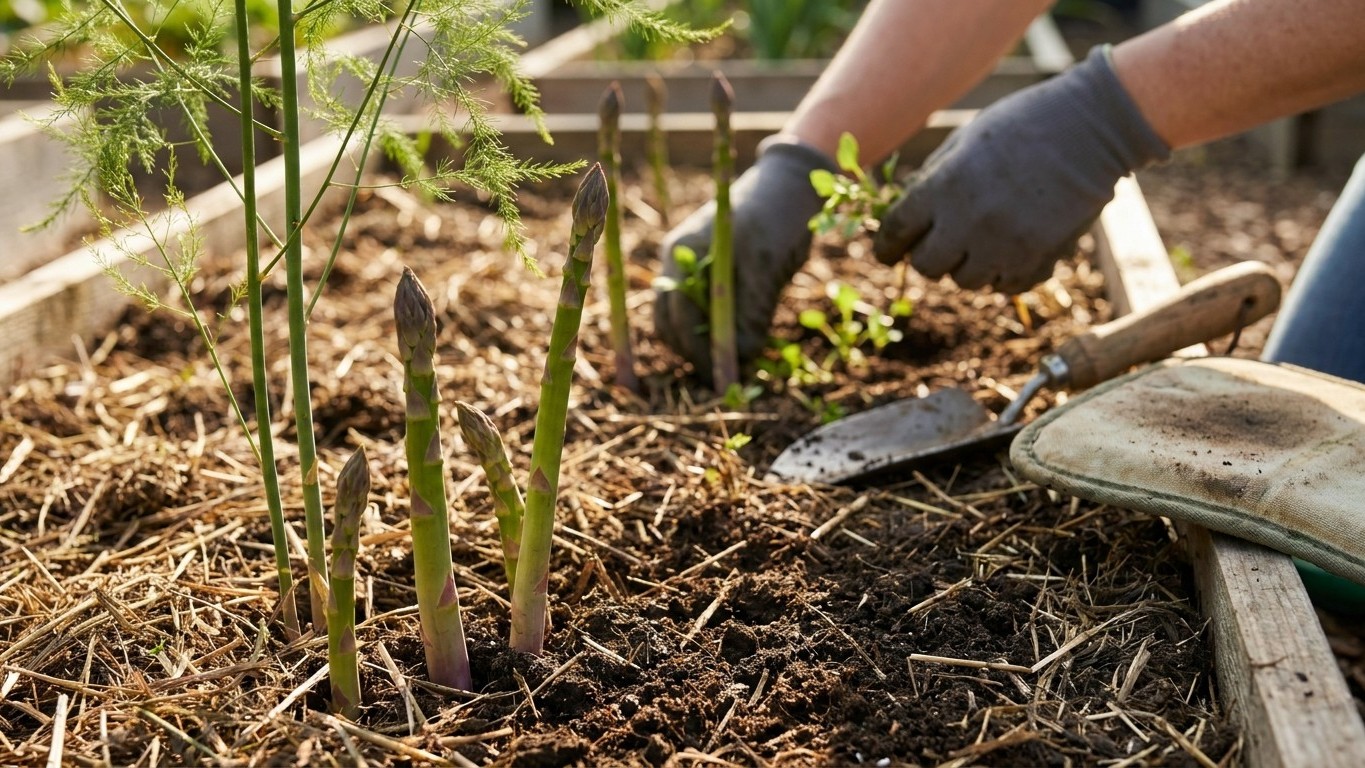
The part that matters more, and the part that gets left out of a lot of planting advice, is what happens after the crown sits in that trench. You don’t backfill it all at once. Clemson’s instruction is to “continue to pull soil over the crowns (about 2 inches every two to three weeks) until the trench is filled, and the crowns are 6 to 8 inches deep.” the crown starts in a shallow trench, spears begin to emerge, and as they grow you gradually pull a couple of inches of soil over the crown every few weeks, filling the trench in stages rather than burying the crown deep from the start.
Skip that gradual fill and bury the crown at full depth immediately, and you risk smothering the emerging growth before it has the strength to push through that much soil. It’s a slow process by design. The trench fills over roughly a month or two of the growing season, not in a single afternoon with a shovel, and that patience is part of what gets a bed established well enough to survive the two-to-three-year wait that follows.
When to Stop Cutting: The Pencil-Size Sign
Once a Waltham Washington bed is finally mature enough to harvest, the question shifts from when to start to when to stop, and Clemson’s answer isn’t a date. It’s a sign the plant gives you directly: “Stop harvesting when the diameter of the spears has been reduced to pencil-size and allow the spear to grow to full height.”
That rule exists because of what’s happening underground. Every spear you cut during harvest season is pulled from the crown’s stored energy reserves, built up during the previous season’s fern growth. Early in the harvest window, the bed has plenty of reserves to draw on, and spears come up thick. As the season goes on and those reserves get spent down, the spears that emerge get progressively thinner, and pencil-diameter is the signal that the bed is running low. Keep cutting past that point and you’re taking from a bank account that needs to refill before winter, which weakens next year’s crop.
Letting the spear grow to full height once it hits pencil-size lets it leaf out into fern, and that fern spends the rest of the season photosynthesizing and rebuilding the crown’s reserves for next spring’s harvest. There’s no week number or calendar date attached to this rule, and that’s the point. A date works in one climate and fails in another. The pencil-size sign works the same way whether the bed is in coastal South Carolina or upstate New York, because it’s reading the plant instead of the calendar.
Common questions
Is Waltham Washington asparagus an all-male hybrid?
No. It’s an open-pollinated variety, which means roughly half the plants will be female and will set berries that drop seed into the bed.
How long until Waltham Washington asparagus produces a real harvest?
Clemson Cooperative Extension states that asparagus takes two to three years to begin production, with limited harvesting possible in year three or four. A full harvest comes later than that.
How deep should Waltham Washington crowns be planted?
Set them 15 to 18 inches apart and 6 to 8 inches deep, but the trench isn’t backfilled all at once. Soil is pulled over the crowns gradually, about 2 inches every two to three weeks, until the trench is filled.
When should I stop cutting spears each season?
Stop when the spears’ diameter shrinks to pencil-size and let that spear grow into full fern. That’s the bed’s way of telling you its stored energy is running low for the season.