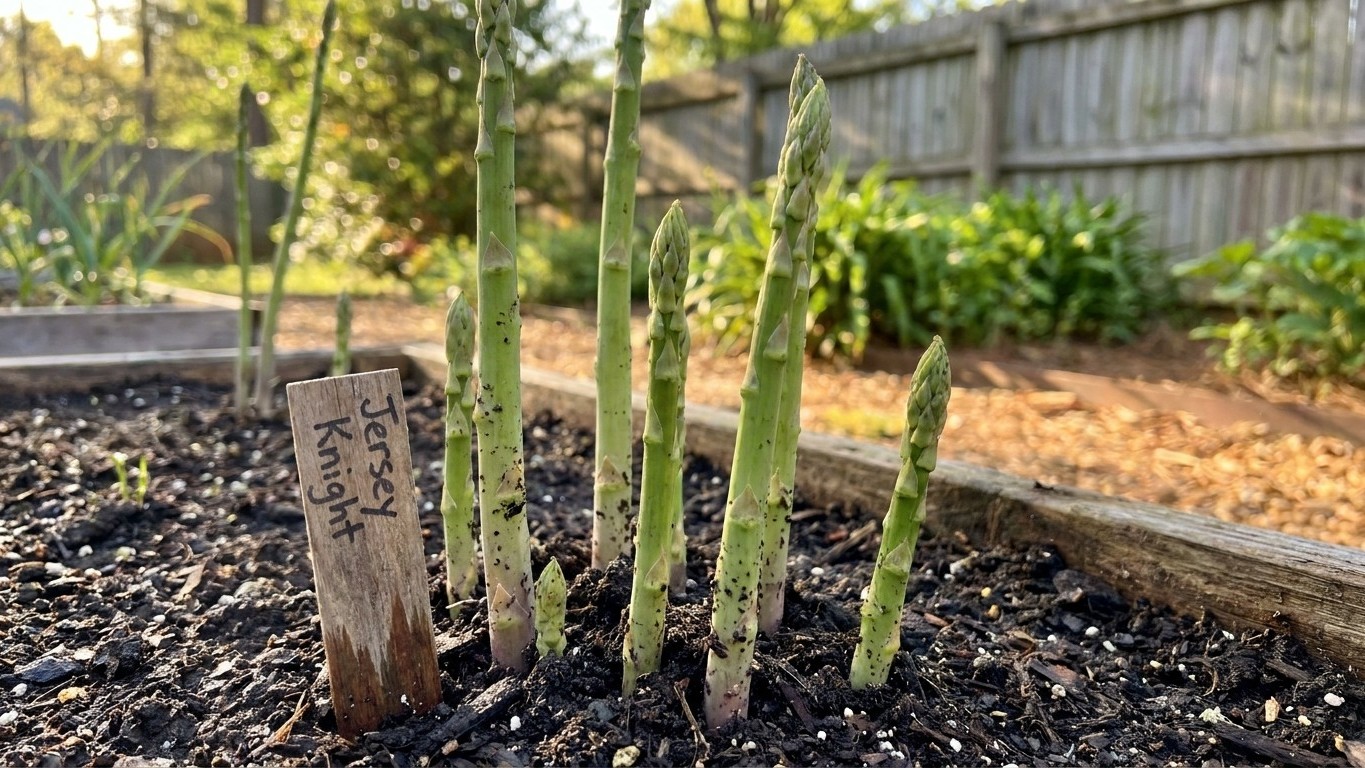

Jersey Knight asparagus is an all-male hybrid recommended by Clemson Cooperative Extension for home gardens across the Southeast. That fact drives everything else: no seed production, no volunteer seedlings crowding the row, and a plant that puts its energy into spears instead of berries. But the bigger question for most gardeners isn’t the variety itself, it’s whether they’re ready for the multi-year commitment that comes with it.
All-Male Hybrid vs. Open-Pollinated: What the Label Actually Buys You
An all-male hybrid, which is what Jersey Knight is, sets no seed at all. Every bit of energy the plant produces goes toward spear growth rather than berry production.
An open-pollinated asparagus variety produces roughly half female plants. Those form berries, the berries drop, and the following spring you’ve got seedlings sprouting between your rows, competing with established crowns for water and nutrients. They need to be pulled or hoed out season after season.
Jersey Knight skips that problem by design. Clemson Cooperative Extension lists it among the cultivars recommended for South Carolina gardens precisely because it channels its resources into what you’re actually trying to grow: spears. No yield figures or days-to-maturity numbers are published for Jersey Knight or the other cultivars on Clemson’s list, so don’t trust any chart online that claims otherwise. What’s documented is the mechanism, not a harvest weight or a calendar countdown: a bed that isn’t spending energy on seed production has more left over for the parts you eat, and less mess to manage in the years ahead.
The Wait Before the First Harvest: Two to Three Years Doing Nothing But Weeding
This is the part that changes whether someone should plant asparagus at all. Clemson Cooperative Extension states it plainly: “asparagus takes two to three years to begin production.” That’s not a typo. Newly set crowns “may need two to three full growing seasons before limited harvesting can be done in the third or fourth year.” Read that carefully, because “limited harvesting” does not mean a real harvest. It means a token cutting while the bulk of the plant’s energy still goes toward building root reserves. A full, sustained harvest arrives later still.
So here’s what you’re actually signing up for: two or three growing seasons of maintaining a bed that gives you nothing to eat. You’ll be weeding it, watering it, watching fern fronds grow tall and fall over in autumn, and cutting them back in late winter, all without a spear on your plate. Then, in year three or four, you get to harvest lightly. Full production comes after that.
For gardeners used to annual vegetables like tomatoes or squash, that’s a hard adjustment, and no cultivar changes the biology. What Jersey Knight’s all-male trait does change is what happens once that wait is over: a cleaner bed, less competition from volunteer seedlings, and decades of production once the crowns mature. Asparagus beds routinely stay productive for 15 years or more, which is the tradeoff that makes the wait worth it for gardeners who plan to stay put.
Planting Depth: Why the Trench Isn’t Filled on Day One
Most planting guides skip the part that actually determines whether crowns survive their first season: the timing of when planting depth is reached. Clemson Cooperative Extension is specific: “Set the crowns 15 to 18 inches apart and 6 to 8 inches deep.” Those are ranges, not fixed measurements, since soil type, drainage, and bed length all nudge the right spacing and depth in slightly different directions.
What trips up a lot of first-time growers is assuming that 6 to 8 inches means digging a trench that deep, dropping in the crown, and backfilling it completely right away. That’s not what happens, and doing it that way is a common reason beds fail to establish. Clemson’s instructions continue past the depth figure with the step that actually matters: gardeners should “continue to pull soil over the crowns (about 2 inches every two to three weeks) until the trench is filled, and the crowns are 6 to 8 inches deep.”
In practice, the crown sits in an open or partially filled trench when first set. As developing spears push upward through the loose soil, you add another couple of inches over the top every two to three weeks, letting new growth keep reaching the surface each time. The trench fills in stages, not all at once, and the crown reaches its final depth gradually, in step with the plant’s own growth.
Burying a crown at full depth immediately smothers the emerging spear before it can reach light and start photosynthesizing. That single mistake accounts for a fair share of asparagus beds that never establish well. The gradual fill isn’t a nice-to-have refinement, it’s the mechanism that lets the crown breathe while it settles in.
When to Stop Cutting: The Pencil Test That Beats Any Calendar
Once a bed reaches full production, the question shifts from “when can I start harvesting” to “when do I need to stop.” Clemson Cooperative Extension ties the answer to the plant itself rather than a date on the wall: “Stop harvesting when the diameter of the spears has been reduced to pencil-size and allow the spear to grow to full height.”
The logic is worth understanding, not just following. Each spring, an established crown draws on root reserves built up the previous summer and fall to send up thick, harvestable spears. As the harvest window stretches on, that reserve gets spent down, and spears get progressively thinner. Once they’ve narrowed to pencil diameter, the crown is signaling it’s running low on stored energy. Continuing to cut at that point starves the plant of what it needs to rebuild.
Letting those pencil-thin spears grow into full fern, rather than cutting them, lets the plant photosynthesize through summer and refill its underground reserves before winter dormancy. Skip that step, or push the harvest too long, and next year’s spears come in weaker and thinner across the board.
This is deliberately a sign, not a schedule, which is exactly why it works no matter where you’re growing. A calendar date that fits a South Carolina spring won’t necessarily fit a bed in Minnesota or coastal California, where soil warms and crowns wake up at different rates. The spear diameter, though, tells the same story everywhere. Watch the spears, not the calendar, and the bed tells you when it’s done for the season.
Common questions
Is Jersey Knight asparagus better than open-pollinated varieties?
It depends on what you’re optimizing for. Jersey Knight, as an all-male hybrid, avoids the seed-drop and volunteer-seedling problem that comes with open-pollinated varieties, where roughly half the plants are female. That means less weeding of unwanted seedlings over time. Neither type has a published yield advantage, since Clemson doesn’t list yield figures for these cultivars.
How long until Jersey Knight asparagus produces a full harvest?
Clemson Cooperative Extension states that asparagus generally “takes two to three years to begin production,” with crowns needing “two to three full growing seasons before limited harvesting can be done in the third or fourth year.” A full, sustained harvest comes after that initial limited cutting period, not during it.
How deep should Jersey Knight asparagus crowns be planted?
Clemson recommends setting crowns 15 to 18 inches apart and 6 to 8 inches deep, but that final depth is reached gradually. Soil is pulled over the crowns in increments of about 2 inches every two to three weeks until the trench is completely filled and the crowns sit at the full 6-to-8-inch depth.
How do I know when to stop cutting asparagus each spring?
Watch the spears themselves rather than counting weeks. Clemson’s guidance is to stop harvesting once spear diameter narrows to pencil-size, then let those thinner spears grow to full height and fern out. That fern growth is what rebuilds the plant’s root reserves for next year’s crop.