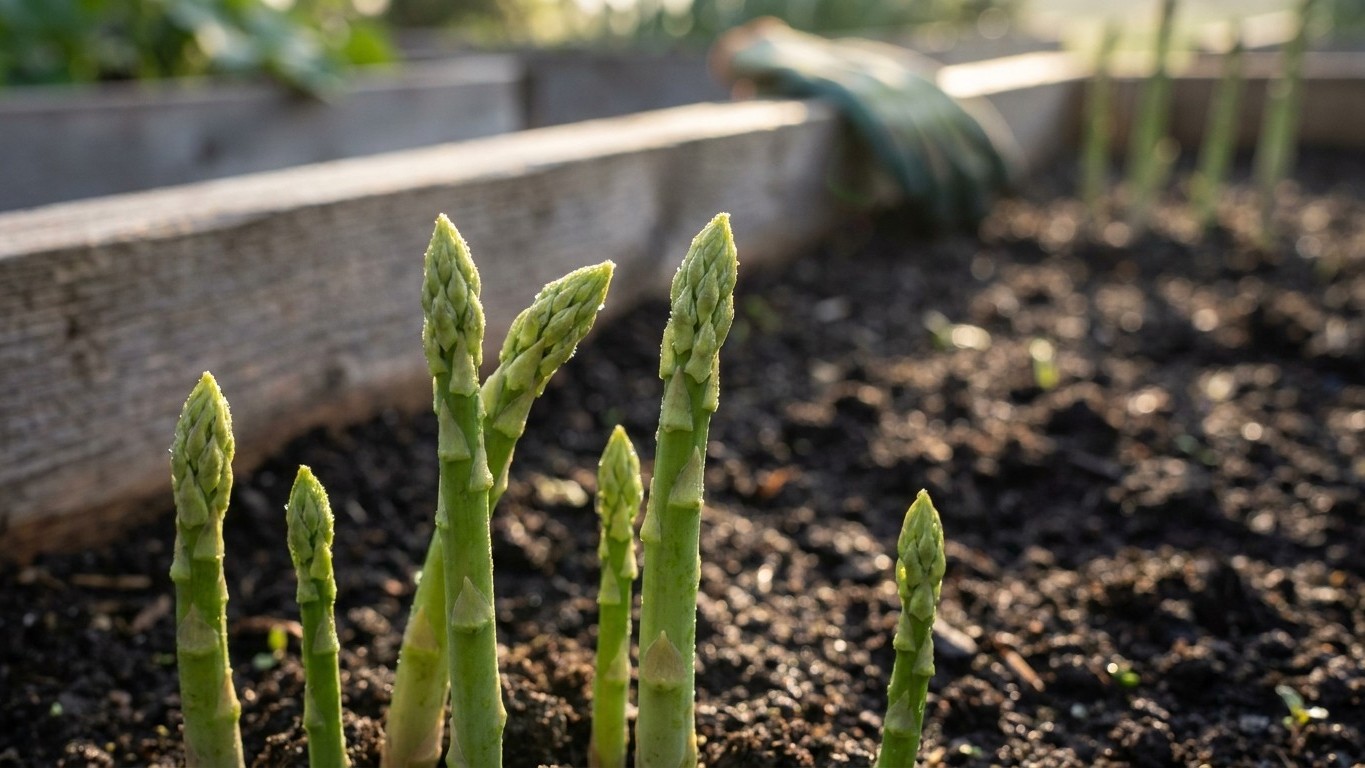

Jersey Gem is an all-male hybrid asparagus variety recommended by Clemson Cooperative Extension, planted from dormant crowns in early spring as soon as soil can be worked. Because it sets no seed, every bit of stored energy goes into spear production instead of berries, which matters more for a long-term bed than any planting date on a calendar.
All-Male Hybrid vs. Open-Pollinated: What the Label Actually Buys You
The distinction between an all-male hybrid and an open-pollinated variety isn’t a marketing footnote. It changes what happens in the row for the next twenty years. Jersey Gem, listed among the cultivars recommended by Clemson Cooperative Extension, is an all-male hybrid. An all-male plant sets no seed at all. That sounds like a small technical detail, but it changes the math of the bed. Every calorie the plant would otherwise spend building berries goes into spear production instead.
Open-pollinated asparagus, by contrast, produces roughly half female plants. Those females drop berries every fall, and those berries sprout the following spring as volunteer seedlings scattered through the row. A grower ends up weeding out asparagus from asparagus, which sounds harmless until you realize those volunteers compete with the established crowns for water, nutrients, and light for years.
An all-male bed doesn’t do that. It stays clean. No berries drop, no seedlings crowd the row, and the gardener isn’t stuck thinning out a plant she paid for and planted on purpose. This is the actual value of buying an all-male hybrid like Jersey Gem, not a bigger spear or an earlier harvest, since no yield figure or days-to-maturity number is published for this cultivar or its relatives. The benefit is structural: a bed that spends its energy on food instead of reproduction, and stays that way indefinitely.
The Wait: Two to Three Years Before You Cut a Single Spear
This is the part that decides whether planting asparagus makes sense for a given yard, and it belongs near the top of the decision, not buried at the bottom. Clemson Cooperative Extension states plainly that “asparagus takes two to three years to begin production.” That’s not a rough estimate rounded down for effect. It’s the baseline expectation for any newly planted bed, Jersey Gem included.
The same source goes further, noting that a bed “may need two to three full growing seasons before limited harvesting can be done in the third or fourth year.” Read that sentence carefully, because it’s easy to skim past the word that matters most: limited. Year three or four doesn’t bring a full harvest. It brings a short, restrained cutting period while the crowns keep building the root reserves they’ll rely on for decades.
So the honest version of what a gardener signs up for looks like this: two or three seasons of watering, weeding, and mulching a bed that gives back nothing edible, followed by a fourth season of picking a little and stopping early, followed by the payoff. Asparagus beds routinely produce for fifteen to twenty years once established, which is the reason growers tolerate the wait. But nobody should plant crowns expecting spears the following spring. That expectation is the single most common reason new asparagus beds get pulled out in frustration before they ever hit their stride.
Anyone comparing asparagus to a vegetable garden staple like tomatoes or peppers needs to reset that comparison entirely. This isn’t an annual crop. It’s closer to planting a fruit tree: patience up front, decades of return after.
Planting the Trench: Why the Crown Isn’t Buried Deep on Day One
Once a gardener accepts the timeline, the planting method itself trips up a lot of first-time growers, mostly because of one detail that gets skipped in casual advice. Clemson Cooperative Extension instructs growers to “set the crowns 15 to 18 inches apart and 6 to 8 inches deep.” Those spacing and depth figures should stay as ranges, not get averaged down to a single number, since soil type, drainage, and bed layout all shift where within that range a given crown should sit.
Filling the Trench Gradually
Here’s the part that almost never makes it into shorthand planting guides: the crown does not go into a fully backfilled trench 6 to 8 inches deep on the first day. It’s planted in an open trench, and the extension service is specific about the process from there, telling growers to “continue to pull soil over the crowns (about 2 inches every two to three weeks) until the trench is filled, and the crowns are 6 to 8 inches deep.”
That means the trench starts shallow, with the crown resting on a small mound at the bottom, and gets filled in stages as new spears push up through the loose soil. Each time growth appears, another couple of inches goes back over the crown, roughly every two to three weeks, until the full depth is reached. Burying a crown at full depth immediately, before any top growth has emerged, is one of the more common ways a brand-new asparagus bed fails to establish. The crown suffocates under soil it wasn’t ready to push through, and the gardener never finds out why the bed looked fine at planting and empty by midsummer.
When to Stop Cutting: The Pencil-Size Sign
Once a bed reaches full production, the trickiest ongoing decision isn’t when to start cutting each spring. It’s when to stop. Clemson Cooperative Extension gives a rule based on the plant itself rather than the calendar: “Stop harvesting when the diameter of the spears has been reduced to pencil-size and allow the spear to grow to full height.”
The mechanism behind that rule matters more than the rule itself. Every spear cut in spring comes directly out of the root system’s stored carbohydrate reserves, built up the previous summer by the ferny top growth. As the harvest window stretches on, those reserves get drawn down further and further, and the plant responds by sending up progressively thinner spears. Pencil-diameter spears are the plant’s way of signaling that its bank account is running low.
Letting the spear grow to full height and leaf out into fern at that point isn’t optional maintenance. It’s how the crown rebuilds the reserves it just spent, ahead of the next winter’s dormancy and the following spring’s harvest. Ignore the sign and keep cutting thin spears anyway, and a bed can weaken season over season until production drops noticeably.
The advantage of a sign over a date is that it travels. A calendar cutoff written for one climate zone means little in another, but pencil-size spears mean the same thing whether the bed sits in coastal South Carolina or upstate New York. The plant tells the grower directly, no regional adjustment required.
Common questions
Is Jersey Gem asparagus an all-male hybrid?
Yes. Jersey Gem is listed as an all-male hybrid variety by Clemson Cooperative Extension, which means it sets no seed and directs its energy into spear growth rather than berry production.
How long before a Jersey Gem asparagus bed produces spears?
Clemson Cooperative Extension states that asparagus generally takes two to three years to begin production, with limited harvesting possible in the third or fourth year. No published source gives a shorter timeline for Jersey Gem specifically.
How deep should asparagus crowns be planted?
Crowns are set 15 to 18 inches apart in a trench roughly 6 to 8 inches deep, but that full depth is reached gradually, with about 2 inches of soil pulled over the crown every two to three weeks as growth appears, according to Clemson Cooperative Extension.
When should I stop cutting asparagus spears each spring?
Stop harvesting once spear diameter shrinks to about the size of a pencil, and let remaining spears grow to full height and fern out, per Clemson Cooperative Extension guidance. This lets the plant rebuild the root reserves it will need for the next season.