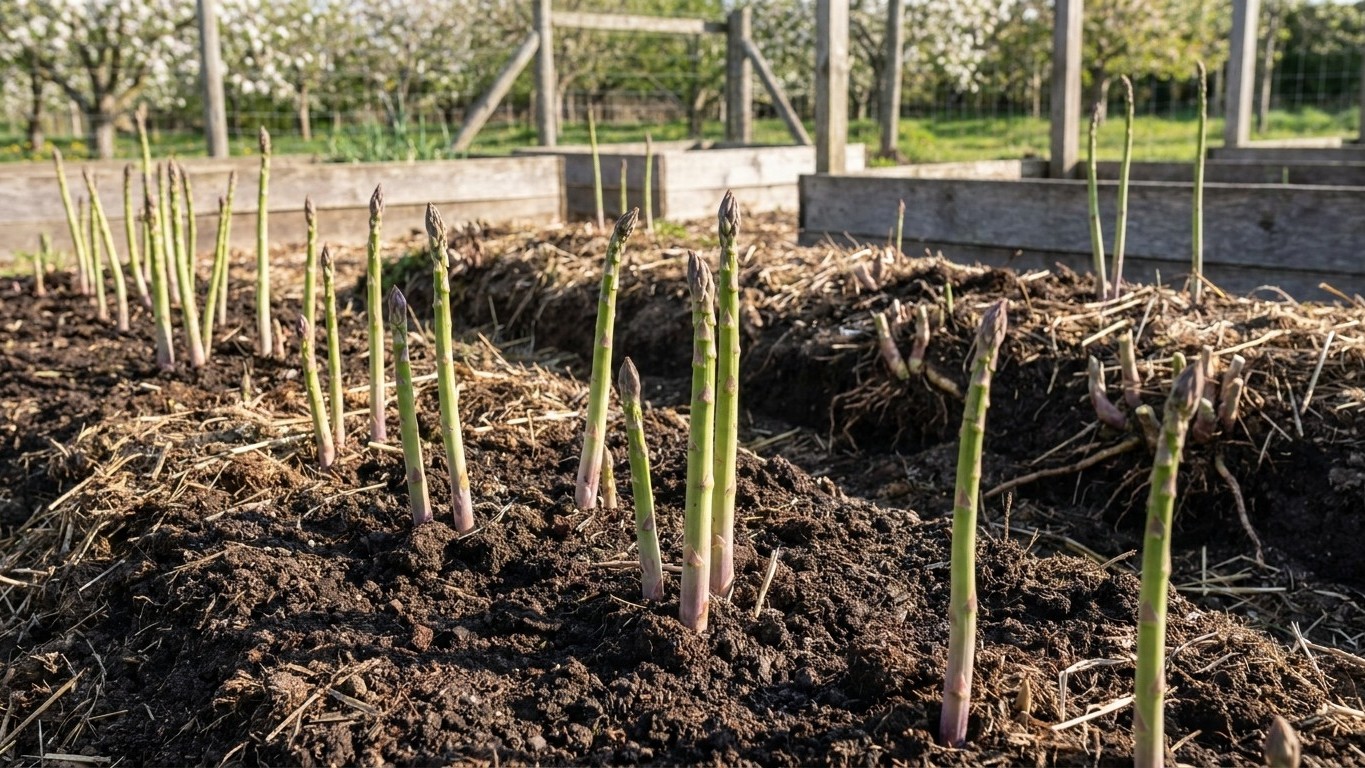

Jersey Giant is an all-male hybrid asparagus variety recommended by Clemson Cooperative Extension. Plant its crowns in early spring, in a shallow trench that gets filled in gradually, and expect no harvest at all for two to three growing seasons. The payoff after that wait is a bed that can produce spears for decades with almost no reseeding to manage.
All-Male Hybrid vs. Open-Pollinated: What Jersey Giant Actually Buys You
The label “all-male hybrid” sounds like a marketing footnote. It isn’t. An all-male hybrid sets no seed at all, and that single fact changes how the bed behaves for the rest of its life. Instead of putting energy into berries, the plant puts everything into spear production. No seed also means no volunteer seedlings popping up between rows the following spring, which is exactly what happens with open-pollinated varieties.
An open-pollinated planting runs roughly half female plants. Those females flower, set berries, and drop seed into the soil every fall, and by spring the bed is full of thin seedlings competing with established crowns for water and nutrients. Jersey Giant sidesteps that entirely: because every plant is male, all of its stored energy goes into the spears you actually want to eat rather than into reproduction. That’s the real value of the hybrid designation, less weeding, more predictable spacing, and a bed that stays the shape you planted it in.
What isn’t published, for Jersey Giant or for any comparable cultivar, is a specific yield figure or a days-to-maturity number. Clemson Cooperative Extension, which recommends the variety for home gardens, doesn’t list either. What it does publish is a timeline, and that timeline matters more than any yield number would.
The Wait: Why Two to Three Years Before You Pick a Single Spear
Here’s the part that changes whether asparagus belongs in your garden at all. Clemson Cooperative Extension states plainly that “asparagus takes two to three years to begin production.” That’s not a suggestion or a worst-case scenario. It’s the baseline.
Crowns planted this spring need “two to three full growing seasons before limited harvesting can be done in the third or fourth year,” according to the same source. “Limited harvesting” is not a full harvest, it’s a few spears, carefully rationed, while the plant is still building the root system that will feed it for the next fifteen or twenty years. A genuinely normal harvest, cutting spears every day or two for six to eight weeks, doesn’t arrive until later still.
So what are you signing up for in the meantime? Two or three seasons of weeding, watering, and top-dressing a bed that gives back nothing you can put on a plate. Asparagus is one of the only vegetables where the investment is measured in years before the return, which is also why an established bed is worth protecting rather than replacing. Once it’s producing, it keeps producing for a very long time, but only if you treat the first few years as pure maintenance, not harvest.
Planting the Crown: The Trench You Fill Gradually
The planting depth for Jersey Giant, and for asparagus crowns generally, is one of the most misunderstood steps in the whole process. Clemson Cooperative Extension instructs gardeners to “set the crowns 15 to 18 inches apart and 6 to 8 inches deep.” Read alone, that sounds like a single digging job: dig a trench 6 to 8 inches down, drop in the crown, cover it, done.
That’s not how it works. The same source continues: gardeners should “continue to pull soil over the crowns (about 2 inches every two to three weeks) until the trench is filled, and the crowns are 6 to 8 inches deep.” The crown starts out shallow, sitting in an open trench with only a light covering of soil. As spears emerge and the plant establishes itself, you pull in another couple of inches of soil, wait a few weeks, then pull in more, until the trench fills gradually over the course of the season.
Why the gradual fill matters
Burying a crown 6 to 8 inches deep immediately, before it has any top growth, is a common way to lose the planting. The young shoot has to push through that much soil before it ever sees sunlight, and a crown already stressed from Transplanting doesn’t always have the reserves to manage it. Filling in stages lets the plant establish its own growth rhythm before it’s asked to push through the full depth of soil.
Keep the spacing and depth figures as ranges rather than rounding to a single number. Soil type, drainage, and how quickly your particular crowns break dormancy all push the ideal number toward one end of the range or the other.
When to Stop Harvesting: The Pencil-Size Sign
Once a Jersey Giant bed is finally producing, the hardest discipline isn’t planting or weeding. It’s knowing when to quit picking for the season. Clemson Cooperative Extension gives a clear rule: “Stop harvesting when the diameter of the spears has been reduced to pencil-size and allow the spear to grow to full height.”
Notice what that rule is not. It’s not a date on the calendar, and it’s not a number of weeks after the first cutting. It’s a physical sign coming directly from the plant. Early in the harvest window, spears tend to come up thick. As the season progresses and the crown’s stored energy gets spent on repeated cutting, the spears get progressively thinner. Once they’ve narrowed to roughly pencil-size, the plant is telling you it’s running low on reserves.
The mechanism behind the rule is straightforward. Every spear you cut is energy the crown spent and won’t get back. A bed still sending up thick spears has plenty in reserve to spare; a bed sending up pencils is running closer to empty. Cutting past that point pulls from reserves the plant needs to grow its fern, photosynthesize through summer and fall, and rebuild the underground storage that next spring’s harvest depends on.
This is also why the rule works everywhere asparagus is grown, regardless of climate zone or planting date. A calendar-based cutoff would need constant adjustment depending on how warm the spring was and how early the bed woke up. The pencil-size sign doesn’t need adjusting, it reads the plant’s actual condition instead of guessing at it from a date.
Common questions
Is Jersey Giant asparagus self-seeding?
No. It’s an all-male hybrid, so it produces no berries and no seed. Unlike open-pollinated varieties, it won’t send up volunteer seedlings in the rows the following spring.
How long does a Jersey Giant asparagus bed take to start producing?
Clemson Cooperative Extension puts the timeline at two to three full growing seasons before any harvest, with only limited picking possible in year three or four. A full, sustained harvest comes later than that.
How deep should Jersey Giant crowns be planted?
Set them 15 to 18 inches apart and 6 to 8 inches deep, but not all at once. Start shallow and pull about 2 inches of soil over the crowns every two to three weeks until the trench is fully filled.
How do I know when to stop cutting asparagus spears for the season?
Stop once the spears coming up have narrowed to roughly pencil thickness, then let the remaining growth reach full height. That thinning is the plant signaling it needs to rebuild its energy reserves before winter.