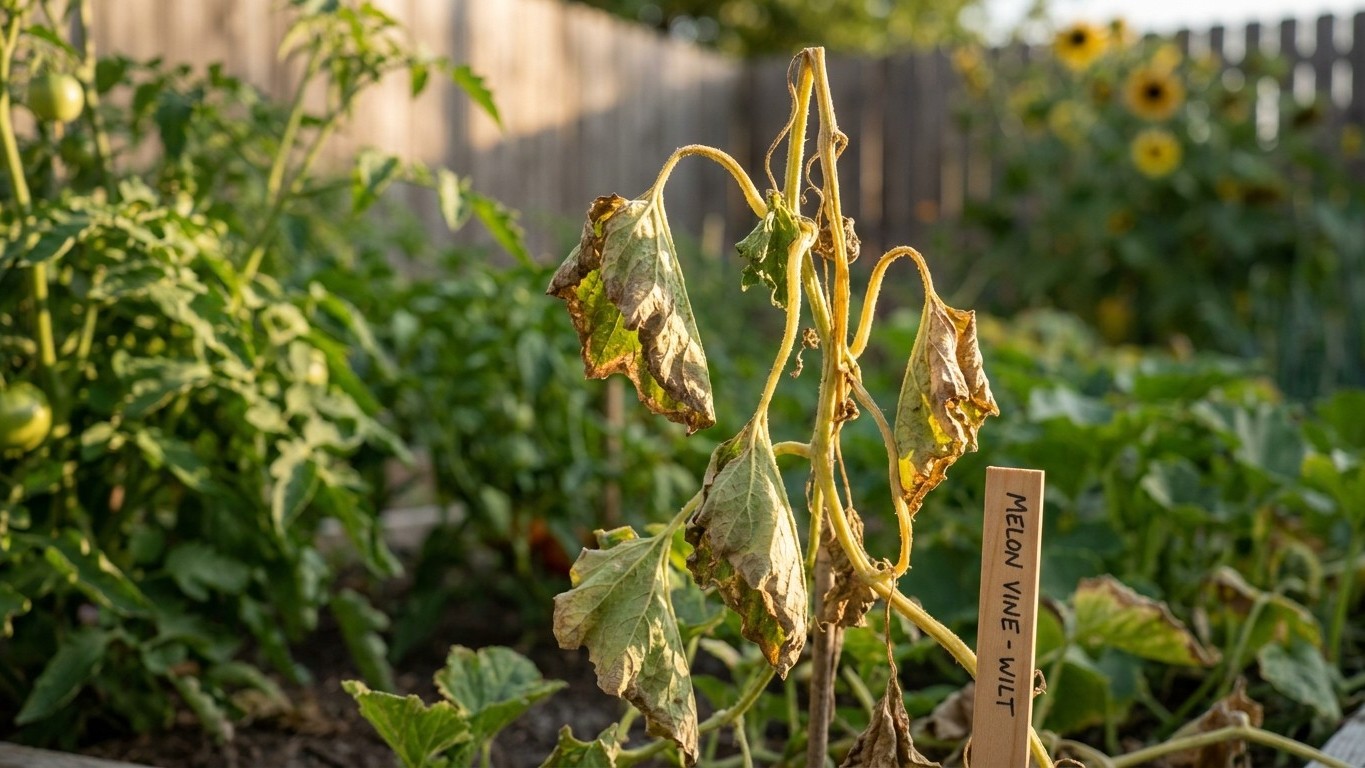

A melon vine that wilts by afternoon and perks back up by morning is just thirsty. One that wilts and stays wilted, day after day, is dealing with something water can’t fix: a blocked vascular system, usually from bacterial wilt or fusarium, and neither has a cure once it’s inside the plant.
What is actually going on

Every vine moves water from roots to leaves through a bundle of tissue called xylem, essentially plumbing built into the stem. Wilting from drought happens because the plant isn’t pulling enough water in. Wilting that doesn’t recover happens because something is physically blocking that plumbing, and no amount of watering gets past a clog.
Two culprits cause almost all of this kind of collapse in home gardens. Bacterial wilt is carried by striped and spotted cucumber beetles. The insects feed on leaves and stems, and bacteria from their gut enter the wound. Once inside, the bacteria multiply and form a slime that physically plugs the xylem. This one moves fast, often taking down a whole vine within a week or two of the first wilted leaf.
Fusarium wilt works differently. It’s a soil-borne fungus that enters through the roots, especially roots that are stressed, nicked by a hoe, or damaged by root-feeding insects. Once inside, it colonizes the vascular ring and causes the same kind of blockage, but the progression is often slower and can start on just one side of the vine before spreading. Warm soil favors it, and once it’s established in a garden bed, it doesn’t leave on its own.
Neither disease responds to extra water, extra fertilizer, or patience. The instinct to water a wilting vine harder is the natural response and the wrong one here, since standing water in already-stressed soil can make root stress worse and give fusarium an easier entry point.
Type matters more than variety name when talking about resistance. Some cantaloupe and muskmelon types have been bred with resistance to fusarium races, while resistance to bacterial wilt is far less common across melon types generally. Because resistant lines vary by region and by which fusarium race is locally common, the reliable move is checking with a state extension service or land-grant trial list for what’s been tested in that specific area, rather than trusting a name on a seed packet without local context.
One more point worth being direct about: a melon does not ripen after it’s cut from the vine. It softens, and it can look and feel more like a ripe melon, but the sugar already in the fruit at harvest is all the sugar it will ever have. If a wilt takes down the vine before the fruit has finished sizing and sweetening, there’s no windowsill fix waiting on the other side.
In the garden
Before assuming the worst, there’s a field check that takes less than a minute and separates a soil or watering problem from a vascular disease. It won’t identify the exact pathogen, but it tells a gardener which direction to go next.
| Test | How to do it | If this happens | If this happens instead |
|---|---|---|---|
| The ooze test | Cut a wilted stem near the soil line, then touch the two cut ends together and slowly pull them apart. | Sticky white strands stretch between the pieces like thin cheese: that’s bacterial wilt, and the vine should come out now, since it will only decline further and can spread through beetle feeding. | A clean break with no strands means bacterial wilt is unlikely; look at the vascular ring instead. |
| The vascular ring | Slice a stem lengthwise and look at the ring of tissue just under the outer skin. | Brown or reddish-brown discoloration in that ring points to fusarium; the vine is not coming back and should be removed to limit fungal buildup in that spot. | Pale, unbroken tissue suggests the cause is elsewhere, most likely root damage, waterlogging, or a borer at the base of the stem. |
| The whole-planting pattern | Compare the wilted vine to its neighbors in the same bed. | Only one plant down while others nearby look fine often points to fusarium sitting in one patch of soil, or to mechanical injury at that one plant. | Wilt moving from vine to vine down the row over a week or two is the classic bacterial wilt signature, since beetles carry it as they feed their way along the planting. |
| The beetle count | Check the base of the plant and the undersides of leaves at dusk, when cucumber beetles are most active. | Striped or spotted beetles present in numbers makes bacterial wilt the leading suspect, and managing that population early next season matters more than treating this year’s plant. | No beetles found shifts the suspicion toward a fungal or root-based cause, and toward soil history rather than insect pressure. |
Whatever the result, a vine that fails this test doesn’t get better with feeding, staking, or a fungicide poured at the base after the fact. The useful information from this check isn’t for saving this year’s plant. It’s for deciding what to do differently in that same bed next year.
What it depends on where you are
Some of this is the same everywhere melons are grown, and some of it changes hard by region, and it’s worth being honest about which is which. The biology of bacterial wilt and fusarium doesn’t change state to state. What changes is pressure and timing.
Cucumber beetle populations build faster and stay active longer where winters are mild and the growing season stretches long, which raises bacterial wilt pressure across much of the South and the mid-Atlantic. In shorter-season northern regions, beetle populations still show up, but the window of risk is compressed, and a late planting can sometimes dodge the worst of the early-season beetle flush that a spring planting runs straight into.
Fusarium plays by different rules. Its spores can persist in soil for years regardless of climate, but warm soil temperatures speed up infection, so regions with hot early summers tend to see symptoms show up sooner and spread faster once a field is contaminated. Rainfall patterns matter too, since heavy, poorly drained soil stresses roots and gives the fungus an easier way in, while soil that drains well and warms gradually tends to see a slower disease curve even when the fungus is present.
None of this changes what the field test in the section above tells a gardener about their own vine. It changes how much beetle management and rotation planning matters relative to other risks, and that’s a local question. A state extension service, or the site’s own state-by-state melon guides, will have the season-length and pest-pressure specifics that apply to one particular garden rather than the country as a whole.
The mistake that costs the most
The single most expensive mistake isn’t misreading a wilted vine in the moment. It’s planting melons back in the same spot the following spring because this year “was just bad luck” or “maybe the weather.”
Fusarium spores don’t clear out on their own. They sit in soil for years, sometimes for the better part of a decade, waiting for another susceptible root to grow nearby. A gardener who loses a patch to fusarium in July and replants that same bed with melons the next May is very often planting straight back into the same infected soil, and the second loss tends to arrive faster than the first because the fungal population had a full season to build.
The fix isn’t a treatment poured into the soil after the fact, since there isn’t one that reliably clears fusarium from a home garden bed. The fix is rotation: moving melons, along with other cucurbits like squash and cucumbers, out of that specific spot for several years, and using that time to check with a state extension service for melon types with documented resistance to the fusarium races common in that region. Pairing that rotation with early-season attention to cucumber beetle numbers, before bloom rather than after wilting starts, addresses the bacterial side of the same problem at the point where it can still be managed rather than only diagnosed.