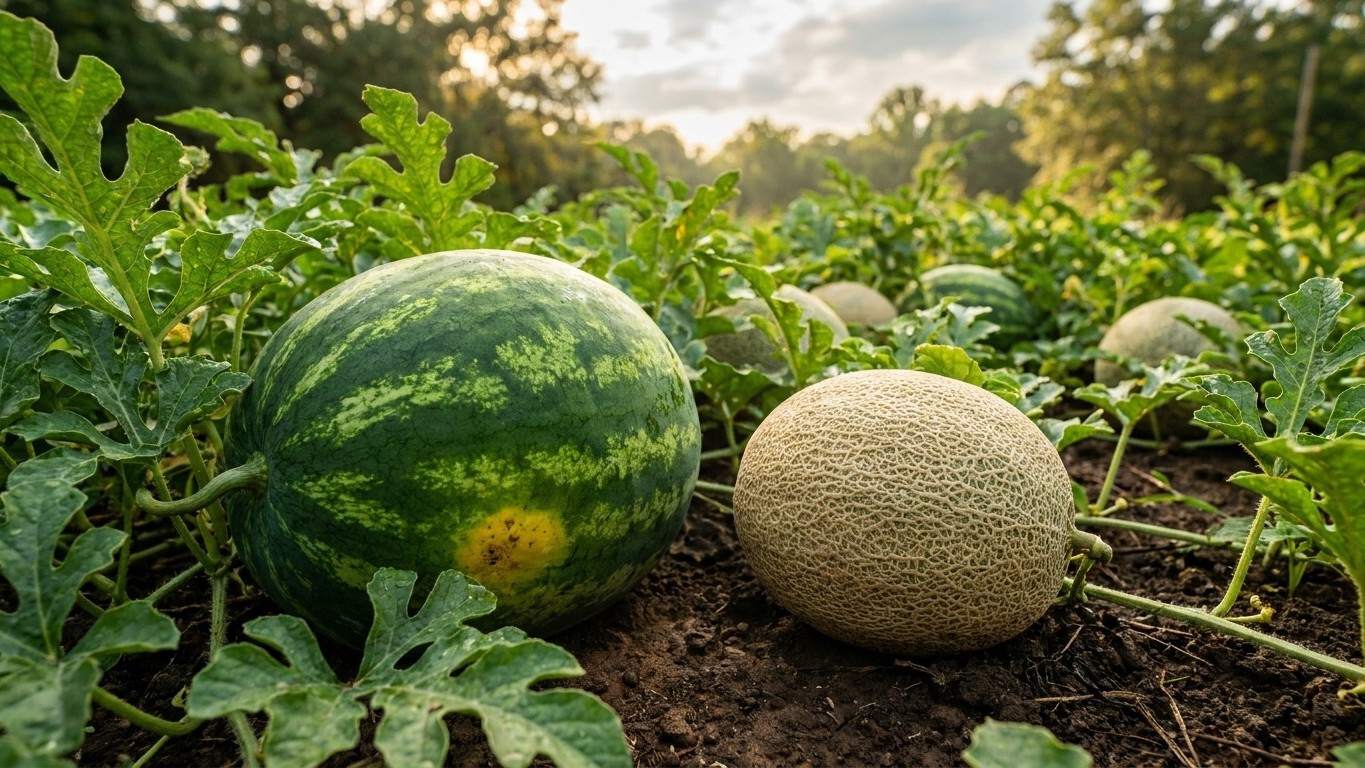

Watermelon and cantaloupe are the safe picks across Alabama; honeydew and other dry-climate melons fight a losing battle against the state’s humid summers. The state’s long frost-free window and heavy summer heat favor heat-loving vine crops, but humidity, not season length, decides which melon types actually finish sweet instead of rotting on the vine.
The short answer for Alabama
Start with the calendar. At the reference station used for these normals (Huntsville, station USW00003856), the last spring frost falls between March 19 and April 3, and the first fall frost arrives between November 2 and November 16. That’s a frost-free window of roughly 213 to 242 days, depending on how the two ranges line up in a given year. Almost every melon type, from a quick 75-day cantaloupe to a slow 100-day watermelon, fits inside that window with weeks to spare. Season length simply isn’t the constraint here.
Heat isn’t the constraint either. The same reference station logs an average of 58.5 days a year at or above 90°F. Melons are warm-season crops that stall in cool soil and thrive once the heat sets in, so that many hot days is an asset, not a threat.
What actually separates a good melon year from a bad one is the combination of that heat with roughly 12.1 inches of rain falling across June, July and August, most of it as July’s 4.49-inch peak rather than a steady drizzle. That pattern, warm and wet in bursts, is exactly the recipe for the fungal diseases that plague melons in the Southeast. Types bred for dry climates don’t have the resistance built in.
By melon type
| Melon type | Fit for Alabama | Why |
|---|---|---|
| Watermelon | Strong | Heat-loving, tolerates humid-summer disease pressure better than most |
| Cantaloupe / muskmelon | Strong | Matures well inside the long frost-free window, handles the heat load |
| Honeydew | Weak | Bred for arid climates; struggles against summer humidity and rot |
| Casaba / Crenshaw | Weak | Thin rind and low disease resistance clash with the rainfall pattern |
The takeaway for a state page: pick your melon by moisture tolerance first, then worry about which cultivar fits your garden size. Your county extension office will have the cultivar-level answer, and that’s covered further down.
What will not work here

Dry-climate melons top the list of failures. Honeydew, casaba and Crenshaw types evolved for low-humidity growing regions, and Alabama’s summer rainfall, concentrated in July’s 4.49-inch average with June and August close behind, keeps foliage and fruit surfaces damp far longer than those varieties can tolerate. The result is powdery mildew, downy mildew and fruit rot showing up before the melon ever sweetens.
A rigid once-a-week watering schedule also fails here, just not for the reason gardeners expect. With 58.5 days a year above 90°F, evaporative demand swings hard from one day to the next, while summer rain tends to arrive as thunderstorm bursts rather than gentle, even soakings. A gardener watering strictly by the calendar, ignoring both the heat spikes and the gaps between storms, ends up with soil moisture that lurches from soaked to bone-dry. Melons respond to that lurch by cracking their rinds or dropping fruit at the blossom end, especially in watermelon, which is sensitive to inconsistent moisture right as the fruit sizes up.
Tight spacing is another common mistake that backfires specifically because of the humidity here. Packing vines close together, a trick that works fine in drier climates, traps moist air around the leaves and accelerates the same mildew problems that dry-climate varieties already struggle with. Wider spacing and better airflow matter more in Alabama’s climate than in a dry-summer state where the same layout would be harmless.
Finally, planting too early into cool, still-wet spring soil is a real risk given the March 19 to April 3 frost window. Melon seed wants warm soil to germinate reliably, and a gardener who direct-seeds the moment the calendar clears the last-frost date, without checking that the soil itself has actually warmed, often loses the planting to seed rot rather than frost. The frost date protects against cold air; it says nothing about cold, saturated soil.
What changes across Alabama
Alabama isn’t one climate, and the hardiness zone range makes that obvious: the USDA Plant Hardiness Zone Map places the state anywhere from 7a to 9a, based on average annual extreme minimum temperatures. That’s a wide spread for one state, and it means there’s no single melon calendar that fits Mobile and the higher elevations of northeast Alabama equally well.
The frost dates cited above come from the Huntsville-area reference station, which sits toward the cooler end of that zone range. A gardener near the Gulf Coast, closer to zone 9a, should expect a noticeably longer frost-free season than the Huntsville figures suggest, both an earlier last spring frost and a later first fall frost. That extra length opens the door to succession plantings or even a second melon crop timed for early fall, options that don’t make sense on the Huntsville numbers alone.
Higher elevations and the northernmost parts of the state, closer to zone 7a, run the other direction: expect the frost-free window to be tighter than the Huntsville figures, not looser, and treat the March 19 to April 3 spring frost range as an early estimate rather than a guarantee. Cooler spring soil at these elevations also means the soil-warmth check matters even more before seeding.
None of this can be resolved from a state-level page. The right move is to look up your own location on the USDA Plant Hardiness Zone Map rather than guess which end of the 7a-9a range applies to your yard.
Where to check this for your own county
The Alabama Cooperative Extension System, at aces.edu, is the source built for exactly this gap between a state answer and a county answer. Two things are worth pulling up there specifically: the local vegetable planting calendar for your county, and any variety trial results for melons grown in your part of the state.
The planting calendar matters because it will reflect your county’s actual frost history rather than the Huntsville station numbers used above. A county in the Tennessee Valley and a county on the coastal plain can differ by two or three weeks on both ends of the season, and that difference changes when it’s safe to set out transplants or direct-seed.
The variety trial information matters even more for melons specifically, since Extension agents track which cultivars actually held up against local disease pressure in a given year, information no state-wide page like this one can capture. If a particular watermelon or cantaloupe cultivar has shown strong resistance to the mildews common in your county’s humidity, that’s the kind of detail a county Extension office will have and a state overview won’t.
Say it plainly: a county recommendation beats a state one every time. This page gives you the reasoning behind Alabama’s climate and why certain melon types make sense here. Your county Extension office gives you the specifics, tuned to your soil, your rainfall pattern and the diseases that actually showed up in local gardens last season.
Checking this against your own garden
Every date and normal describes an average. Your own garden will tell you something more current, and three simple observations outrank any calendar.
Feel the soil before you seed. Melon seed wants soil that’s warm to the touch, not just air that’s warm during the day. If the soil still feels cool an inch or two down even after the calendar’s frost window has passed, that’s a sign your particular spot, whether from shade, heavy clay, or a low-lying cold pocket, runs behind the regional average, and you should wait rather than trust the date alone.
Watch for the first flush of male flowers. Melon vines produce male flowers before female ones, often by a week or more, and that first flush signals the plant has shifted into reproductive growth. Seeing it earlier or later than you’d expect from the regional heat pattern tells you how your yard’s own heat accumulation compares to the wider area.
Track how fast the first true leaves push out after the seed leaves. Vigorous, quick true-leaf growth means the seedling has settled comfortably into your soil and air temperatures. Sluggish true-leaf emergence, even when the calendar says conditions should be fine, is your garden telling you it runs cooler than the regional normals, and that any second planting should wait a little longer than the state page suggests.