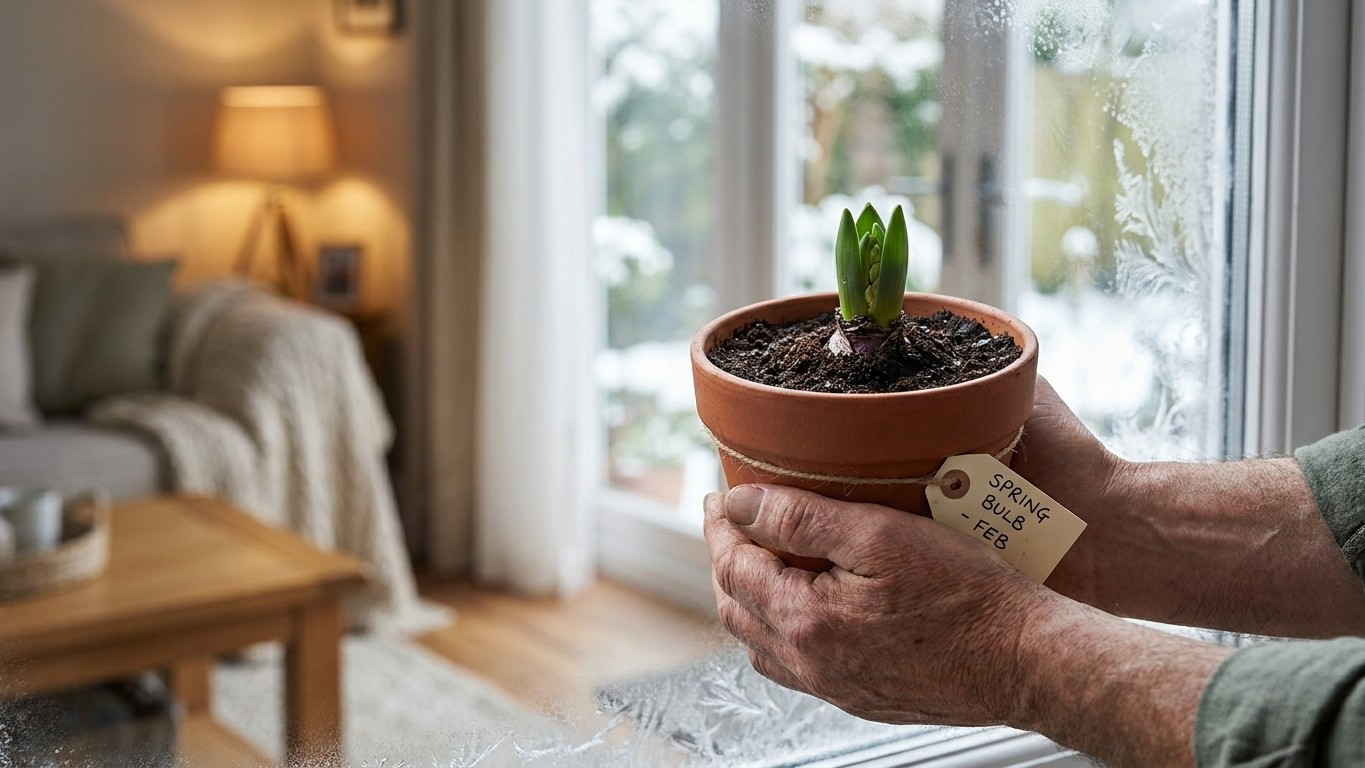

Alabama’s winter rarely gets cold enough, for long enough, to chill spring bulbs the way they need in the ground. Forcing solves that: you supply the cold yourself, indoors, then bring the bulb into warmth on your schedule instead of the weather’s.
Why this matters in Alabama

The number that decides this is 33.1°F. That’s the mean daily minimum for the coldest month at the Huntsville reference station (NOAA NCEI Climate Normals, 1991-2020). It sits right at the edge of the 45°F threshold spring bulbs need to hold for 12 to 14 weeks before they’ll bloom properly, and an average is not a guarantee. Some nights dip well below it, plenty of others don’t, and the stretch rarely stays cold enough long enough to count as a full chilling period in the ground.
That’s the first situation described in the two-part problem forcing exists to solve: a winter that doesn’t deliver the sustained cold a tulip or hyacinth bulb requires. Alabama’s USDA hardiness zone runs from 7a up to 9a across the state (USDA Plant Hardiness Zone Map, 2023, based on 1991-2020 normals), and that range matters here. Huntsville, in the northern part of the state, sits toward the cooler end of that band. Mobile and the Gulf Coast counties sit at the warm end, closer to 9a, where a true winter chill is even less reliable. A recommendation dated to Huntsville’s numbers will read differently if you garden two hundred miles south.
The second situation, the one involving containers, is a different mechanism entirely and it’s worth separating from the first. A bulb bed in the ground is insulated by the soil around it; only the top few inches feel the full brunt of a cold snap. A bulb in a pot has no such buffer. The pot wall is exposed on every side, so a container can freeze solid, roots and all, at air temperatures the same bulb would shrug off in a garden bed. That means the hardiness zone number that describes survival in the ground doesn’t describe survival in a pot. A bulb rated hardy to zone 7a can still die in a 7a container that freezes through overnight, because the threshold for a pot is different from the threshold for open soil.
Put those two facts together and the practical takeaway for most of Alabama is this: the state’s mild coldest-month minimum makes natural, reliable chilling unlikely almost anywhere in the state, and anyone trying to chill a potted bulb outdoors as a workaround runs into the second problem, a pot that freezes through even where the ground stays workable. Indoor forcing, where you control the cold directly, sidesteps both issues at once.
How to do it here
The sequence below assumes you’re supplying the cold yourself rather than relying on an Alabama winter to do it. Every step is something you can check on your own thermometer or refrigerator dial, not a general instruction to trust.
- Pick a bulb suited to forcing and pot it in late fall. Use a container with drainage holes and a standard well-draining potting mix. Set the bulbs close together, shoulders at or just below the soil surface.
- Water once, thoroughly, then let the pot sit until it’s evenly moist, not soggy. This is the last watering before the cold period begins for most gardeners; check the soil weekly and only add water if it’s gone fully dry.
- Move the pot to a spot that holds a steady temperature between roughly 35°F and 45°F for the required weeks. Most spring bulbs need 12 to 14 weeks in that range. In Alabama, that’s rarely an outdoor bed given the 33.1°F coldest-month average, so the two practical options are an unheated garage that reliably stays above freezing on its coldest night, or the vegetable drawer of a working refrigerator.
- Keep the refrigerator drawer away from any fruit that’s ripening. Apples, pears, and bananas give off ethylene gas as they ripen, and ethylene damages the flower bud forming inside the bulb before you ever see it. A bulb that sat next to a fruit bowl for three months can come up with leaves and no flower at all.
- Check the garage option against the pot’s true exposure, not just the zone map. Because a container has no soil mass to buffer it, treat any bulb going through cold treatment in a pot as needing shelter at least two hardiness zones milder than what the bulb would tolerate in open ground, or move it indoors and mulch it heavily on any night below freezing.
- Bring the pot into a cool, bright room once the chilling weeks are up. Sixty to sixty-five degrees is enough. A sudden move into a hot, dark spot is what produces a flower stalk too short to clear the leaves.
- Rotate the pot every few days once shoots appear. Forced bulbs lean hard toward a light source, and an unrotated pot topples faster, especially with taller stems.
Which bulbs are worth it
Not every bulb answers this effort the same way. The ones that force well tend to have a shorter cold requirement and a stem that stays low enough not to topple once it’s indoors in warm, dry air. The ones that sulk usually need either a longer chill than most gardeners want to manage in a refrigerator drawer, or grow a stalk too tall and top-heavy for a small pot.
Where a bulb is going to be a one-season purchase in Alabama anyway, forcing costs nothing extra in the long run. A hyacinth or a paperwhite grown from a store-bought bulb was never going to naturalize reliably in most of the state’s mild winters, so using it up on an indoor bloom is not a loss.
- Paperwhite narcissus — needs no cold period at all, blooms in three to four weeks from potting
- Hyacinth — short stem, reliable bloom after about 12 weeks of chilling
- Crocus — compact, tolerant of imperfect timing
- Grape hyacinth (Muscari) — short stem, forces easily in a shallow bowl
- Tulips — long chill requirement and a tall, floppy stem once forced, uneven results without exact timing
- Daffodils (trumpet types) — taller stems tend to lean and need staking indoors
- Allium — chill period runs long and the flower head is often too heavy for the stem indoors
What goes wrong, and when you can still fix it
Leaves, no flower
This means the chilling period was cut short. The bulb has enough stored energy to push leaves but never finished forming a flower bud inside. There’s no fix once the leaves are up; the bulb has already spent what it had. Note the number of weeks it actually got in the cold and add at least two more next time.
A flower on a stem too short to see over the leaves
This happens when the pot moved from cold to warm too fast, or into a spot that was too warm too soon. The flower is already formed and will open, just low and often hidden. Nothing recovers the stem length this season, but a slower transition next time, a few days at an in-between temperature before full room warmth, fixes it going forward.
Rot at the base of the bulb
Soft, dark tissue at the base almost always means the pot never drained. Standing water during the cold weeks suffocates the roots and invites rot before the bulb ever gets a chance to bloom. A rotted bulb won’t recover this season. For the next round, drainage holes and a mix that doesn’t stay saturated matter more than almost anything else in the process.