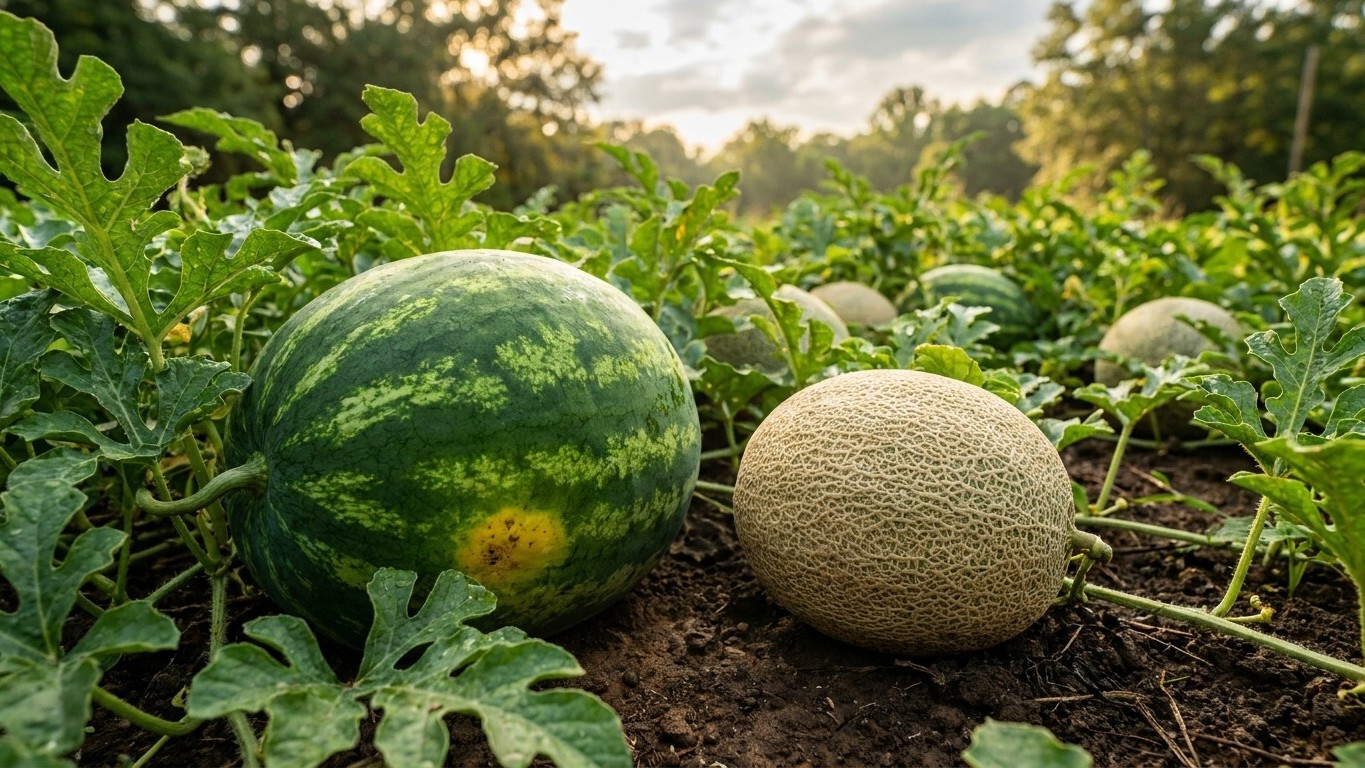

Short-season muskmelons and compact icebox watermelons are the safest bet almost everywhere in Illinois, while honeydew and full-size, 100-day watermelons only pencil out in the state’s southern tip. The dividing line comes down to two numbers: how many frost-free days a spot actually gets, and how many of those days climb past 90F.
The short answer for Illinois
For most of Illinois, the safest melon category is a fast muskmelon (cantaloupe-type), one bred to mature in roughly 75 to 85 days, paired with an icebox-size watermelon in the 80 to 85 day range. Full-size watermelons that need 95 to 100 days, and honeydew types that want sustained heat on top of that, belong in the southern third of the state where the frost-free window runs longest and hottest.
That decision comes straight from this state’s own numbers, not a generic melon chart. At the reference weather station, last spring frost falls between April 11 and April 22, and first fall frost arrives between October 24 and November 3. Stretch that out and the frost-free window at that station runs somewhere around six to seven months, depending on where in that date range a given year lands. Six to seven months sounds generous, but melons don’t just need to avoid frost, they need enough hot days to actually ripen sugar, and that’s where Illinois gets less generous: the same reference station averages only 14.0 days a year at or above 90F. That’s a moderate heat load, nowhere near what a Deep South garden gets, and it’s the number that rules out the slowest, heat-hungriest melon types for anyone north of the state’s southern counties.
Rainfall factors in too. Summer rain at the reference station averages about 12.1 inches across June, July and August, with July running driest at 3.71 inches. That’s enough moisture that irrigation isn’t the limiting factor here the way it is in drier states, but it also means humidity sticks around, which matters more for disease risk than for melon choice itself. Muskmelons and icebox watermelons ripen inside that six-month window and inside that 14-day heat budget with room to spare. Honeydew and full-size watermelon eat into every spare day and every spare degree, which is why they’re a southern-Illinois crop more than a statewide one.
If a gardener wants one melon type to try first anywhere in the state, a fast muskmelon is the lowest-risk choice: short enough to finish even in a cool year, forgiving enough of a late spring frost pushing the start date back.
What will not work here

The clearest failure mode in Illinois is a slow, heat-hungry melon planted north of where the season actually supports it. A watermelon that needs 100 days to mature, started only after soil has warmed past the last frost date of April 11 to April 22, is racing a fall frost that can show up as early as October 24. Subtract transplant setback, a cool stretch in June, and any early-October chill, and that 100-day variety is often still on the vine when the first frost date is only weeks away. It’s not a marginal risk, it’s the math not working.
Heat load makes the same point from a different angle. With only 14.0 days a year averaging 90F or hotter at the reference station, a melon bred for Deep South heat, the kind that needs long stretches of 90-plus days to push sugar into the fruit, simply doesn’t get enough of those days here to reach its full flavor potential. It may vine, flower and set fruit, and still disappoint at harvest because the sugar never fully developed. That’s a heat-budget failure, not a growing-technique failure, and no amount of fertilizer fixes it.
Watering habits sourced from a drier state also fail here. Illinois summers bring about 12.1 inches of rain over June through July and August, which is a meaningful amount of moisture, but it doesn’t arrive evenly. July, the driest of the three months at 3.71 inches, often delivers that rain as a handful of thunderstorms rather than steady soaking, and a thunderstorm mostly runs off rather than sinking in, especially on clay soil common across much of the state. A gardener who assumes the season’s rainfall total means they can skip watering for weeks at a stretch is likely to see the melon vines wilt between storms.
Tight spacing is the third trap. That same rainfall pattern keeps humidity high enough, especially in low spots and along the Illinois and Mississippi River bottoms, that powdery and downy mildew move fast through crowded vines. Melons planted at the spacing recommended for a drier climate tend to mildew out here well before frost even becomes a factor.
What changes across Illinois
Illinois is not one melon climate, it’s several stacked on top of each other. The state spans USDA hardiness zones 5a through 7b, a spread built on a single measurement, the average annual extreme minimum temperature, and that two-and-a-half-zone range tells you the season length and heat load at the southern tip look nothing like what a garden near the northern border gets.
A gardener near zone 7b, in the southernmost counties, is working with a frost-free season noticeably longer than the reference-station dates above, and almost certainly more days above 90F than the statewide reference of 14.0. That’s exactly the kind of stretch where a full-size, 100-day watermelon or a honeydew has room to actually finish. A gardener near zone 5a, up toward the northern counties, is working with a shorter, cooler season than the reference figures suggest, since those figures already come from an airport station and rural or elevated ground nearby tends to run a week or two colder on both ends. For that gardener, sticking to the fastest muskmelon and icebox watermelon types isn’t caution for its own sake, it’s what the calendar actually allows.
No single Illinois planting date or melon variety fits both ends of that range. What matters is knowing roughly where a given garden sits inside that 5a-to-7b spread, and the way to find that out is the USDA Plant Hardiness Zone Map, not a guess based on which end of the state feels warmer in July.
Elevation and river bottoms add a second layer of variation on top of latitude. A low-lying garden near a river can hold cold air on a frost-prone spring night even in a county that’s otherwise solidly in a warmer zone, while a sheltered south-facing slope can run a week ahead of an open field nearby. Zone tells you the region. It doesn’t tell you the specific plot.
Where to check this for your own county
The Illinois-wide picture includes reference frost dates, a statewide heat number, and a hardiness zone range spanning three-plus zones. That’s useful for deciding which melon type to even attempt, but it’s not a substitute for county-level guidance, and it isn’t meant to be.
The University of Illinois Extension, at extension.illinois.edu, is where that county-level answer lives. Two things are worth looking for there specifically. First, a local planting calendar for the reader’s own county or the nearest county office, which will reflect that area’s actual frost dates rather than the airport-station dates cited here, dates that can run a week or two later in spring and earlier in fall once you’re away from the reference station itself. Second, any variety trial results or extension bulletins naming muskmelon, watermelon or honeydew varieties that performed well in Illinois trials specifically, since those trials account for the state’s humidity and disease pressure in a way a seed catalog’s national description doesn’t.
A county recommendation beats a state one every time, because it’s built on local frost records and local trial plots rather than a single airport-based average covering the whole state. The state-level layer tells a reader what category of melon makes sense and why, based on season length and heat load. The extension office’s county material is the next, more specific layer down, and it’s the one that should settle the actual planting date and variety choice.
Checking this against your own garden
Every date and average describes a reference station and a statewide range. The garden in front of a reader outranks all of it, and three simple observations settle what that garden is actually doing.
Soil warmth by feel comes first. Melon seed germinates poorly in cold soil, so before planting, a gardener can simply press a hand into the top few inches of bed soil on a sunny mid-morning. If it feels cool to the touch rather than comfortably warm, the ground hasn’t caught up to the calendar yet, regardless of what the reference frost date says.
The first flush of male flowers is the second signal. Melon vines put out male flowers, the ones without a small swollen bulge behind the petals, well before the female flowers that actually set fruit. Seeing that first flush of male blooms means the plant has moved into reproductive growth and the heat load so far has been enough to get it there. A vine that’s still all foliage well into summer is a sign that season’s heat has been running behind the statewide average that year.
First true leaves, the leaves that emerge after the two rounded seed leaves and actually look like melon foliage, mark the point where a seedling has shifted from surviving to actively growing. If those true leaves are slow to appear, or come in small and pale, that’s the garden’s own microclimate saying the soil or the season is running cooler than the reference numbers assume. None of these signs need a thermometer or a gauge, just a hand and a close look at the vine, and together they tell a gardener more about their own patch of ground than any statewide average can.