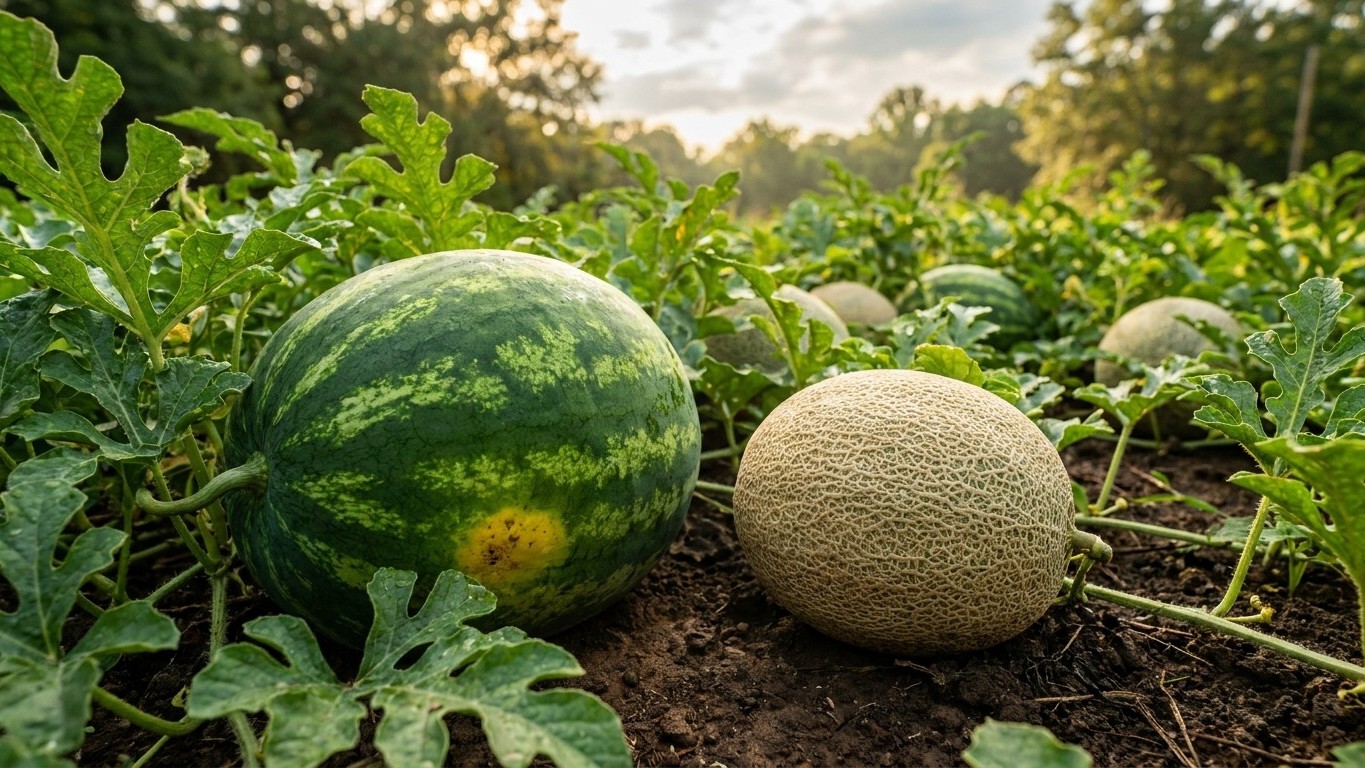

Cantaloupe and muskmelon types are the safest bet across New Jersey, with icebox watermelons a close second. Honeydew and the largest long-season watermelons are the riskiest picks, because they ask for more sustained heat and a longer stretch of dry weather than the state’s average summer reliably supplies.
The short answer for New Jersey
Start with the two numbers that actually decide this: the frost-free window at the Newark reference station runs from roughly March 29 to April 6 on the spring end, to November 4 through November 16 in the fall. That’s a season long enough, on paper, for almost any melon on the market. The catch is heat load, not season length. Newark averages 20.8 days a year at or above 90F, which is moderate, not the sustained blast of a desert-growing region. That single fact rules certain types in and others out before you even look at a seed catalog.
Melons that finish in 75 to 90 days and don’t demand weeks of unbroken heat, cantaloupe, muskmelon, and icebox-type watermelons, fit that heat profile well. Melons bred for longer, hotter growing regions (many heirloom watermelons, most honeydews) push the edges of what a New Jersey summer with 20.8 hot days can reliably finish.
| Melon type | Typical days to maturity | Heat requirement | Fit for NJ (Newark reference) |
|---|---|---|---|
| Cantaloupe / muskmelon | 75-90 | Moderate | Good |
| Icebox / personal watermelon | 70-80 | Moderate | Good |
| Charentais | 75-85 | Moderate | Good, but watch humidity |
| Large / heirloom watermelon | 85-100 | High, sustained | Borderline |
| Honeydew | 85-100 | High, sustained | Marginal |
The second number that matters here is rainfall, not just heat. Summer at the reference station averages about 13.2 inches of rain across June, July and August, split roughly 4.34, 4.66, and 4.15 inches by month. That’s enough moisture to keep humidity high through most of the growing season, which is exactly the condition that favors fungal disease on melon leaves and vines. So the practical answer for New Jersey isn’t just “pick a fast melon.” It’s “pick a fast melon bred for disease resistance,” because the state’s summers give you both moderate heat and real humidity at the same time, a combination that rewards varieties selected for powdery mildew and downy mildew tolerance over varieties selected purely for size or sugar content.
What will not work here
Long-season honeydew varieties bred for the desert Southwest or California’s Central Valley are the clearest mismatch. Those regions routinely rack up months of 90-plus-degree days; Newark averages just 20.8 such days a year. A honeydew that needs 100 days of strong, consistent heat to build sugar is working against the clock in a New Jersey summer, and even if it technically fits inside the frost-free window, it often finishes bland or fails to ripen fully before the first fall frost arrives between November 4 and 16.
Large heirloom watermelons in the 90-to-100-day range carry the same problem, compounded by size. A bigger fruit needs more sustained warmth to move sugar into the flesh, and 20.8 hot days spread across a whole summer isn’t a lot of runway for a slow-finishing giant. Growers who plant these varieties tend to harvest a large, pale, watery melon rather than the deep-red, high-sugar fruit the variety is capable of in a hotter state.
The rainfall numbers create a second, less obvious failure point. A gardener who waters on a fixed weekly schedule, assuming the summer’s roughly 13.2 inches of rain will fill in the rest, is gambling on rain that often arrives as a single thunderstorm rather than a steady soak. That kind of rain runs off more than it soaks in, especially on compacted or sloped ground, so a “wet summer” on paper can still leave melon roots dry between storms. At the other end, close plant spacing in a summer that’s already carrying 4-plus inches of rain most months is asking for trouble: dense foliage stays wet longer after a storm, and that lingering moisture is what lets fungal disease take hold on melon leaves before the fruit has even set.
None of this means melons fail across the board in New Jersey. It means the failures cluster around the same two causes every time: varieties asking for more heat than 20.8 days a year can supply, and watering or spacing habits that ignore how the state’s roughly 13.2 inches of summer rain actually behaves once it hits the ground.
What changes across New Jersey
New Jersey spans USDA Hardiness Zones 6a to 7b, based on the USDA Plant Hardiness Zone Map’s average annual extreme minimum temperature. That’s a wide spread for a state its size, and it means there’s no single melon calendar that applies evenly from the Highlands down to the Cape May peninsula. The frost dates and heat-day figures used above come from the Newark reference station, and they describe that station, not every backyard in the state.
A garden sitting toward the warmer end of that 6a-7b range, generally the milder, more coastal or southern parts of the state, can expect a longer effective growing season and more heat-unit accumulation than Newark’s 20.8 annual days above 90F would suggest. That’s the kind of location where a longer-season watermelon or even a honeydew becomes more realistic. A garden toward the cooler end of the range, especially at higher elevation inland, should assume a shorter frost-free window than the Newark dates and lean harder toward the fastest-finishing cantaloupe and icebox watermelon varieties.
Elevation matters here in a way flat-map zone numbers don’t capture. Cold air sinks, so low-lying or inland valley gardens can run noticeably colder on a given night than a nearby ridge or coastal spot at the same latitude, even within the same broad hardiness zone. That’s part of why USDA zones are described as a range for the state rather than a single number: the system measures one variable, extreme minimum temperature, and elevation and local topography can shift that variable meaningfully within just a few miles.
The practical takeaway isn’t to guess which end of the 6a-7b range applies to a given yard. It’s to treat the Newark frost dates as a starting reference and check them against local, county-level guidance, which is exactly where the next section points.
Where to check this for your own county
The state-level answer above is a starting point, not a finish line. New Jersey’s own land-grant extension service, Rutgers Cooperative Extension, publishes county-specific guidance that beats anything a general state page can offer, because it accounts for the local soil, microclimate and disease pressure that a statewide average necessarily smooths over. That service is reachable at njaes.rutgers.edu.
Two things are worth looking for once there. First, a local planting calendar for the specific county, which will reflect frost timing closer to that county’s actual conditions rather than the Newark airport figures used as the statewide reference. Second, any list of melon varieties that Rutgers or a county agent has actually trialled in New Jersey conditions, since variety performance against local disease pressure, particularly the powdery and downy mildew risk created by the state’s humid summers, is exactly the kind of detail that a regional trial captures and a general buying guide can’t.
The state’s climate normals say a lot about melon types in general: season length, heat load, and summer rainfall patterns at one reference station. A county extension office can go further, because it can tell a grower which named varieties held up against local disease pressure in an actual trial plot, not just which categories of melon fit the climate on paper. That’s a meaningful difference, and it’s the reason a county-level recommendation should always outrank a state-level one when the two disagree.
Checking this against your own garden
Every date and average describes a reference station, not a specific backyard, so the most reliable check left is the garden itself. Three signs are worth tracking before committing to a melon planting date, and none of them require anything beyond a hand and a pair of eyes.
- Soil warmth by feel: melon seed wants soil that feels warm to the touch, not just frost-free air. Ground that still feels cold a few inches down, even after the calendar says it’s past the last frost date, is telling you that particular spot lags the regional average and needs another week or two before seeding.
- The first flush of male flowers: melon vines produce male blooms before female ones, and a strong early flush signals the plant has settled into active growth. A vine that’s slow to flower at all, well past when a seed packet’s maturity window would suggest, is a sign the local season is running cooler or shorter than the state reference implies.
- The first true leaves: the rounded seedling leaves give way to the deeply lobed true leaves within a couple of weeks of a healthy start. A long delay in that transition usually points to soil that’s still too cool or too wet, both common in a state averaging over 4 inches of rain most summer months.
None of these signs replace the frost dates or heat-day figures cited earlier. They’re the correction factor: the way a grower in a specific yard, on a specific patch of soil, finds out whether their microclimate runs ahead of or behind the reference station.