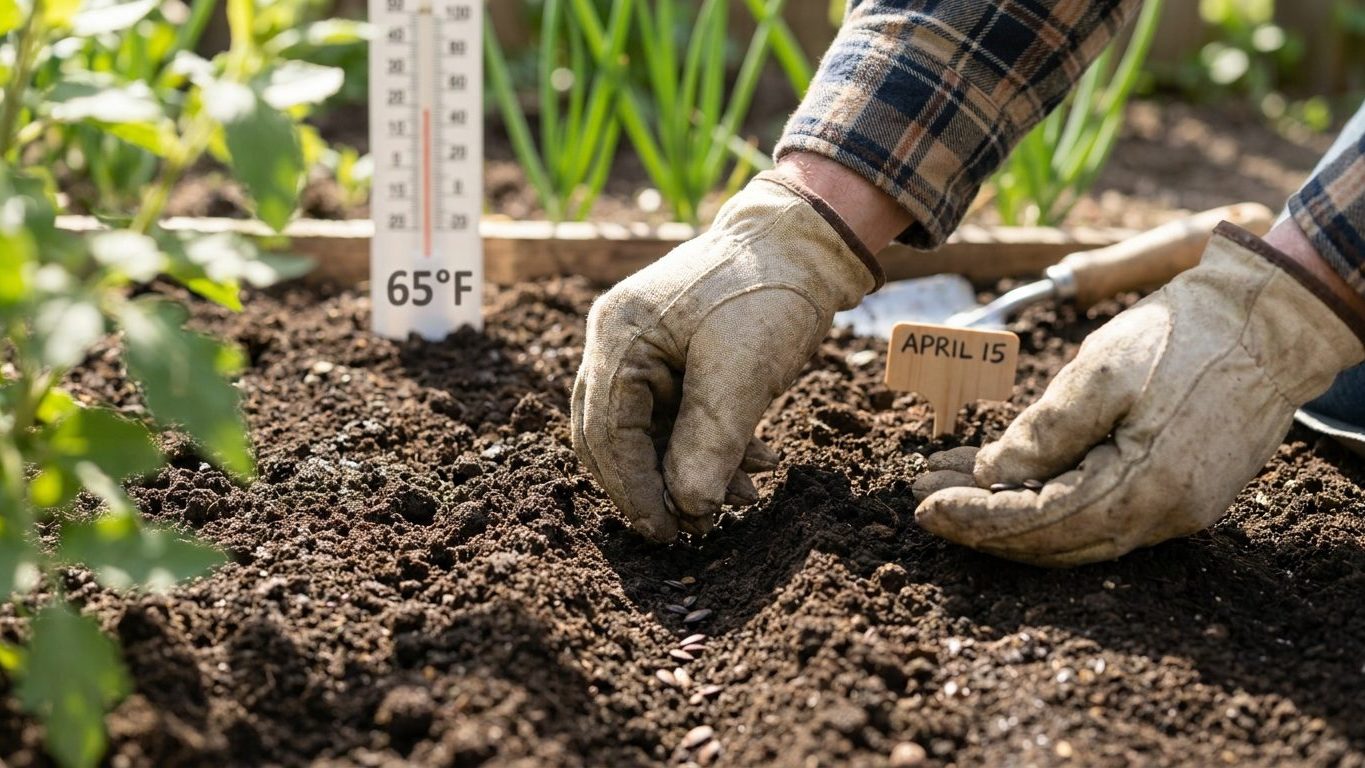

Sow melon seed indoors in early-to-mid April, then move transplants outside only once nights have settled, generally the last week of May into early June. The mean last spring frost at Halifax Stanfield sits at May 7, but that date is a midpoint, not a guarantee, and gardeners here need to treat it that way.
The short answer for Nova Scotia
The Halifax Stanfield station puts the average last spring frost at May 7 and the average first fall frost at October 18, both drawn from Environment and Climate Change Canada’s 1981-2010 normals. Stretch a calendar between those two dates and you get roughly 164 frost-free days on paper. That sounds workable for melons, which typically need 70 to 90 days from transplant to harvest depending on the variety. But a mean date is not a safe date. Frost falls later than May 7 in about half of all years, which means a gardener who plants right on that date is gambling on a coin flip.
The more useful reading is this: treat May 7 as the center of a spread, not the edge of it, and push actual transplanting into late May or the first days of June, once the soil itself has warmed rather than just the calendar. Start seed indoors three to four weeks before that transplant date, since melon seedlings resent being held too long in pots and stall if they get root-bound.
The other number that shapes everything here is heat, or the lack of it. Halifax Stanfield averages 0.0 days a year above 90°F. Melons are heat accumulators; they don’t just need frost-free days, they need warm ones, ideally with soil in the 70s and air routinely in the 80s to push sugar development and fruit sizing. A season with essentially zero days that hot is not a season built for the slow, heat-hungry end of the melon world. That single fact does more to narrow the planting calendar here than the frost dates do.
Rainfall is comparatively generous through the growing months, about 11.2 inches across June, July and August, with August running slightly drier at 3.68 inches than June’s 3.79. That’s not a drought-summer profile. It changes the risk calculus: watering neglect is less likely to be the failure point here than fungal pressure from persistent dampness, which matters when you get to spacing and variety choice below.
What will not work here

Direct-seeding melons straight into garden soil in early May is the most common way this goes wrong. Melon seed germinates poorly below 60°F soil temperature, and a Nova Scotia spring, even one that lands close to the May 7 mean frost date, rarely delivers soil that warm that early. Seed sown directly at that point often rots before it sprouts, or germinates so slowly that the plant loses weeks it can’t spare later.
Long-season melon varieties are the second failure point, and the arithmetic is unforgiving. A cultivar bred for 95 to 100 days to maturity, the kind that thrives with a long run of 90°F-plus days in a hotter growing region, is asking for a heat budget this station simply doesn’t have. With 0.0 average days above 90°F, fruit on a long-season type may reach full size but never finish ripening, sitting bland and under-sweet even as the vine runs out of season. This is not a spacing or fertility problem; it’s a heat-unit shortfall that better soil can’t fix.
Humidity, not drought, is the real summer risk
Because summer rainfall here runs a healthy 11.2 inches rather than a scorched, arid total, the classic failure mode of hot dry regions, under-watered vines collapsing in August, is less common. Instead, the risk flips: melons planted at tight spacing in consistently damp air are prone to powdery and downy mildew, both of which spread fastest where foliage stays wet and airflow is poor. A planting scheme copied from a hot, dry state’s garden guide, with plants packed close because water is scarce there, works against you in a Nova Scotia summer where the constraint is fungal pressure, not drought.
Waiting for a truly frost-free calendar before starting anything indoors is the last trap. Given the 70-to-90-day maturity window most melons need and a mean fall frost of October 18, a gardener who waits until late May to even start seed indoors, rather than transplant, is cutting the season close for anything but the fastest-maturing types.
What changes across Nova Scotia
The zone figure attached to this province, 6b in the Canadian hardiness system, belongs specifically to the reference city behind the Halifax Stanfield station, not to Nova Scotia as a whole. That distinction matters more here than it would in a smaller or flatter territory. The Canadian system is built from seven climate variables, not the single minimum-temperature measure the USDA scale uses, and Natural Resources Canada is explicit that the two systems don’t convert cleanly, so this number should never be read against a USDA figure or assumed to travel unchanged to another part of the province.
Nova Scotia is not one climate wearing one zone. Coastal districts exposed to the Atlantic and the Bay of Fundy run cooler and foggier through early summer than inland pockets like the Annapolis Valley, which is known provincially for warming faster in spring and holding heat longer into fall, an advantage that shows up in the region’s long-standing fruit-growing history. Cape Breton’s higher ground and its more northern latitude push both the last spring frost and the first fall frost later and earlier respectively, shortening the usable window well below the province-wide averages cited here.
None of this means a gardener in Yarmouth or Sydney should assume they share Halifax’s numbers. It means the spread across the province is wide enough that a single planting date is a starting estimate, not an instruction. The way to find where a specific property sits is the interactive zone map at Natural Resources Canada’s Plant Hardiness site, which lets a reader check the zone tied to their own municipality rather than borrowing Halifax’s.
Where to check this for your own county
Nova Scotia’s provincial agriculture department maintains its resources at novascotia.ca/agri/, and that page is the next stop for anyone trying to move past province-wide averages toward something closer to their own soil. A provincial figure like the May 7 mean frost date is built from one weather station; a county-level or local extension recommendation is built from repeated observation in conditions closer to a reader’s actual garden, and it will consistently beat a province-wide number for accuracy.
What’s worth looking for on that site is any local planting guidance tied to a specific county or growing district, along with records of which melon varieties have actually been trialled in Nova Scotia conditions rather than simply sold in a seed catalog written for a warmer growing region. A variety that performs well in a trial run near the Annapolis Valley’s warmer microclimate may behave differently on the South Shore or in Cape Breton, and provincial trial notes, where they exist, capture that difference in a way a national seed catalog can’t.
The province-wide answer is built from a single reference station’s normals. It’s a reasonable starting point for planning, not a substitute for whatever county-specific figures the provincial agriculture department can offer. Where the two disagree, the local figure should win.
Checking this against your own garden
Every date here is an average pulled from decades of records at one airport station. A reader’s own garden, with its own slope, soil, and exposure, will often run days or even weeks ahead of or behind that station, and three simple observations do a better job of catching that than any calendar.
Soil warmth by feel is the first and most direct check. Press a bare hand into the top few inches of soil where melons will go; if it still feels cold to the touch rather than mild, the ground hasn’t caught up to the air temperature yet, and transplants set into it will sulk regardless of what the calendar says. The second is the first flush of male flowers on the vine, which typically opens before the female flowers, those with a small swelling at the base, arrive; seeing males open tells you the plant has reached reproductive readiness for that specific spot and season. The third is how quickly true leaves follow the seedling’s first pair of round cotyledon leaves; a fast, vigorous push of true leaves signals the plant is finding real warmth and light, while a stalled seedling is telling you the microclimate it’s sitting in still runs cooler than the provincial average suggests.
Taken together, these three signs read a garden’s actual conditions in real time, which is something no station average, however carefully sourced, can do from a distance.
Some gardeners also time melons by the Moon: when to plant watermelon and cantaloupe by the moon, as almanac tradition rather than fact.