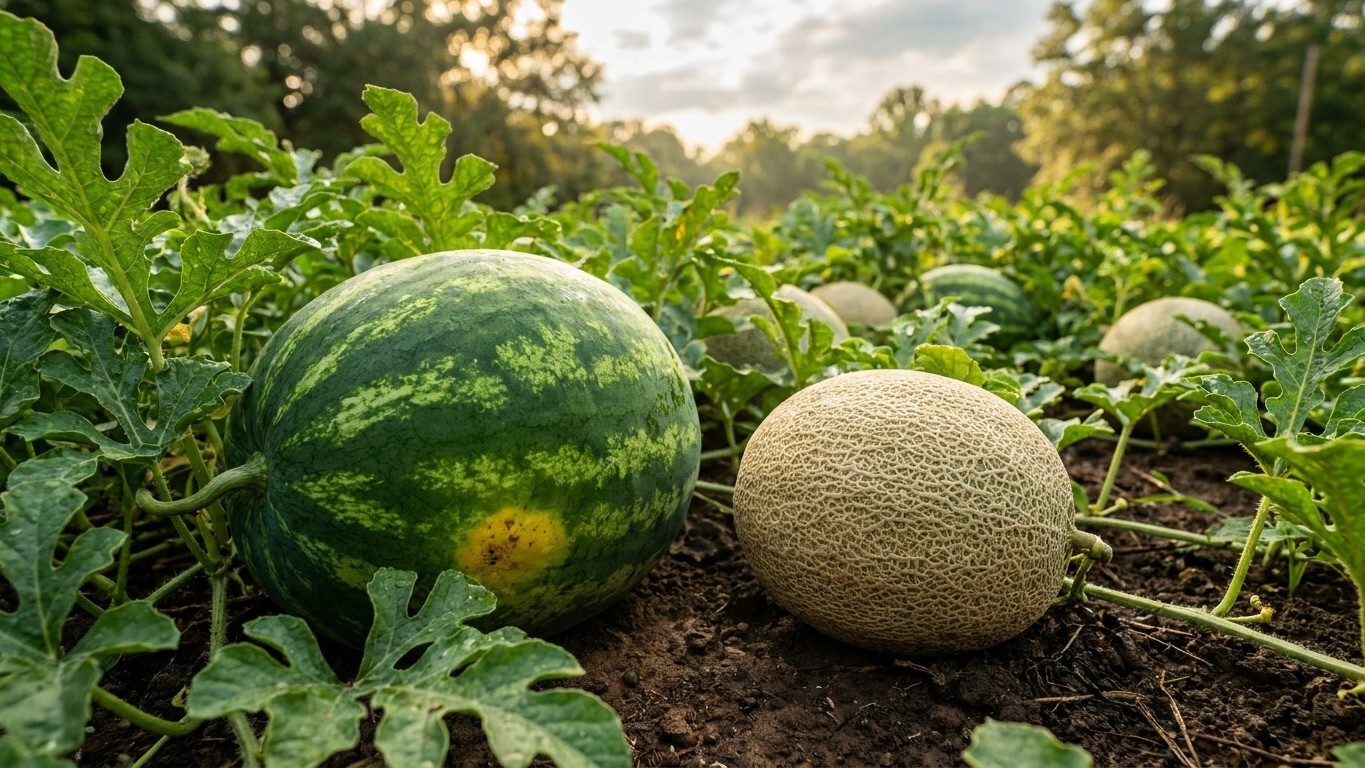

Fast-maturing muskmelon and cantaloupe types built for short, cool summers are the safer bet here, not the long-season watermelon and honeydew varieties bred for hot southern states. Nova Scotia’s growing season runs roughly 164 days between mean frost dates, but the province averages zero days a year at 90F or above, so heat, not calendar time, is the real ceiling on what ripens.
The short answer for Nova Scotia
The choice among melon types comes down to a heat budget, not a fruit preference. A melon vine doesn’t just need frost-free days, it needs accumulated warmth to push sugar into the fruit, and the Halifax Stanfield reference station records zero days a year reaching 90F. That single number rules out most of the classic large watermelon and honeydew cultivars before frost even enters the discussion.
Frost dates still matter, but treat them as a midpoint, not a guarantee. The station’s mean last spring frost falls on May 7 and the mean first fall frost on October 18, which gives an average frost-free stretch of about 164 days. Because these are averages from the 1981-2010 normals, roughly half the years bring frost later than May 7 or earlier than October 18. A melon that needs every one of those 164 days to finish has no safety margin if the season runs short.
Here’s how the main types stack up against that heat and season budget:
| Melon type | Typical days to maturity | Heat requirement | Fit for Nova Scotia |
|---|---|---|---|
| Short-season muskmelon/cantaloupe hybrids | 65-75 days | Moderate | Good, with transplants and row cover |
| Icebox or mini watermelon types | 70-80 days | Moderate-high | Workable, but little margin |
| Standard large watermelon | 80-100 days | High, sustained | Poor |
| Honeydew | 85-100 days | High, sustained | Poor |
Growers who push toward the riskier end of that table generally lean on techniques that manufacture heat the climate doesn’t supply on its own: starting seedlings indoors three to four weeks before the May 7 mean frost date, transplanting into black plastic mulch to warm the root zone, and covering young plants with row cover to trap daytime heat. None of that changes the zero-days-above-90F reality, but it buys back some of the heat units a direct-seeded, uncovered plant would never accumulate.
What will not work here

Large classic watermelon cultivars and most honeydew varieties are the clearest mismatches. Both types were bred against summers where 90F-plus days are routine, and Nova Scotia’s reference station averages none. Even in a season where frost cooperates on both ends, a fruit that needs sustained heat to convert starch to sugar can reach full size and still taste flat and underripe by the time the mean fall frost arrives on October 18.
Direct-seeding outdoors on the assumption that May 7 is a safe date is another common failure. Since that date is a mean, not a probability threshold, seed sown straight into soil that’s barely woken up faces two problems at once: cold soil slows or rots melon seed before it germinates, and any year where frost lands after May 7, which happens roughly half the time by definition, can kill young seedlings outright. Transplants started indoors sidestep both risks.
Spacing and watering habits imported from drier, hotter states also misfire here. Nova Scotia’s summer rainfall averages about 11.2 inches across June, July and August, with even the driest month, August, still bringing 3.68 inches. That’s not a drought pattern that rewards close spacing to conserve soil moisture. It’s a humid, rain-fed pattern where tight spacing and overhead watering trap moisture on leaves and encourage powdery and downy mildew. The failure mode in this territory isn’t a thirsty vine, it’s a damp, crowded one.
A short list of what tends to fail specifically here:
- Long-season watermelon and honeydew varieties needing sustained heat the region doesn’t provide
- Direct-seeded melons planted on or right after the May 7 mean frost date
- Dense vine spacing that traps humidity from the region’s 11-inch summer rainfall
- Overhead irrigation that keeps foliage wet through already-humid summer weeks
What changes across Nova Scotia
The 6b hardiness figure cited for this province comes from a single reference point, the Halifax Stanfield station, and it uses the Canadian system, which weighs seven climate variables rather than the single minimum-temperature measure the USDA system uses. That number describes conditions near Halifax. It does not describe Cape Breton’s highlands, the Annapolis Valley, or any coastal community exposed differently to wind and water.
What can be said with confidence is that a province with this much coastline and interior variation almost certainly spans more than one hardiness zone, and the gap between a milder coastal pocket and a cooler inland or upland one can mean real weeks of difference in both spring warm-up and fall frost arrival.
A reader gardening inland or at higher elevation should expect the local last frost to land later than the May 7 mean and the first fall frost to arrive earlier than October 18, shortening the already-tight window for anything but the fastest 65-to-75-day melon types. A reader in a sheltered coastal spot may find the opposite: a slightly longer effective season than the provincial average suggests. Neither guess replaces a proper check, and Natural Resources Canada’s Plant Hardiness Site is built exactly for that, mapping zones down to the municipality rather than the province.
Where to check this for your own county
Nova Scotia’s provincial agriculture department, at novascotia.ca/agri/, is the place to find figures tied to a specific county. A county-level source describes conditions where the reader’s soil actually sits, and that always beats a provincial generalization.
Two things are worth hunting for on that site or through the county contacts it lists. The first is a local planting calendar, since counties further from the coast or at higher elevation routinely see later last frosts and earlier first frosts than the May 7 and October 18 means used here, which shifts the safe transplant window for melons in either direction. The second is any list of melon or cucurbit varieties trialled specifically in that county, since agricultural extension programs frequently test which fast-maturing types actually finished a crop in local conditions rather than relying on seed-catalog days-to-maturity numbers alone.
A county-level recommendation, built from local trial results and local frost records, will always be more reliable than anything a provincial page can offer, simply because it’s closer to the ground the reader is actually planting in.
Checking this against your own garden
A direct look at the reader’s own soil and plants beats any average, and three simple checks tell most of what matters. Soil warmth by feel comes first: pushing a hand a few inches into the bed before transplanting tells whether the ground has actually caught up to the season, since melon roots stall in cold soil even when the calendar says the mean frost date has passed.
The first flush of male flowers is the second signal worth watching. Melons typically produce male flowers before the female flowers that actually set fruit, and an early, steady run of male blooms suggests the plant has already banked enough warmth to move toward fruiting. A patch that sits in flower without progressing to females for weeks is often sitting in a cooler microclimate than the provincial averages assume.
The third is the speed at which true leaves emerge after the seedling leaves. Quick, vigorous true-leaf growth points to a warm pocket doing better than the Halifax reference station’s numbers, while slow, stalled growth after transplant suggests a cooler spot, maybe a low corner that collects cold air or a shaded edge that lags the rest of the yard. Reading those three signs on the actual plants in the actual bed will always tell a grower more about their own patch than any provincial mean frost date can.