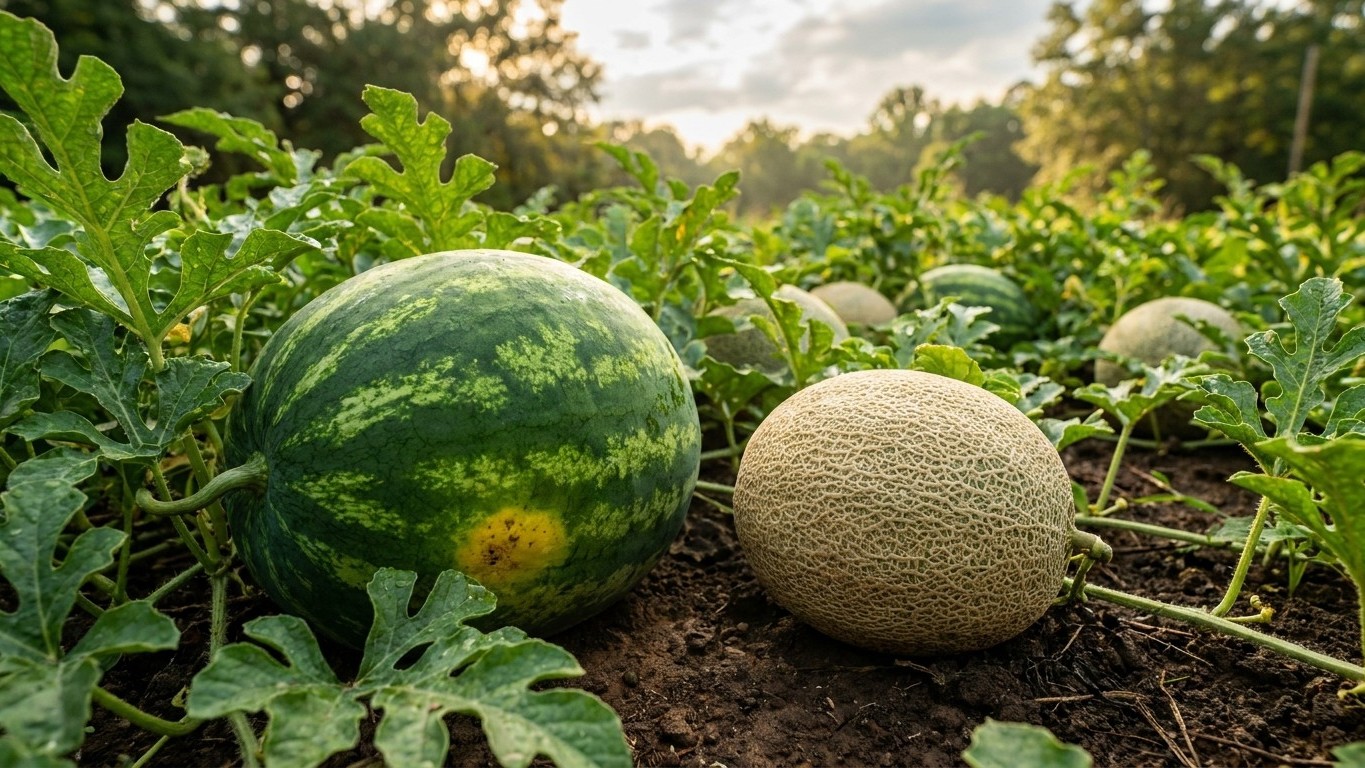

Nunavut cannot reliably grow any melon type outdoors, and the reason isn’t just the short season. It’s the total absence of summer heat: the reference station shows zero days a year reaching 90°F, which is the number that actually ripens a melon. Every melon type on the market, from watermelon to the fastest icebox varieties, needs sustained warmth that this territory’s climate record simply doesn’t produce.
The short answer for Nunavut
Start with the two numbers that matter most. At the Rankin Inlet A reference station, the mean last spring frost falls on June 19 and the mean first fall frost on September 13. That’s a mean frost-free window of roughly 86 days, and even that figure needs a warning label: it’s an average, not a guarantee, so in one year out of two the real window is shorter, either because spring frost lingers past June 19 or fall frost arrives before September 13.
Eighty-six days sounds workable for a fast crop. It is not workable for melons, because melons don’t just need days, they need heat units, and the same station records 0.0 days a year at or above 90°F. Every melon type, without exception, uses hot daytime air to push sugar into the fruit and to trigger the flowering that starts the whole process. Without that heat, a vine can sit in the ground for the entire frost-free window and still never flower, let alone ripen.
Breaking it down by type makes the gap obvious. Watermelon and honeydew are the two longest-season, most heat-hungry melon categories grown in North America; neither has a realistic path here, outdoors or otherwise, given a zero reading on the 90°F measure. Cantaloupe and other muskmelon types sit in the middle of the pack for heat demand and still need considerably more warm-day accumulation than Rankin Inlet’s record shows. The only category worth naming at all is the small, fast-maturing icebox type bred for short northern seasons elsewhere in Canada and the northern United States, and even that category depends on daytime heat this territory’s normals simply don’t deliver.
So the honest decision tree looks like this: outdoors, in open ground, no melon type has a realistic shot in Nunavut based on the climate normals this page relies on. The only path with any theoretical possibility is a fast icebox-type melon started indoors and finished under heavy protection, a cold frame or heated greenhouse that manufactures the heat the outdoor air won’t provide. That’s a container-gardening and greenhouse project, not a field crop, and it should be treated as an experiment rather than a planting plan.
What will not work here

Watermelon fails first and fails hardest. It needs the longest heat exposure of any common melon type, and a station reading of zero days above 90°F means the vine never gets the sustained warm stretch it’s built for. Even if a gardener starts seedlings indoors and transplants after the mean frost date, the plant spends its entire outdoor life in air that never reaches the temperature range that triggers strong fruit set.
Honeydew fails for the same reason and adds a second problem: it’s also one of the slowest melon types to finish ripening once fruit has set, which matters when the mean fall frost lands September 13 and, in half of all years, arrives even earlier. A melon that’s still sizing up in late August has effectively already lost the season here.
Direct outdoor sowing is the real trap
Melon seed germinates reliably once soil warms to around 70°F. Nunavut’s climate normals show no reliable stretch of air temperature that would push soil to that mark outdoors, which means direct-sown seed either rots in cold, damp ground or germinates so late that the already-thin frost-free window shrinks further before the plant has true leaves. This is a cold-and-wet failure, not a drought failure: the summer rainfall record here, about 5.0 inches across June, July and August, with June the driest month at 1.05 inches, isn’t unusually low. The problem is that cool soil and modest rain combine to keep root zones cold and slow, exactly the opposite of what melon roots need.
Anyone tempted to plant based on the mean frost dates alone is making the second mistake this territory punishes. Because June 19 and September 13 are averages, treating either as a safe boundary ignores that frost arrives later in spring, or earlier in fall, in roughly half of all recorded years. A planting plan built on the mean date instead of a buffer around it is a plan built to fail in alternating years, and melons have no recovery time to spare when that happens.
None of this changes with variety selection, spacing, or mulch color. The limiting factor recorded at this station is heat accumulation, and no amount of technique substitutes for daytime air the thermometer never reaches.
| Melon type | Season length needed | Heat load needed | Realistic outdoors in Nunavut? |
|---|---|---|---|
| Watermelon | Long | High | No |
| Honeydew | Long | High | No |
| Cantaloupe / muskmelon | Medium | Medium-high | No |
| Fast icebox-type melon | Short | Medium | Only under heated protection |
What changes across Nunavut
Every figure on this page comes from one station, Rankin Inlet A, and one hardiness reading tied to that same reference point: zone 0a on the Canadian system. That’s the coldest classification the Canadian scale produces, and it belongs to Rankin Inlet specifically, not to Nunavut as a whole. Nunavut is roughly the size of Western Europe, spread across islands, coastline and inland terrain that vary enormously in exposure to wind, sea ice, and latitude. There is no single hardiness answer for a territory this size.
The Canadian hardiness system itself is built from seven separate climate variables, not the single-temperature measure the USDA system uses, so it can’t be converted or compared across the border in a simple way. What that means practically is that a reading of zone 0a for Rankin Inlet tells a reader almost nothing about conditions in a different Nunavut community without checking that community specifically.
Communities further north or more exposed to open water will run colder than this reference point; a few sheltered inland spots may run marginally milder. The spread across the territory is wide enough that this page can only describe the general picture drawn from one station’s normals, not the specific figure for any one household. The right move is checking the hardiness map itself, at Natural Resources Canada’s Plant Hardiness Site, for the community closest to the actual garden, rather than assuming the Rankin Inlet figure applies broadly.
Where to check this for your own county
Canada doesn’t organize agricultural guidance by county the way the United States does, and Nunavut’s own provincial-level extension site could not be verified as reachable at the time this page was checked. That’s why the working link on this page points to the federal department instead, at agriculture.canada.ca/en, a link confirmed live rather than a provincial address that might not load.
What to look for there is specific, not general. First, any local planting calendar for the reader’s own community or region rather than for Nunavut as a whole, since the territory’s climate varies too much for one calendar to serve every location. Second, any record of which crop varieties, melon or otherwise, have actually been trialled in that community’s growing conditions, since a variety that has survived a local trial season is worth more than any generic recommendation drawn from a single reference station elsewhere in the territory.
A community-level recommendation beats a territory-wide one every time, and this page is the territory-wide one. Everything above is built from Rankin Inlet A’s climate normals and should be read as the broad picture for Nunavut, not as the final word for any specific garden. Where a local agricultural office, a community greenhouse project, or a extension contact has actual growing records for a specific location, that information overrides the figures here.
Checking this against your own garden
For anyone still experimenting, likely inside a heated greenhouse or cold frame given everything above, the reader’s own observations beat every date on this page. Soil warmth by feel matters first: press a bare hand into the growing medium in the morning, and if it still feels cool rather than mild, seed and transplants are better held back regardless of the calendar date. Melon roots stall in cold soil no matter what the mean frost date says.
The first flush of male flowers is the second signal worth watching. Melon plants typically produce several rounds of male flowers before female flowers, the ones that actually become fruit, appear. Seeing only male flowers for an extended stretch under protection is a sign the plant isn’t getting enough sustained warmth to move into fruit-setting mode, a strong echo of the zero-days-above-90°F reality this whole territory faces.
Third, watch how fast true leaves emerge after the seedling stage. Slow, stalled leaf growth points to a growing space that isn’t holding heat the way it needs to, whether that’s a cold frame losing warmth overnight or a greenhouse without enough supplemental heat. Fast, steady leaf growth is the best on-the-ground evidence that a specific setup is beating the territory’s baseline climate, and it’s a far better guide for that one garden than any regional average could ever be.