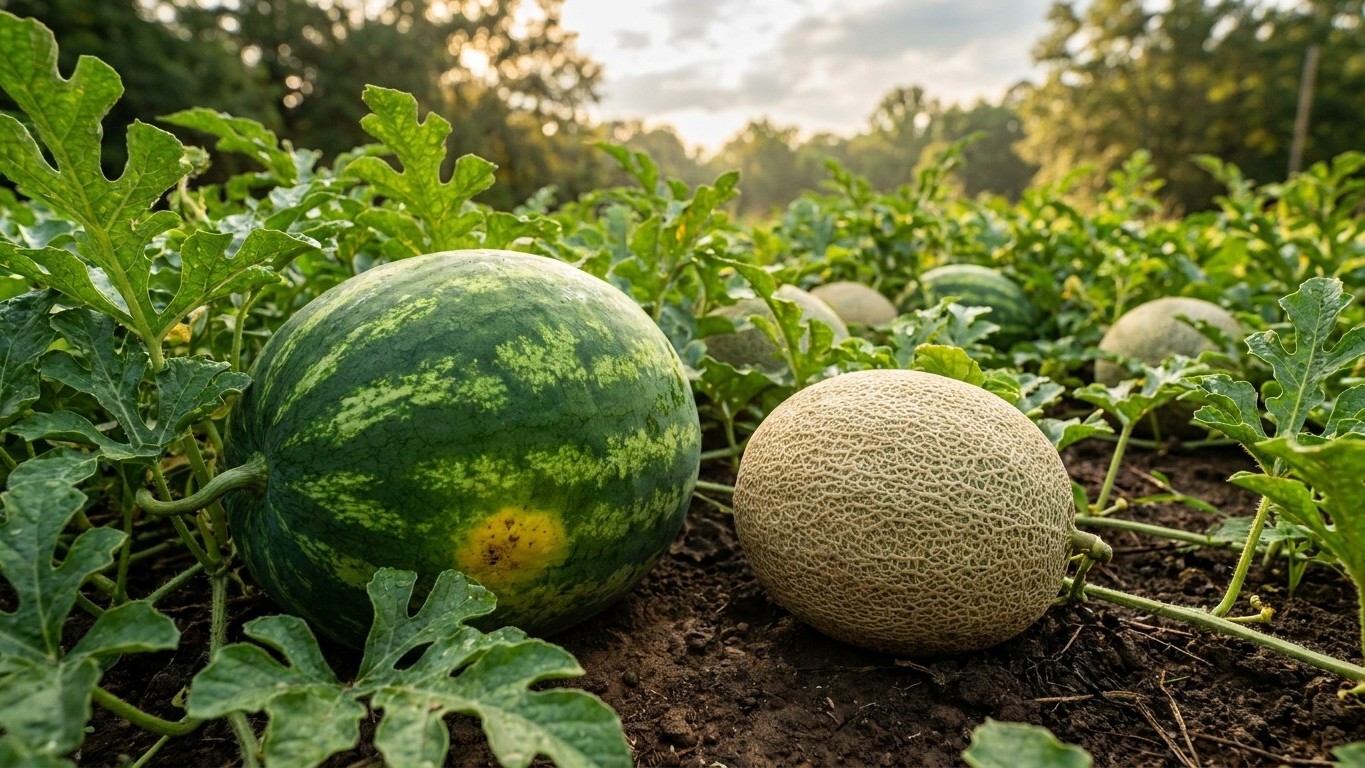

Short-season, quick-maturing melon types beat long-season heat lovers in Ontario. The reference climate for this province averages zero days a year at or above 90F, so varieties bred for sustained heat rarely finish sweet, while compact cantaloupe and icebox watermelon types built for cooler summers reach the table reliably.
The short answer for Ontario
Start with the two numbers that actually run this decision: an average last spring frost of April 30 and an average first fall frost of October 16, both measured at Toronto Lester B. Pearson. That’s a frost-to-frost window of roughly 169 days on paper. But both dates are means, not guarantees. In one year out of two, frost arrives later than April 30 in spring and earlier than October 16 in fall, which means the usable window in a below-average year is shorter than the raw math suggests.
The bigger constraint isn’t frost at all. It’s heat. The same reference station averages 0.0 days a year at or above 90F. Melons don’t just need time, they need heat units, warm nights especially, to convert starch to sugar inside the fruit. A vine can hit its “days to maturity” number on the calendar and still taste flat if the summer never delivered the heat load that variety was bred around.
That’s why the decision in Ontario runs by type, not by brand name:
| Melon type | Typical days to maturity | Heat requirement | Fit for this reference climate |
|---|---|---|---|
| Compact cantaloupe / muskmelon | 65-75 days | Moderate | Good fit |
| Icebox watermelon | 75-85 days | Moderate | Workable, with mulch or row cover |
| Standard slicing watermelon | 85-95 days | High | Marginal |
| Honeydew | 80-90 days | High | Poor fit |
| Long-season heirloom watermelon | 95-100+ days | High, sustained | Poor fit |
The pattern is simple: the shorter the days-to-maturity and the lower the heat requirement, the better the odds against a season that runs about 169 days on average and rarely breaks into real summer heat.
What will not work here

Long-season watermelons and honeydews are the clearest failure point, and the reason is more specific than “not enough time.” Even in a year where frost holds off past October 16, a 95-to-100-day variety bred for a hot Southern summer still needs a stretch of genuinely hot days to push sugar into the fruit. With an average of zero days at or above 90F at the reference station, those heat units simply aren’t there most years. The vine can look full-sized and the fruit can reach its expected weight while the inside stays pale and underwhelming.
Dense spacing is the second trap, and it runs in the opposite direction from what a gardener coming from a drier state might expect. Summer rainfall here averages about 8.9 inches across June, July and August, spread fairly evenly (2.81 inches in June, 2.98 in July, 3.07 in August), rather than arriving as one or two heavy events. That steady moisture, combined with vines packed tight for a hoped-for heat boost, is a setup for powdery and downy mildew on the leaves before fruit even sets. Wide spacing and airflow matter more here than they would in a summer with less rain and more raw heat.
Watering on a drought schedule is the third mismatch. Some melon guides recommend deep, infrequent watering built around surviving heat waves, useful advice in a territory with long stretches above 90F. That model doesn’t fit a summer averaging zero days at that mark and nearly 9 inches of rain over three months. Layering heavy supplemental watering on top of what the sky is already delivering tends to produce root rot and mildew rather than solve a dryness problem that mostly isn’t there.
What changes across Ontario
The hardiness zone figure available for this page, 7a, comes from Toronto Lester B. Pearson using Canada’s own system, and it describes that one station, not the province. This matters because the Canadian system is built from seven climate variables rather than the single winter-minimum figure the USDA uses, and Natural Resources Canada is explicit that there’s no simple conversion between the two. A Canadian zone number here should never be read as a USDA zone, and it shouldn’t be treated as Ontario’s zone either.
Ontario is not one climate. The mild pocket represented by the Toronto-area reference station sits in the warmest part of the province, and conditions shift substantially moving north, where the frost-free season runs shorter, and where the sowing and transplant dates that make sense near Lake Ontario stop applying. The honest answer is that there is no single number for “Ontario,” only a spread that runs from the reference conditions to something meaningfully colder further north.
For a reader outside the immediate Toronto area, the practical shift is straightforward even without a personal zone number: push transplant dates later than the April 30 mean would suggest, favor the shortest-maturity end of the melon table above, and lean harder on black plastic mulch or row covers to make up for heat units that are already scarce in the milder south and scarcer still further north. Checking a personal zone against Natural Resources Canada’s Plant Hardiness Site is the right next step, not a guess based on this page’s single reference station.
Where to check this for your own county
This page works from one weather station and one provincial-level dataset. A county or regional recommendation, built from local trial plots and local frost records, will beat that every time, and Ontario’s own agriculture resources are built for exactly that gap.
The place to start is Ontario’s agriculture and food page. Once there, the two things worth hunting down are a local or regional planting calendar, since frost timing and heat accumulation both shift as you move away from the Toronto-area reference station used on this page, and any variety trial results specific to melons, since those trials will show which cantaloupe and watermelon varieties actually performed in a given county’s soil and summer rather than which ones simply exist on a seed catalog page.
Treat everything in the sections above as the provincial-level starting point. It’s useful for narrowing melon type and setting expectations, but it isn’t a substitute for whatever a local extension office or county agricultural office has recorded for a specific piece of ground.
Checking this against your own garden
None of the dates or averages on this page outrank what’s actually happening in a specific yard, and three simple observations tell a gardener more than any calendar date can.
Soil warmth by feel is the first check. Push a bare hand a few inches into the planting bed at midday. If it feels cool rather than comfortably warm, the soil hasn’t caught up to the season yet, regardless of what the calendar says about the April 30 average frost date, and seed or transplants set into it will simply sit and sulk.
The first flush of male flowers is the second signal. Melon vines produce male blooms before female ones, and their arrival marks the start of the countdown toward fruit set. A vine throwing male flowers earlier than expected suggests a warmer-than-average microclimate, maybe a south-facing slope or a spot shielded from wind; a late flush suggests the opposite, and points toward choosing the shortest-maturity variety available next season.
The first true leaves, appearing after the seedling’s initial pair, are the third. How quickly they show up after seeding or transplanting is a direct read on how much heat that particular bed is actually accumulating, which is the real question behind every date on this page.