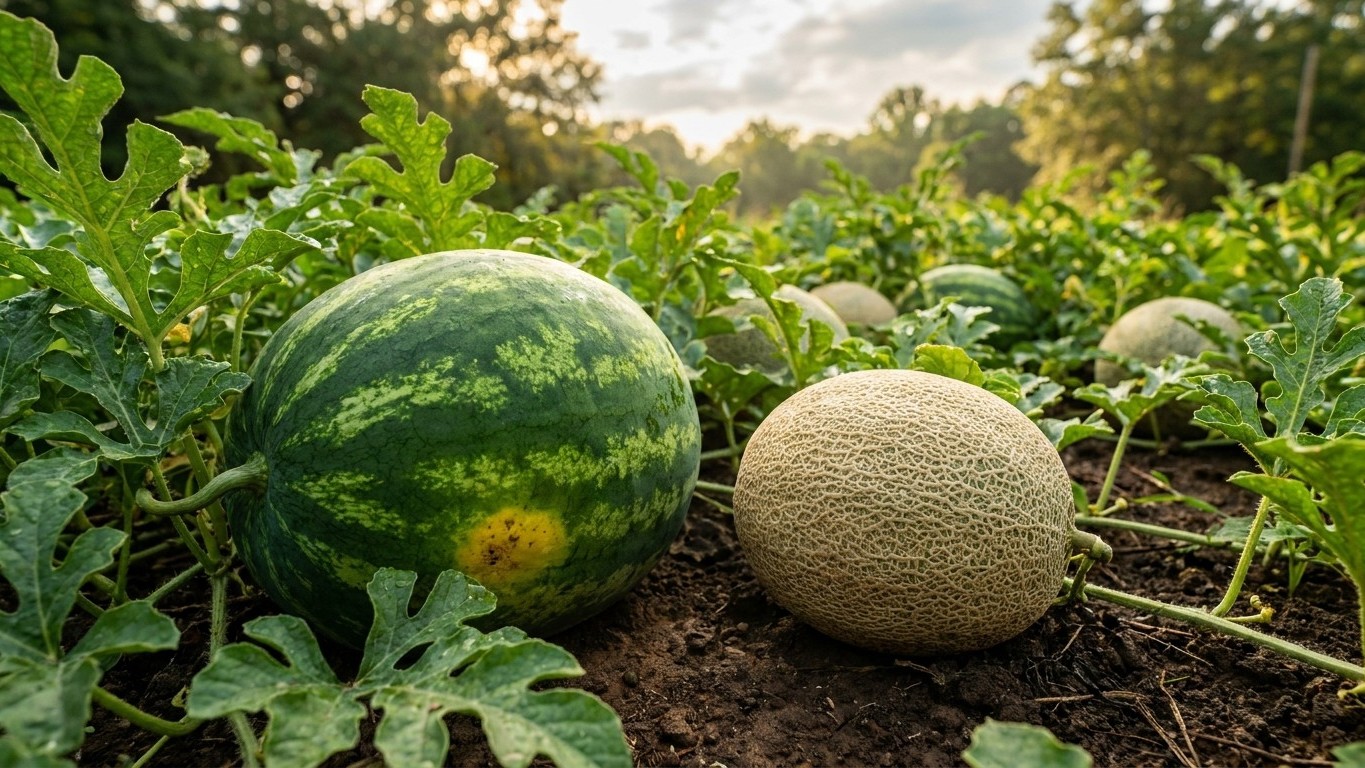

Pick short-season cantaloupe or icebox watermelon varieties over long-season honeydews and giant watermelons if you’re anywhere outside the Philadelphia corner of the state. Pennsylvania‘s frost dates and modest heat load favor melons that finish fast and don’t ask for a long, hot summer to ripen.
The short answer for Pennsylvania
The type of melon that works here comes down to two numbers: how long your frost-free window runs, and how much heat you get inside it. Philadelphia’s last spring frost falls somewhere between March 29 and April 6, and the first fall frost lands between November 5 and November 16. Stack those together and the mild southeast corner of the state gets something in the range of 210 to 230 frost-free days, depending on where in that probability band your actual spring and fall land. That’s a workable window for most melons, but it’s not a Southern-summer window, and the heat load backs that up: Philadelphia averages only 24 days a year at 90F or hotter. That’s warmth, not a heat wave season.
Match the variety to that reality. Cantaloupe and muskmelon types that mature in 75 to 85 days are the safest statewide bet, because they fit comfortably inside even a shortened season and don’t need extreme heat to sweeten up. Icebox and short-season watermelons, the smaller round types bred to ripen in 70 to 80 days, are the second reliable category. Both give you margin on either end of the season, which matters in a state where a wet, cool spring can delay planting by two weeks without warning.
Honeydew and full-size watermelon varieties that need 90 to 100 days or more are a heavier lift here. They’re not impossible in the Philadelphia area with black plastic mulch and a warm microclimate, but they leave almost no room for error, and a cool June or a late-arriving heat spell can leave fruit unfinished when frost shows up in early November. Anywhere north or at elevation, where spring frost risk lingers two to four weeks longer, those long-season types become a gamble rather than a plan.
So the decision by type is straightforward: build the garden around fast cantaloupe and icebox watermelon, treat honeydew and large watermelon as a bonus crop for a hot, sheltered spot in the mildest part of the state, and don’t count on either type to bail you out if the season runs short.
What will not work here
Long-season melons are the first thing to cross off. Anything bred for a 95- to 110-day maturity is betting the entire growing window on a frost-free stretch that Pennsylvania’s own climate normals don’t guarantee. Even in the mildest reading of the data, a fall frost can arrive as early as November 5. Push that against a slow start from a cool, wet spring and a 100-day melon can run out of season before it runs out of size. In the northern tier or the Alleghenies, where frost arrives two to four weeks earlier than in Philadelphia, that same variety is simply not a realistic choice.
Watering on a once-a-week schedule is the second failure point, and it catches gardeners who assume Pennsylvania’s rainfall does the job for them. Summer rain here averages about 12.7 inches across June, July, and August, with June actually the driest of the three months at 4.04 inches. That sounds like enough, but it typically arrives as scattered thunderstorms rather than steady soaking rain, and on 24 days a year the temperature is pushing past 90F, driving evaporation hard. Melons that go dry for stretches between waterings during fruit set respond with blossom drop or bland, watery fruit. The fix isn’t more water on a fixed schedule, it’s checking soil moisture through the hottest weeks and watering deeply when it’s dry an inch or two down, not by the calendar.
Tight spacing is the third trap, and it’s specific to a state with Pennsylvania’s summer humidity. That same rainfall pattern, combined with warm nights, keeps foliage damp longer than in a drier climate, and melon leaves packed close together stay wet even longer after a storm or a morning dew. Powdery mildew and downy mildew move fast through crowded vines in exactly those conditions. Give plants the full spacing the seed packet recommends, angle rows for airflow, and resist the urge to squeeze in one more hill.
Direct seeding into unwarmed soil rounds out the list. With last frost dates running into early April across much of the state, garden soil in that window is often still cold and wet. Melon seed sitting in cold ground doesn’t germinate, it rots.
What changes across Pennsylvania
Pennsylvania spans USDA hardiness zones 5a through 7b, a range built on the average annual extreme minimum temperature rather than on frost dates directly, but it’s a useful stand-in for how differently the state behaves from one county to the next. A spread from 5a to 7b covers roughly 20 degrees Fahrenheit of expected winter extreme cold, which is the difference between a mild mid-Atlantic winter and one that behaves more like inland New England.
That range is not a rounding error, it’s the whole reason a single statewide planting date doesn’t exist. The reference frost dates cited above, drawn from the Philadelphia station, describe the mildest corner of the state. The caution attached to those same normals is explicit: the northern tier and the Alleghenies run two to four weeks later in spring, and correspondingly earlier into fall on the other end. Two to four weeks shaved off both ends of the season is a full month or more of growing time gone, which is exactly the margin a long-season melon can’t afford to lose.
What that means in practice: a reader in the milder southeast can plant closer to the early end of the spring window and can consider stretching toward a slightly longer-season variety. A reader in the north or at higher elevation should plan around the later end of that window, lean on black plastic mulch or row cover to bank extra heat units early, and stick hard to the fastest-maturing cantaloupe and icebox watermelon varieties rather than experimenting with anything long-season.
The USDA Plant Hardiness Zone Map is the tool built for that, and it’s worth five minutes to look up the county before finalizing which varieties make the cut.
Where to check this for your own county
Penn State Extension, at extension.psu.edu, is the source built for the next level of detail. A statewide article can talk about frost date ranges and hardiness zone spreads, but it can’t tell a grower in Erie County what a grower in Chester County needs to know, and that gap is exactly what a county-level extension office fills.
Two things are worth searching for once there. First, the local planting calendar for the specific county or region, which translates the statewide frost date ranges into an actual recommended planting window for that location, rather than the 30-to-70% probability band cited from the National Weather Service normals. Second, look for variety trial results or recommended melon varieties specific to that county or to Pennsylvania growing conditions broadly. Land-grant universities run yearly or multi-year trials comparing how different cantaloupe, watermelon, and honeydew varieties actually perform under local disease pressure, local soil, and local season length, and that data is worth more than any general guidance from a statewide article.
The extension office serving a specific county has already done the work of narrowing that range down to something workable for that address.
Checking this against your own garden
None of the dates above beat what’s actually happening in the soil. Three signs from the garden itself outrank every frost date and probability band cited here, because they measure the real microclimate of that specific yard rather than a regional average.
Soil warmth by feel comes first. Push a bare hand into the planting bed a couple of inches down. If it feels cool and damp rather than merely cool, the soil likely hasn’t reached the 65 to 70 degrees melon seed wants for reliable germination, no matter what the calendar says about the last frost having passed. A warm, slightly dry crumble to the soil is the better signal to plant.
The first flush of male flowers is the second marker. Melon vines put out male blossoms well before the female flowers that actually set fruit. Their appearance signals the plant has moved from establishing roots and leaves into active growth, and it’s a rough preview that female flowers, and eventually fruit set, are a couple of weeks out. A yard that’s consistently slower to reach this stage than a neighbor’s garden a few blocks away is quietly telling the gardener that its microclimate runs a bit cooler, whether from shade, elevation, or exposure.
First true leaves matter too, the leaves that emerge after the initial seed leaves and actually look like miniature melon foliage. Their timing and vigor show whether the plant is settling into real growth or stalling from cold roots or thin soil. A garden where true leaves are slow to fill in is a garden that may need warmer soil, richer ground, or simply more patience before fruit set arrives.