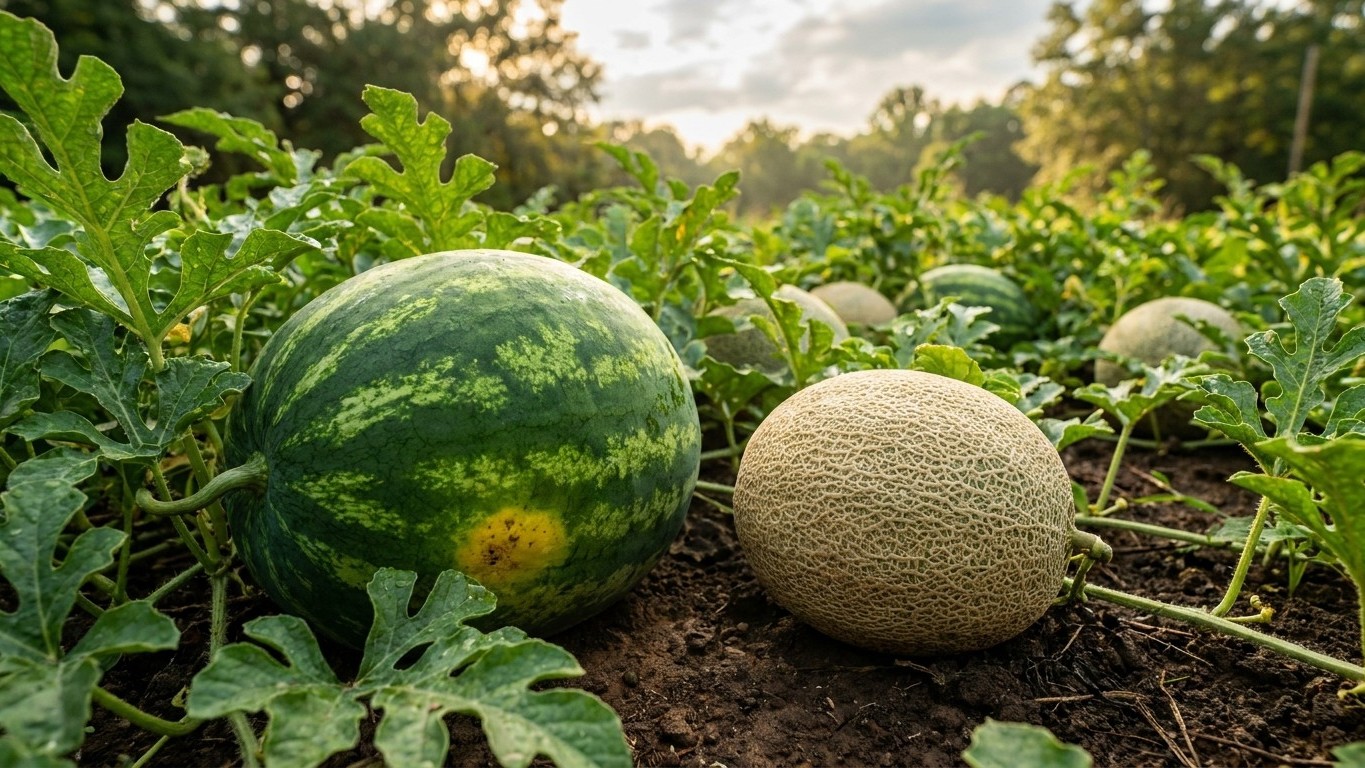

Short-season muskmelon and cantaloupe types, bred for cool summers and maturing in roughly 65 to 75 days from transplant, are the safest bet for Prince Edward Island gardens. Large watermelons and true honeydews, built for regions with sustained heat, are a much tougher sell here. The reasons come straight from the island’s own weather numbers, not from a general melon-growing guide.
The short answer for Prince Edward Island
Pick by type first, variety second. On paper, Charlottetown’s frost dates give a frost-free stretch of about 154 days, from a mean last spring frost on May 16 to a mean first fall frost on October 17. That sounds generous for melons. It is not, and the gap between “on paper” and “in practice” is exactly what a territorial page like this one needs to spell out.
Those two dates are averages from Environment and Climate Change Canada’s 1981-2010 normals for the Charlottetown A station. An average frost date means frost arrives later than that date about half the years on record. Nobody sets tender transplants outside on a coin-flip date, so most island gardeners wait past May 16 before melons go in the ground, often into early June once soil has actually warmed. That trims the usable window down closer to 110 to 130 days once you also hold back a safety margin before the mean fall frost in October.
The bigger constraint is heat, not the calendar. Prince Edward Island averages 0.0 days a year at or above 90°F. That is not a rounding error. It means the reference station records essentially no genuinely hot days across an entire summer, and melons are a crop that ripens on accumulated heat, not just on frost-free days. A watermelon bred in a region that regularly hits the 90s will spend the whole PEI summer running behind schedule, producing small, pale, under-sweet fruit even if it technically survives to harvest.
That combination, a shortened effective season plus almost no heat spikes, points squarely toward compact, early-maturing muskmelon and cantaloupe types developed for short northern seasons. Look for seed packaging or descriptions that specifically flag “early” or list a days-to-maturity figure under about 75 days from transplant. Those varieties are bred to size up and sweeten on cooler, shorter summers rather than waiting on heat that Prince Edward Island rarely supplies.
What will not work here

Large watermelons bred for hot regions are the clearest mismatch. Varieties needing 85 to 100 days and sustained heat to build sugar are working against both of PEI’s limiting facts at once: a real growing window closer to 110 to 130 days once transplant timing is factored in, and zero days a year reaching 90°F to push sugar development. The fruit may reach full size in a warm year, but the flavor rarely catches up.
True honeydew and casaba types run into the same wall. These melons are typically slower than cantaloupes and depend even more heavily on stretches of real heat to finish properly. Without that heat load, they tend to stall at a pale, watery stage rather than turning fully ripe, which is a frustrating result after a full summer of care.
Rainfall changes the picture too. PEI’s summer normal runs about 10.8 inches of rain across June, July and August, with July, the driest of the three, still averaging 3.15 inches. That is a steady drip through the growing season rather than a dry, sun-baked stretch. Melon foliage sitting damp for days at a time is exactly the condition that lets powdery mildew and downy mildew take hold, and dense plantings make it worse by trapping moisture around the leaves. Tight hill spacing or crowded rows, fine in a drier climate, become a liability here.
| Melon type | Typical days to maturity | Fits PEI’s effective window (~110-130 days)? | Realistic with 0.0 days ≥90°F? |
|---|---|---|---|
| Large watermelon (hot-region types) | 85-100+ | Tight to no | No |
| Honeydew / casaba | 80-100 | Tight to no | No |
| Standard cantaloupe | 75-90 | Marginal | Marginal |
| Early/short-season muskmelon | 60-75 | Yes | Yes, best fit |
Direct seeding any of these into cold spring ground is its own risk. Without hot spells to push soil temperature up quickly, seeds sown straight into the garden can sit and rot before germinating. Starting indoors and setting out transplants once the soil has genuinely warmed gives a melon crop a head start that direct seeding cannot match on this island.
What changes across Prince Edward Island
The hardiness zone figure for Prince Edward Island, 5b in the Canadian system, comes from Natural Resources Canada’s data for the reference city of Charlottetown. It is not a province-wide number, and Prince Edward Island, small as it is, does not sit in one uniform climate. Coastal stretches along the Northumberland Strait tend to warm up a little sooner in spring than inland ground, while areas facing the Gulf of St. Lawrence on the north shore often run cooler and windier through the same weeks.
Worth flagging plainly: the Canadian zone system is built from seven climate variables, not the single winter-minimum-temperature measure the USDA system uses in the United States. Natural Resources Canada itself says there is no simple conversion between the two, and a single Canadian zone can overlap several USDA zones. If a seed catalog or a gardening reference lists a USDA zone number, do not line it up against PEI’s 5b as if they were on the same scale.
For a reader trying to place their own garden inside the island, the right move is Natural Resources Canada’s Plant Hardiness Zone map rather than a guess based on general geography.
Where to check this for your own county
Prince Edward Island is organized into three counties, Prince, Queens and Kings, and growing conditions shift enough between them, and within them, that an island-wide page like this one is a starting point rather than a final answer. The provincial resource to check is princeedwardisland.ca/en/topic/agriculture.
Once there, look specifically for two things. First, any local planting calendar that reflects real dates for your part of the island rather than the Charlottetown A station averages. Second, any list of melon varieties that have actually been trialled in island conditions, since a variety proven to perform on PEI soil carries more weight than a general description on a seed packet written for a national market.
A recommendation built around your own county’s soil, wind exposure and local frost pattern will always beat a province-level page. This article works from station-level averages for one reference point on the island. It is useful for understanding why short-season, low-heat melon types make sense here, but it is not a substitute for what your local agricultural office has recorded about your specific stretch of ground over multiple seasons.
Checking this against your own garden
None of the dates or averages above beat what your own garden tells you directly, and three simple observations carry more weight than any calendar.
Feel the soil before you trust the season. Push a finger a few inches into the bed where melons will go, in the morning before the sun has had a chance to warm the surface. If it still feels cool and damp rather than warm through, the ground has not caught up to the calendar yet, whatever the mean frost date says, and setting transplants out early risks stalled growth rather than a head start.
Watch for the first male flowers. Melon plants open male blossoms before female ones, and a slow, sparse first flush is a sign that your particular spot is running behind the seasonal average, whether from shade, wind exposure, or simply cooler soil than a neighbor’s garden a mile away.
Track how quickly true leaves follow the first seedling leaves. A fast move from seedling leaves to a full set of true leaves signals your microclimate is accumulating warmth well; a sluggish pace suggests you are gardening on the cooler end of whatever range exists across the island, and that shorter-season varieties matter even more for you than the general PEI recommendation above.