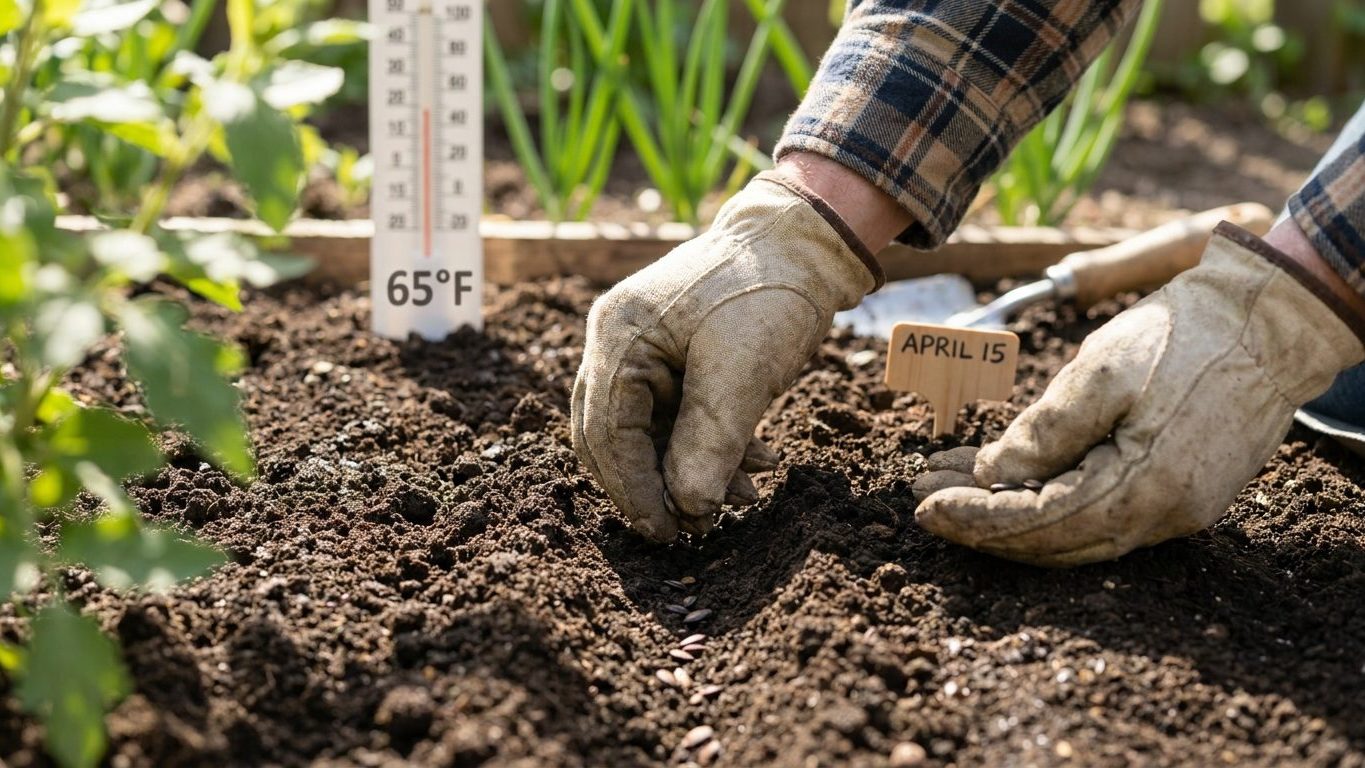

In Quebec, start melon seeds indoors around late April and transplant outdoors only after the frost risk has genuinely passed, generally the third week of May at the earliest and closer to the first week of June for most gardens. The mean last frost date of May 6 is not a safe planting date; it’s a midpoint, and in half the years frost arrives later.
The short answer for Quebec
Environment and Climate Change Canada’s normals for the Montreal/St-Hubert station put the average last spring frost at May 6 and the average first fall frost at October 5. That’s a mean frost-free window of about 152 days. But a mean is not a guarantee: in roughly half of all years on record, frost has landed after May 6, sometimes well after. Treat that date as the center of a bell curve, not the edge of it.
What this means practically: seeds started indoors need 3 to 4 weeks of growth before they’re ready for the garden, so a mid-to-late April start indoors lines up with a transplant window that opens in mid-to-late May and is safer by the first days of June. Direct-seeding melons straight into cold Quebec soil in early May, the way a grower further south might, skips the buffer this region needs.
The other number that shapes the calendar here is heat, not frost. The Montreal reference station records an average of 0.0 days a year reaching 90°F or higher. Melons are warm-season fruit that push their fastest growth and sweetest sugars when daytime highs climb into the 85 to 95°F range repeatedly through the season. Quebec’s summer simply doesn’t deliver that kind of heat load on average, which means the growing season length on paper (152 frost-free days) overstates how much usable “melon heat” is actually available.
The practical fix growers use here is to compress the effective season and boost the heat the plant experiences directly: starting transplants early indoors, hardening them off under cover, warming the soil with black plastic mulch before setting plants out, and choosing varieties bred to ripen fast in cooler summers rather than the 90-plus day varieties bred for hot, long southern seasons. None of that changes the frost dates; it changes how much of that window actually counts toward ripening fruit.
What will not work here

Long-season melon varieties, the ones bred for 90 days or more of hot summer growth, are a poor match for a region averaging zero days above 90°F. Even if the calendar leaves enough calendar days between frosts, the heat units those varieties need to sweeten and finish simply don’t accumulate reliably here. A melon that needs consistent 90°F-plus afternoons to convert starch to sugar will often sit green, or ripen so late that the October frost cuts it off first.
Direct-seeding outdoors right at the average last frost date is another common failure point. Because May 6 is a mean, not a floor, sowing seed into open ground on that exact date leaves a coin-flip’s chance of a late frost killing tender seedlings. Growers who skip the indoor start and the transplant buffer are the ones most likely to lose a planting outright rather than just delay it.
Cool nights, not dry summers, are the risk
Unlike a hot, arid climate where the failure mode is drought stress from weekly watering, Quebec’s summer rainfall runs a fairly steady 10.6 inches across June, July and August, with June (the driest of the three) still bringing 3.42 inches. That’s enough moisture that under-watering is rarely the reason a melon crop fails here. The more common problem is the opposite: cool, humid nights combined with dense foliage create conditions favorable to powdery mildew and other fungal pressure, especially on vines planted too close together or left un-thinned.
Skipping soil-warming steps compounds all of this. In a climate with real heat spikes, a slow start can sometimes be outrun by a hot stretch later in the season. Here, there’s no such heat spike to fall back on. A melon transplant set into cold, unwarmed soil in mid-May, without black plastic mulch or a row cover to trap daytime warmth, loses days it has no heat surplus later to recover.
What changes across Quebec
The hardiness zone figure available for this region, 5b under the Canadian system, applies to the reference city used in Natural Resources Canada’s mapping, not to the province as a whole. Quebec is not one climate. The St. Lawrence lowlands around Montreal sit in some of the mildest zones the province has, while the Gaspésie, the Saguenay-Lac-Saint-Jean region, Abitibi-Témiscamingue and the far north run through progressively colder zones, some far colder than 5b. There is no single frost-date or hardiness answer for “Quebec” as a whole; the spread across the province is wide.
Note also that the Canadian hardiness system is not the same scale as the USDA zones used elsewhere on this site. It’s built from seven climate variables rather than one, and Natural Resources Canada is explicit that there’s no simple conversion between the two systems, a single Canadian zone can overlap nine different USDA zones. So a Quebec zone number should never be read against a US zone number as if they were equivalent.
For a reader gardening north of the St. Lawrence valley, or at higher elevation anywhere in the province, the practical shift is to push both the indoor start and the transplant date later and to plan on a shorter effective season overall. Row covers, cold frames or low tunnels become less of an option and more of a requirement in those areas, since the frost-free window shrinks the further north or the higher up the garden sits. Which zone an individual property falls into is a lookup on the hardiness zone map itself rather than a general calendar.
Where to check this for your own county
Quebec’s ministry of agriculture, MAPAQ, is the place to check regional detail. A provincial-level calendar like this one is built from a single reference station and averaged frost dates; it’s a starting point, not a local forecast. A regional or county-level recommendation from MAPAQ, built from trials and observations closer to a specific area, will almost always beat a province-wide figure.
What to look for once there: any regional planting calendar MAPAQ publishes for vegetable and fruit crops in the reader’s specific administrative region (MRC), and any variety trial results for melons or cucurbits conducted in that region. Quebec’s growing conditions vary enough between the Montérégie, the Capitale-Nationale, the Bas-Saint-Laurent and other regions that a variety performing well in one area can underperform in another, even within the same general hardiness range.
The mean frost dates, the heat profile and the rainfall pattern come from a single reference station near Montreal. That’s useful as a baseline for understanding how the season is shaped, but it isn’t a substitute for a local extension recommendation. Where the two disagree, the local source should win, because it reflects local conditions.
Checking this against your own garden
No frost date outranks what a gardener can observe directly in their own soil and plants. Three simple checks matter more than any calendar date.
- Soil warmth by feel: push a finger a few inches into the planting bed. If it feels cold to the touch rather than mildly warm, the soil hasn’t caught up to the calendar yet, regardless of what the average frost date suggests, and transplanting now risks stalling the plant rather than helping it get ahead.
- The first flush of male flowers: melons produce male flowers before female ones, and their appearance signals the plant has shifted from vegetative growth into reproductive mode. Seeing them early, well before expected, suggests a warmer-than-average microclimate on that particular plot; seeing them late suggests the opposite.
- The first true leaves on seedlings: after the initial seed leaves, the appearance of true leaves indicates a seedling has enough root and leaf structure to handle the stress of transplanting and hardening off. Rushing a seedling outside before true leaves are established, just to hit a calendar date, tends to backfire.
Each of these tells a gardener something a mean frost date from a single station 30 or more miles away simply can’t: what’s actually happening in that specific yard, that specific soil, that specific year.
Some gardeners also time melons by the Moon: when to plant watermelon and cantaloupe by the moon, as almanac tradition rather than fact.