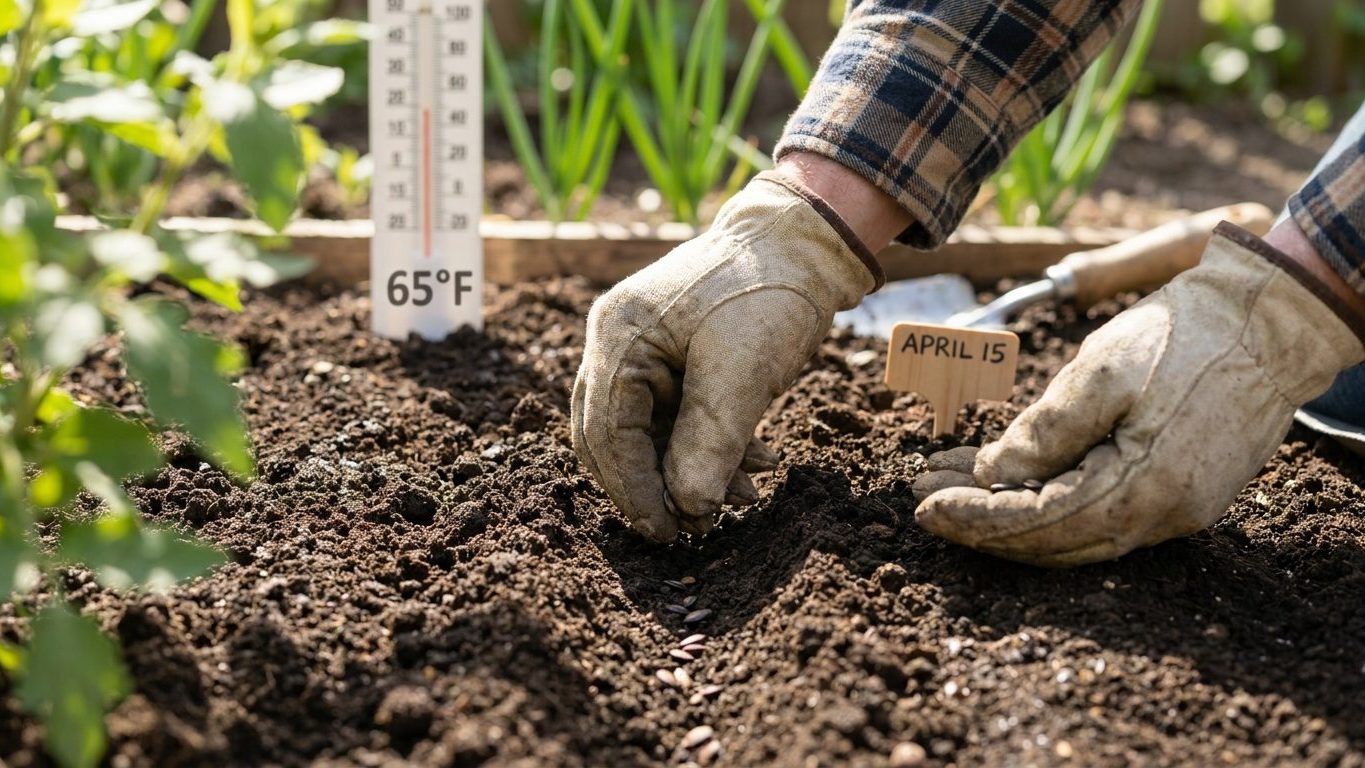

Rhode Island gardeners should start melon seeds indoors around mid-April and move transplants outside once the last frost risk has passed, generally from late April through mid-May at the reference station in Providence. That window comes straight from NOAA’s 30-70% freeze-probability band, not a guaranteed frost-free date, so treat it as a planning tool rather than a calendar promise.
The short answer for Rhode Island
NOAA’s 1991-2020 Climate Normals put the last spring frost at the Providence reference station somewhere between April 7 and April 17. That’s the 30-70% probability band for a 32F freeze, meaning there’s still a real chance of frost after April 17 in some years, and a smaller but non-zero chance before April 7 in others. Melons don’t tolerate any frost at all, so the safe move is to treat April 17 as the earlier edge of the window and push transplanting a bit later, once nighttime lows settle above 50F.
Work backward from there. Melon seedlings typically need three to four weeks indoors before they’re ready to go in the ground, which puts the indoor start around the first half of April for most Rhode Island gardens. Direct-seeding outdoors is possible too, but soil temperature matters more than the calendar date: melon seed germinates poorly in cold soil, and April soil in southern New England is often still recovering from winter even after the air has warmed.
On the back end, the first fall frost at the reference station falls between October 24 and November 3. That gives a working frost-free stretch of roughly six months at the airport station, but the region’s heat load inside that window is modest. Providence averages only 9.4 days a year at 90F or hotter, which is the number that actually limits melon fruiting more than the frost dates do. Melons ripen on accumulated heat, not just on being frost-free, so a long calendar window doesn’t automatically mean a long ripening season.
The practical answer for a Rhode Island garden: transplant established seedlings outdoors in the back half of April into May, once frost risk has clearly passed in your area, and plan on harvest finishing before late October. Everything past that general shape depends on variety choice and local microclimate, which the next two sections cover.
What will not work here

Long-season melon varieties bred for hot, dry climates are the first thing to cross off the list. With only 9.4 days a year above 90F, Rhode Island simply doesn’t deliver the heat accumulation that a 100-plus-day melon needs to finish sweet before the October frost band arrives. A variety that performs beautifully in a Georgia or Kansas garden can sit in a Rhode Island backyard producing vines and flowers but never converting that growth into ripe fruit before the season runs out.
Planting right at the earliest edge of the frost window is another common failure. Because April 7-17 is a 30-70% probability band and not a hard cutoff, a grower who sets tender transplants out on April 8 is gambling on the better half of that range holding. A late frost after transplanting doesn’t just set melons back a week, it usually kills them outright, since melon seedlings have almost no frost tolerance at any growth stage.
Watering on a fixed weekly schedule through the summer is a third trap. Rhode Island’s summer rainfall runs about 10.3 inches across June, July and August, with July as the driest month at 2.91 inches. That sounds like enough moisture on paper, but it arrives unevenly, often as a single thunderstorm that runs off a dry surface rather than soaking in, especially with 9.4 days of 90F-plus heat driving fast evaporation. A garden on sandy, fast-draining soil can go from adequately moist to stressed within two or three dry days during a July heat spell, and a once-a-week watering schedule misses that entirely.
Close spacing is the fourth thing that backfires, particularly once August humidity builds with its 3.59 inches of rain typically falling in scattered, humid events. Melon foliage packed tightly together stays wet longer after rain or morning dew, which is exactly the condition that lets powdery mildew and downy mildew take hold. Air movement between plants matters as much as sun exposure in a summer climate that isn’t bone-dry.
What changes across Rhode Island
Rhode Island’s USDA hardiness zone range runs from 6a to 7b, based on the 2023 map’s average annual extreme minimum winter temperature. That’s a wide spread for such a small state, and it’s built on a single winter-cold variable, which makes it a rough proxy at best for summer planting timing. Still, the spread tells you something real: this is not a one-climate state, and a date that works near the coast can be premature a short drive inland.
Coastal areas along Narragansett Bay and the shoreline toward Newport tend to sit toward the warmer end of that zone range. Water moderates temperature swings in both directions, which usually means a milder, later fall frost and a bit more buffer before the first true cold snap. Inland and northern parts of the state, including the area around the Providence reference station itself, run cooler and see frost arrive somewhat earlier in a typical year.
Elevation adds another layer that the zone map doesn’t fully capture. The hillier interior toward the Connecticut border sits higher and colder on average than the low-lying coastal plain, and cold air tends to pool in low spots and valleys on calm, clear nights, sometimes producing a frost pocket even when nearby higher ground stays frost-free. A garden in a low, sheltered hollow can see frost when a garden a quarter-mile away on a slope does not.
None of this means there’s a single adjusted date for “the north” or “the hills” of Rhode Island. There isn’t one answer, because a 6a-to-7b range is genuinely a range, not an average. What it does mean is that a gardener at the cooler, higher end of that spread should expect to transplant later and watch for frost longer into spring than the state-level dates above suggest, while someone near the warmer coastal edge has more room to move earlier. The USDA hardiness zone map is the tool for finding where a specific address falls inside that range, not a guess based on general geography.
Where to check this for your own county
Everything above comes from a single reference weather station, and Rhode Island, small as it is, still has real local variation on top of that. The next step is URI Cooperative Extension, the state’s land-grant extension service and the source built to localize exactly this kind of question.
Two things are worth looking for once there. First, any county- or region-specific planting calendar the extension publishes, which will reflect local frost patterns rather than a single airport station. Second, look for melon variety trial results or recommendation lists specific to Rhode Island growing conditions, since a variety that has actually been trialled in-state carries more weight than a general seed-catalog description written for a national audience.
A county-level recommendation beats a state-level one every time. The frost dates, heat days and rainfall figures cited here describe Rhode Island as measured at one reference point, which is useful for a first estimate and useless for fine-tuning a specific yard. Extension offices exist precisely to close that gap, often through master gardener volunteers who field these questions directly and know which pockets of their county run warm or cold relative to the rest of the state.
If the extension site doesn’t have a melon-specific calendar for your area, the general vegetable planting guide it publishes will still carry more local weight than any generic national planting chart, because it’s calibrated to New England conditions rather than averaged across a much larger climate range. That local calibration is the entire value of going there before making a final planting decision.
Checking this against your own garden
None of the dates above outrank what’s actually happening in a specific yard. Three simple checks, using nothing more than a hand and a pair of eyes, tell a gardener more about their own microclimate than any regional average.
The first is soil warmth by feel. Cold, damp soil that feels chilly to bare fingers a few inches down is a sign the ground hasn’t caught up to the air temperature yet, no matter what the calendar says, and melon roots sitting in that cold soil will stall rather than grow. Warm, slightly dry-to-the-touch soil at the same depth is the better sign that transplanting won’t shock the plant.
The second is the first flush of male flowers. Melon plants typically produce male flowers before female ones, and their timing is a direct readout of how much heat the plant has actually accumulated in that spot, regardless of the date on the packet. An early flush suggests a warmer-than-average microclimate; a late one, especially compared to a neighbor’s garden, points to a cooler pocket worth factoring into next year’s timing.
The third is how quickly true leaves follow the seedling stage. Slow, stalled growth after the first set of true leaves often signals either cool soil, insufficient light, or both, and it’s a better real-time signal than trusting a fixed number of days from transplant. A gardener who watches these three things across one growing season builds a far more accurate personal calendar than any state or county chart can provide, because it’s calibrated to the actual soil, sun exposure and airflow of that one yard.
Some gardeners also time melons by the Moon: when to plant watermelon and cantaloupe by the moon, as almanac tradition rather than fact.