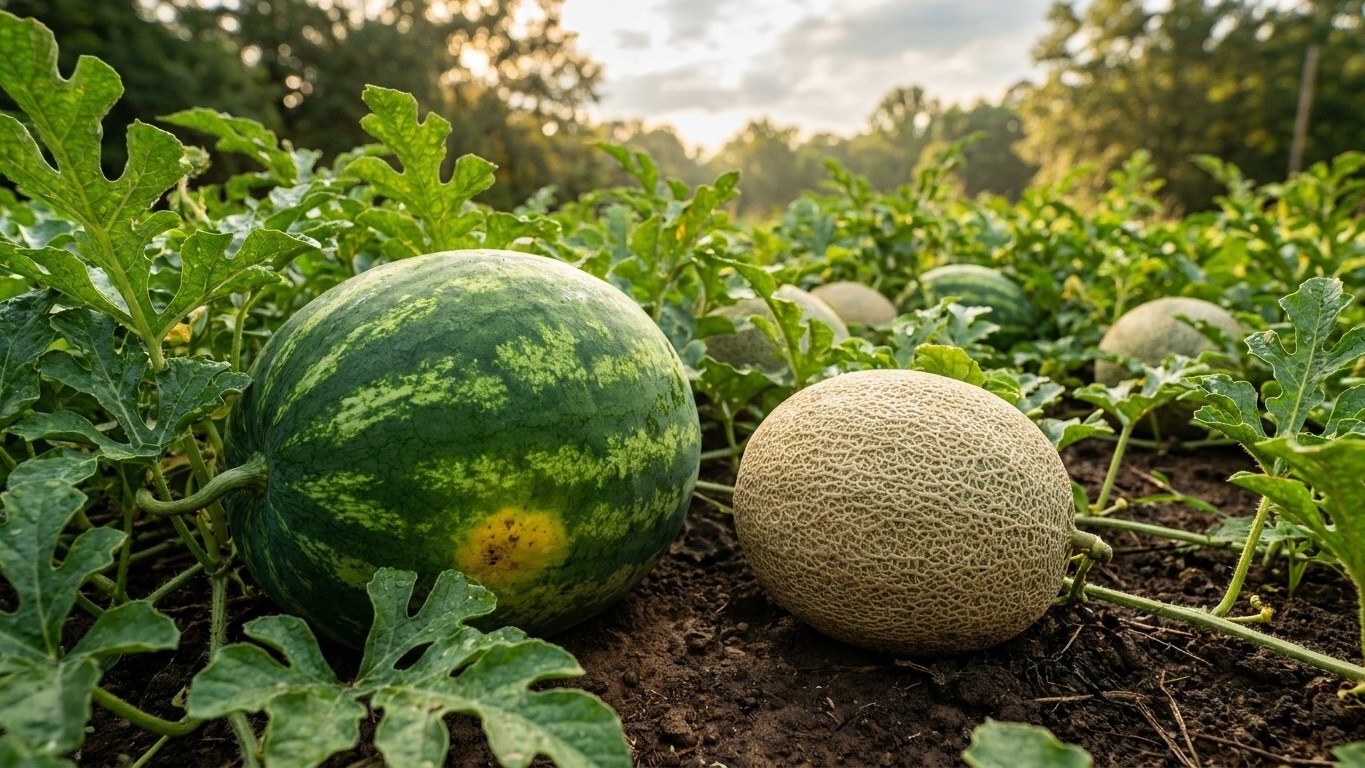

Rhode Island’s best bets are short-season cantaloupe and muskmelon types that mature in 75 to 85 days. The state’s frost-free window and moderate summer heat don’t leave much margin for 90-day-plus watermelons or honeydews unless you extend the season artificially with plastic mulch and row covers.
The short answer for Rhode Island
Start with the calendar, not the seed catalog. At the reference weather station used for Rhode Island’s climate normals, the last spring frost falls between April 7 and April 17, and the first fall frost arrives between October 24 and November 3. On paper that’s a frost-free stretch of roughly 190 to 210 days. That sounds generous for melons, but the real number a gardener works with is smaller, because melon seed doesn’t germinate reliably in cold soil and transplants sulk if the ground hasn’t warmed past the mid-60s. In most of Rhode Island, that soil-warmth threshold doesn’t arrive until mid-to-late May, no matter what the calendar says about air temperature.
That shrinks the usable growing window to something closer to 150 to 170 days for direct-seeded melons, less if a cool, wet spring delays planting further. Against that number, a melon that needs 90 to 100 days to mature is cutting it close even in a good year. A melon that needs 75 to 85 days has room to spare, plus a buffer for the inevitable week of clouds in August.
Heat is the second variable, and here Rhode Island is unremarkable rather than harsh: the reference station averages 9.4 days a year at 90°F or hotter. That’s enough warmth to ripen a cantaloupe or a Galia-type melon properly, but it’s not the kind of heat load that pushes sugar into a giant watermelon the way a Georgia or Texas summer does. So the decision by type looks like this:
- Cantaloupe and muskmelon (75-85 days): the safest choice for the state’s season length and heat.
- Galia and Charentais types (75-85 days): compact, early, and well matched to a shorter window.
- Honeydew (80-90 days): workable in a warm year, tight in a cool or late one.
- Watermelon, large or heirloom types (90-100+ days): risky without black plastic mulch and row covers to add heat units early.
The pattern is consistent: the shorter the days-to-maturity on the seed packet, the better it fits what Rhode Island’s frost dates and heat normals actually offer.
What will not work here

Long-season watermelon is the first casualty. A variety bred for a 100-day season needs to go into warm soil in mid-May and ripen by late August to have any margin before the October frost window opens. Push the transplant date back by even ten days, which a cool spring easily does, and that same watermelon is racing the calendar into a period when nights are cooling and the plant’s sugar production is slowing down. The result is a fruit that’s technically edible but pale, watery, and disappointing compared to what the packet promised.
Humidity is the second problem, and it’s easy to underestimate because Rhode Island’s summer rainfall doesn’t look extreme on paper: about 10.3 inches across June, July, and August, with July running driest at 2.91 inches. That’s a moderate number, not a drought and not a monsoon. But melons don’t care about the seasonal average. They care about how that moisture sits on the leaves. Dense plantings with poor airflow trap humidity around the foliage, and that’s exactly the condition powdery mildew and downy mildew need to take hold. A vine that looks fine in July can be crippled by mildew in August, right when it should be finishing fruit. Wide spacing and morning watering that lets leaves dry by midday matter more here than in a drier climate, because the fungal pressure is real even without heavy rain totals.
Third, don’t assume July’s rainfall will carry a melon patch through on its own. July averaging 2.91 inches sounds adequate until that rain arrives as two thunderstorms instead of a steady drizzle. A single downpour on compacted soil runs off rather than soaking to root depth, and melons that go from too dry to suddenly flooded respond with blossom drop and bitter fruit. A weekly glance at a rain gauge, not faith in the seasonal average, is what actually protects the crop.
Finally, skip melon varieties bred for extreme heat, the ones marketed for the Deep South or the Southwest. With only 9.4 days a year above 90°F, Rhode Island simply doesn’t generate the heat units those varieties are counting on, and they’ll underperform compared to a variety selected for a cooler coastal climate.
What changes across Rhode Island
Rhode Island isn’t one climate, even though it’s one of the smallest states in the country. The USDA Plant Hardiness Zone Map places the state across zone 6a to 7b, and that spread matters more for melons than it might seem, because it’s a proxy for how much buffer a garden has on both ends of the season.
Coastal areas, particularly around Newport County and the shoreline near Narragansett Bay, sit at the warmer end of that range. The ocean moderates temperature swings, which tends to push the last frost earlier and the first frost later than inland locations see. Interior and northern parts of the state, closer to Providence and up toward Woonsocket, run cooler and land at the lower end of the zone spread, with a shorter effective season on both sides.
What it can say is this: a gardener in a warmer coastal pocket has some room to experiment with an 85-to-90-day melon, while a gardener inland or at any elevation should lean toward the 75-day varieties and treat row covers or black plastic mulch as standard equipment rather than insurance. Check the USDA Plant Hardiness Zone Map directly for the zone at a specific address, since the state range alone isn’t precise enough to plant by.
Where to check this for your own county
A state-level page like this one is useful for narrowing down melon types, but it can’t replace what a county-level source knows about a specific piece of ground. Rhode Island’s land-grant extension service, the University of Rhode Island Cooperative Extension, publishes exactly that kind of localized guidance, and it’s worth a direct visit before finalizing a variety list.
Two things are worth looking for specifically once there. First, a local vegetable planting calendar, which will translate the frost-date ranges cited above into practical transplant and direct-seed windows for the counties Rhode Island Cooperative Extension actually covers, Providence, Kent, Washington, Newport, and Bristol. Those counties don’t share identical microclimates, and a calendar built for the state’s own conditions will reflect that better than any general frost-date table.
Second, look for variety trial results or recommended cultivar lists specific to Rhode Island growing conditions. Extension services often run their own trials because commercial seed catalogs are written for a national audience, and a melon that performs well in Ohio or Pennsylvania doesn’t automatically perform the same way against Rhode Island’s particular combination of coastal humidity and a moderate heat season.
The state-level answer is built from broad climate normals. A county recommendation from URI Cooperative Extension, built from local trial data and county-specific frost patterns, will beat it every time there’s a conflict.
Checking this against your own garden
None of the numbers above beat what’s actually happening in a specific yard, and three simple observations will tell a gardener more than any regional frost table.
The first is soil warmth, checked by feel rather than instrument. Push a bare hand two inches into the planting bed at midday. If it feels cool rather than warm, the soil isn’t ready for melon seed or transplants yet, regardless of what the calendar says the date is. Melons germinate and establish roots poorly in cold soil, and waiting an extra week for that soil to feel genuinely warm usually pays off in stronger plants later.
The second is the first flush of male flowers. Melon plants produce male blossoms before female ones, and a garden that’s running warm and on schedule will show that first flush of yellow flowers within a predictable window after transplant. A long delay in flowering, longer than the seed packet’s stated timeline, is a sign that the specific spot, whether shaded, low-lying, or cooler than expected, is running behind the region’s average.
The third is the pace of true leaf development after the first seed leaves emerge. Fast, steady true-leaf growth signals a warm, well-drained spot suited to melons. Slow or stalled growth after germination often points to soil that’s colder or wetter than it looks, information that matters more for next year’s bed placement than for rescuing this year’s crop.