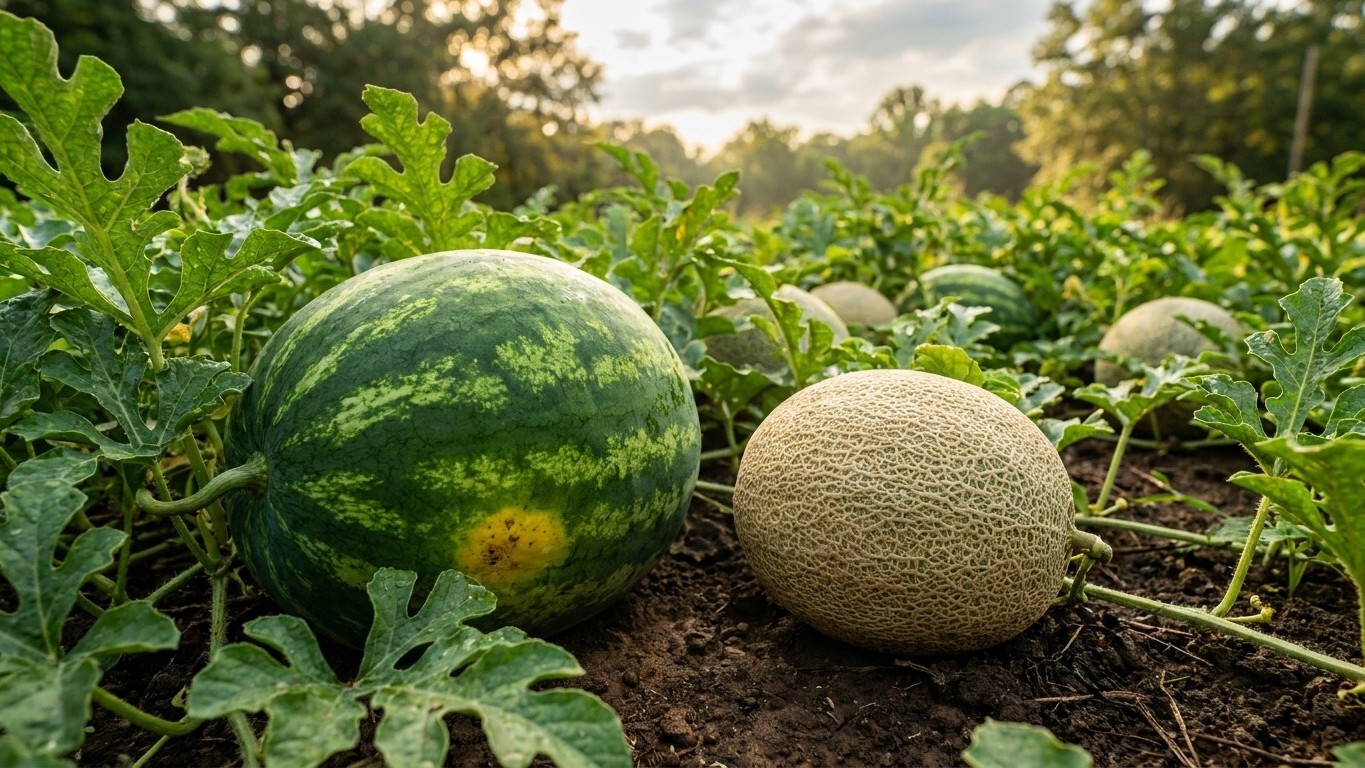

Short-season muskmelon and cantaloupe varieties bred to mature in under 75 days are the safe bet in Wyoming. Icebox-type watermelons work in warmer pockets. Standard honeydews and full-size watermelons rarely finish before frost returns.
The short answer for Wyoming
Wyoming’s growing window runs from a last spring frost between May 7 and May 18 to a first fall frost between September 24 and October 5. That’s roughly 130 frost-free days at 6,000 feet, and the state’s own climate data flags frost as possible in any month at higher elevations. That single fact should drive every melon choice you make here.
Melons count their maturity in days from transplant, not from seed, and most gardeners in this state start indoors and set out plants after the last frost date, not before. Subtract the two or three weeks a transplant needs to recover from shock, and the real window for a melon to flower, set fruit, and ripen shrinks closer to 100 days than 130. That number by itself rules out most of the melon varieties sold in a typical seed catalog.
Heat matters as much as time. Cheyenne, the reference station for these normals, averages just 10.4 days a year at 90F or above. Melons are warm-season plants that size and sweeten fastest when nights stay warm and days run hot; a season with barely ten days that even touch 90F is not generating the heat units that a melon bred for Georgia or Texas expects. That’s the second filter.
Put those two facts together and the decision by type looks like this: choose muskmelon and cantaloupe varieties explicitly bred for short seasons, in the 65 to 75 day range from transplant. Choose icebox or short-season watermelon types rather than the large 85 to 100 day slicers. Treat honeydew as a poor fit unless you’re gardening in one of the warmer, lower-elevation pockets of the state and you’re prepared to use every season-extension trick available. Skip long-season specialty melons entirely; the math doesn’t work here without a high tunnel or greenhouse.
What will not work here

Long-season melons are the first and clearest failure. Any variety listing 85 days or more to maturity is racing a calendar that only gives it roughly 130 frost-free days to begin with, and that’s before accounting for transplant recovery time or a cool early June. A melon that needs 95 days from transplant in a 100-day effective window has no margin for a cold snap, a cloudy July, or a slow germination. It simply runs out of season.
Heat-hungry varieties fail for a related but separate reason. Melons don’t just need time, they need warmth concentrated enough to push sugar development in the final weeks before harvest. With only 10.4 days a year reaching 90F at the reference station, a variety selected for consistent triple-digit heat in the desert Southwest will often size up but never fully sweeten in Wyoming. The fruit looks ready; it tastes like a cucumber. That’s not a growing mistake, it’s a variety mismatch.
Watering on a weekly schedule is the third failure point, and it catches people who gardened somewhere wetter before moving here. Summer rainfall averages about 5.8 inches across June, July, and August, with August, the critical fruit-fill month, delivering just 1.52 inches. That’s not enough to carry a melon planting on rainfall alone, and it’s not enough to make a once-a-week deep soak reliable either, especially on sandy soil that drains within a day. Add in the days above 90F, which spike evaporation, and a melon bed watered on a calendar instead of by soil feel will run dry during exactly the weeks fruit needs steady moisture most.
The fourth failure is planting on faith that the frost dates are guarantees. They’re not. NOAA’s own data for this station describes the spring and fall dates as a 30 to 70 percent probability band, meaning frost has a real chance of arriving before or after those windows in any given year, and at higher elevations it can show up in a summer month outright. Gardeners who direct-sow the day after the “average” last frost, then skip row cover for the following two weeks, lose plantings to a late cold snap more often than the calendar suggests they should.
What changes across Wyoming
Wyoming spans USDA hardiness zones 3a to 6a, a spread of three full zones inside one state’s borders, and hardiness zone is built on a single measurement: the average annual extreme minimum temperature. That’s a cold-tolerance figure, not a season-length one, but the two track together closely enough in this state to matter for melon growers.
A gardener working land near the zone 3a end of that range, typically at higher elevation, is dealing with a shorter effective season than the state-level frost dates suggest, plus a real chance of a summer frost event that the Cheyenne-based averages don’t capture well. For that reader, the short-season varieties recommended above aren’t a preference, they’re closer to a requirement, and row cover or wall-o-water protection through the first several weeks after transplant is worth treating as standard practice rather than insurance.
A gardener at the zone 6a end, generally at lower elevation, has more room to experiment. Some of the mid-season muskmelon varieties in the 75 to 80 day range become plausible, and a larger icebox watermelon variety has a realistic shot at finishing before the fall frost window opens. Even there, the summer rainfall and heat-day numbers cited above still apply statewide, since those are drawn from a single reference station and represent what the broader region can typically expect, not a promise for every valley and hillside.
What it does say is that “Wyoming” is not one growing climate, it’s at least three stacked on top of each other by elevation, and the honest first step is checking the USDA Plant Hardiness Zone Map for your own location before picking a variety off any general list, this one included.
Where to check this for your own county
The state-level answer above is a starting point, not a final one. The University of Wyoming Extension is the source built to narrow that answer down to your county, and it’s worth using before you commit to seed for the season.
Two things are worth looking for specifically once you’re there. First, a county-level planting calendar, if one exists for your area, will reflect local frost data rather than a single Cheyenne-based station. Extension offices closer to your elevation and terrain often have their own observed frost dates, sometimes gathered over decades from local demonstration gardens, that can differ meaningfully from a statewide reference point. Second, look for any list of melon varieties actually trialled in your county or region. Extension programs frequently run variety trials suited to their specific growing conditions, and a variety that performed well in a trial forty miles from your garden is a far better bet than one recommended from national seed catalog copy.
A county recommendation beats a state one every time, for the simple reason that it’s built on data closer to your actual soil, elevation, and microclimate. Statewide and single-station climate normals are genuinely useful for narrowing down melon types and ruling out the varieties that can’t work anywhere in the state. But it can’t replace what your local extension office knows about your specific county, and it isn’t trying to.
Checking this against your own garden
Every date here is a normal built from thirty years of station data, and normals describe an average year, not the one currently happening in your garden. Your own observations will tell you more than any calendar once the season actually starts.
Soil warmth by feel is the first check. Melon seed germinates poorly in cold soil regardless of what the calendar says, and soil that still feels cool and damp when you push a finger a couple of inches down isn’t ready, even if the calendar date has passed. Waiting for soil that feels genuinely warm, not just frost-free, cuts down on rot and slow, uneven germination.
The first flush of male flowers is the second signal worth watching. Melon plants produce male flowers before female ones, sometimes by a week or two, and a healthy early flush of males is a sign the plant has settled in and is building toward fruit set. If male flowers show up but female flowers lag far behind, that’s often a heat or stress signal worth noting for next year’s variety choice.
The appearance of the first true leaves, the ones that emerge after the initial seed leaves and actually look like miniature melon foliage, tells you the plant has moved past its most fragile stage. A slow gap between seed leaves and true leaves in your own bed, compared to what a seed packet’s timeline suggests, is useful information about your particular soil and microclimate, and it’s worth writing down from year to year so your own record starts to outrank the generic one.