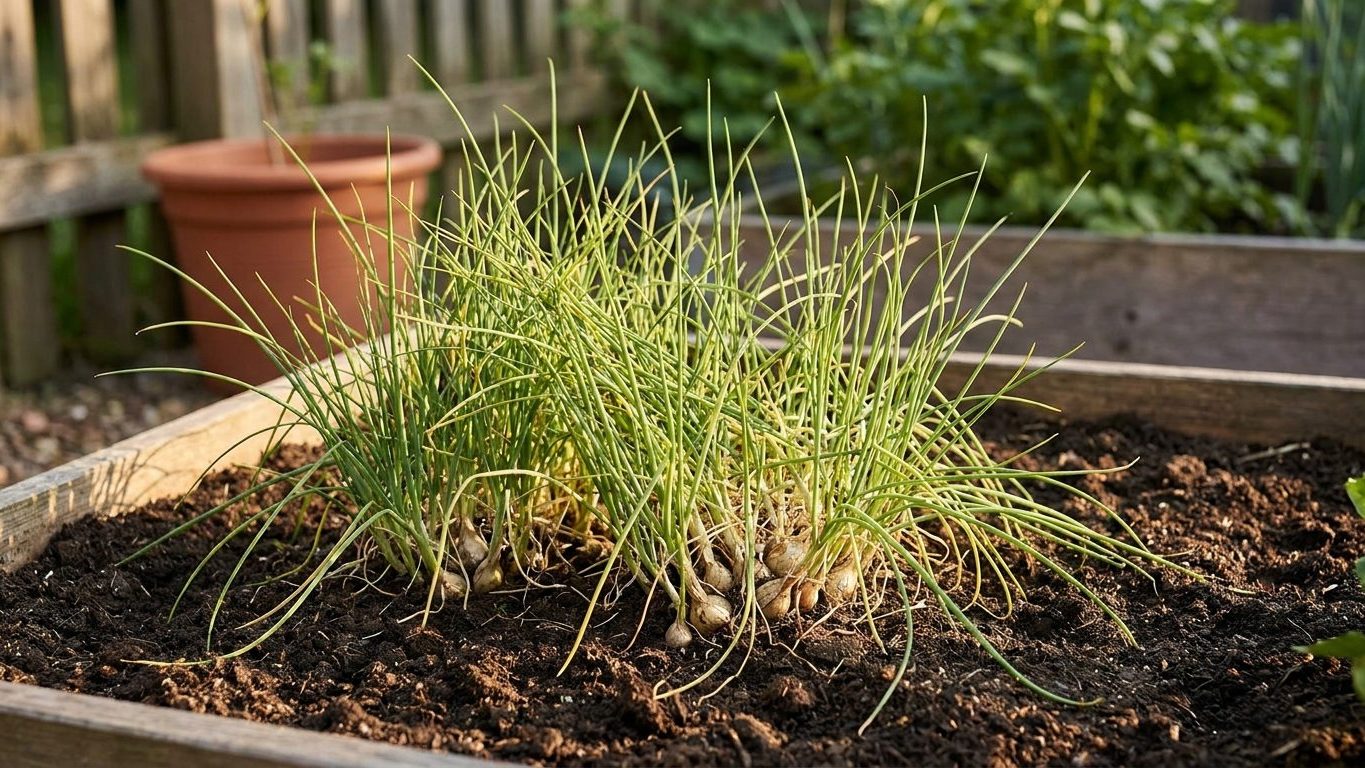

Chives survive neglect that would kill most herbs outright. Skip a week of water, forget they exist through a dry August, plant them in mediocre soil, and they still come back every spring with the same grassy, onion-scented tufts. The one thing they can’t shrug off is a clump left untouched for years, which is where most of the plant’s few problems actually start.
What is actually going on
The thing to understand about chives is clump division. A single chive plant isn’t really a single plant for long. Underground, it’s made of tiny bulbs, similar to a scaled-down onion, and each of those bulbs multiplies every season. Within two or three years, a clump that started as a small tuft has become a dense mat of dozens of bulbs packed so tightly they’re competing for the same sliver of soil.
That crowding shows up above ground before most gardeners notice it below. Leaves that were once pencil-thick and upright start coming in thin, almost wiry, and shorter than they used to be. Flowering can get sparse or stop entirely. The plant isn’t dying. It’s just run out of room, and it’s spending its energy maintaining bulbs instead of pushing new growth. This is the core mechanism that governs everything else about growing chives: the plant’s vigor is tied directly to how much elbow room its bulb cluster has, not to fertilizer, not to sun exposure, not to watering schedule.
Chives belong to the allium family, the same genus as onions, garlic, and leeks, and they share that family’s habit of multiplying underground rather than relying only on seed to spread. That’s part of why they’re described as one of the easiest perennials to keep going: the plant is built to propagate itself without help. Left alone in a spot it likes, a chive clump will still be there a decade later, just slower and stringier than it should be.
Chives also self-seed. The purple flowers that bloom in late spring produce seed heads that drop and germinate readily nearby, which means an established patch tends to expand outward over the years even without any division at all. This is useful in an informal herb bed and mildly annoying in a tidy one, since seedlings show up where they weren’t planted.
Chives carry a long-standing reputation in folk tradition as being good for various ailments. This page doesn’t evaluate that reputation one way or the other. It’s a garden and kitchen herb here, nothing more, and any curiosity about traditional uses belongs somewhere other than a growing guide.
In the garden
The practical work with chives comes down to three decisions: when to divide, whether to let the plant flower, and how much to do before winter. Each one has a wrong answer that shows up later as a weaker plant, not an immediate failure, which is exactly why it’s easy to get wrong for years without realizing it.
| Task | What to do | What happens if you get it wrong |
|---|---|---|
| Dividing the clump | Every 3 to 4 years, dig up the whole clump in early spring or fall, pull or cut it into smaller sections with a few bulbs each, and replant with space between sections. | Skip it and leaves get thinner and shorter each year; the clump keeps living but stops looking or performing like a healthy plant. |
| Letting it flower | Allow some flowers to open for pollinators and visual interest, but cut most stems back after bloom if you want to slow self-seeding. | Let every flower go to seed and the patch spreads well beyond where it was planted, showing up in nearby beds and paths within a couple of seasons. |
| End-of-season cutback | Let the foliage die back naturally after frost, or cut it to a couple of inches above soil once it yellows, then leave the roots undisturbed. | Cut it too early while leaves are still green and the plant loses stored energy it needs to come back strong the following spring. |
| Winter behavior | Expect the top growth to die back completely in cold climates; the bulbs stay alive underground and resprout on their own once soil warms. | Assume the plant died and dig it out, only to find (too late) that new growth would have appeared within weeks of warmer weather. |
Division is the task that actually determines how the plant looks year over year, and it doubles as free propagation. Each divided section, replanted a few inches apart, becomes its own clump and starts the multiplying process over again. Gardeners who divide on a rough three-to-four-year cycle tend to describe their chives as consistently full and upright; gardeners who never divide tend to describe the same plant, years later, as “not what it used to be” without quite knowing why.
Indoors or in containers, the same logic applies on a faster timeline, since a pot restricts root room far more than open ground does. A container clump often needs dividing after two years rather than three or four, and the sign is identical: leaves get skinnier and the pot looks crowded at the base.
What it depends on where you are
How well chives perform, and on what calendar, depends heavily on regional conditions this page has no way of knowing. Season length decides how many months of active harvest a garden gets before dormancy sets in. Summer heat matters too: chives are a cool-season-leaning perennial, and in regions with long, intense summer heat they often slow down or go semi-dormant during the hottest stretch, then pick back up as temperatures ease in early fall. In milder, shorter-summer climates that slump barely happens at all.
Summer rainfall and general humidity change the disease picture as well. Chives are fairly resistant to pests and disease compared to most herbs, but persistent dampness combined with crowding (the same crowding that comes from skipping division) creates conditions where fungal issues can take hold at the base of the clump. A well-drained spot solves most of this before it starts, but what counts as well-drained in a dry climate and in a humid one isn’t the same thing.
None of this changes the core routine described above. Division every few years, a cutback after the foliage yellows, tolerance of neglect in between, all of that holds true Everywhere chives are grown in the US. What shifts by region is timing: when spring division makes more sense than fall division, how early the first spring growth appears, and how much of the year the plant stays actively green versus dormant.
For anything tied to an actual date or a specific frost pattern, the more useful reference is a state-level herb guide on this site, built around that region’s actual season length, plus the local USDA Cooperative Extension office, which tracks frost dates and regional pest pressure specific to that county. National advice can only go so far before local conditions take over the answer.
The mistake that costs the most
The single costliest mistake with chives is letting a clump sit in the same spot for five, six, ten years without ever dividing it. It doesn’t kill the plant. That’s exactly the problem: because chives keep limping along on visibly reduced leaves without ever actually dying, most gardeners never connect the decline to its cause. They assume the plant is just past its best, or blame soil, weather, or age, when the real issue is a bulb cluster so congested it no longer has room to produce full-sized growth.
The fix costs almost nothing and takes about twenty minutes. Dig up the entire clump, not just a wedge cut from the side, and look at what’s underground. A neglected clump often reveals dozens of small, tightly packed bulbs with barely any soil between them. Pull or cut that mass into several smaller sections, each with a handful of bulbs and roots attached, and replant them a few inches apart in refreshed soil. Within one growing season the difference is visible: fuller leaves, better color, and often a return of the flowering that had quietly stopped.
The instinct to leave a plant alone because it “seems fine” is reasonable for most perennials. Chives are the exception where doing nothing is itself the slow failure mode. A clump that’s never divided doesn’t crash, it just fades a little more every year until a gardener looks at it one spring and wonders why the chives that used to be so reliable barely produce anything worth cutting.