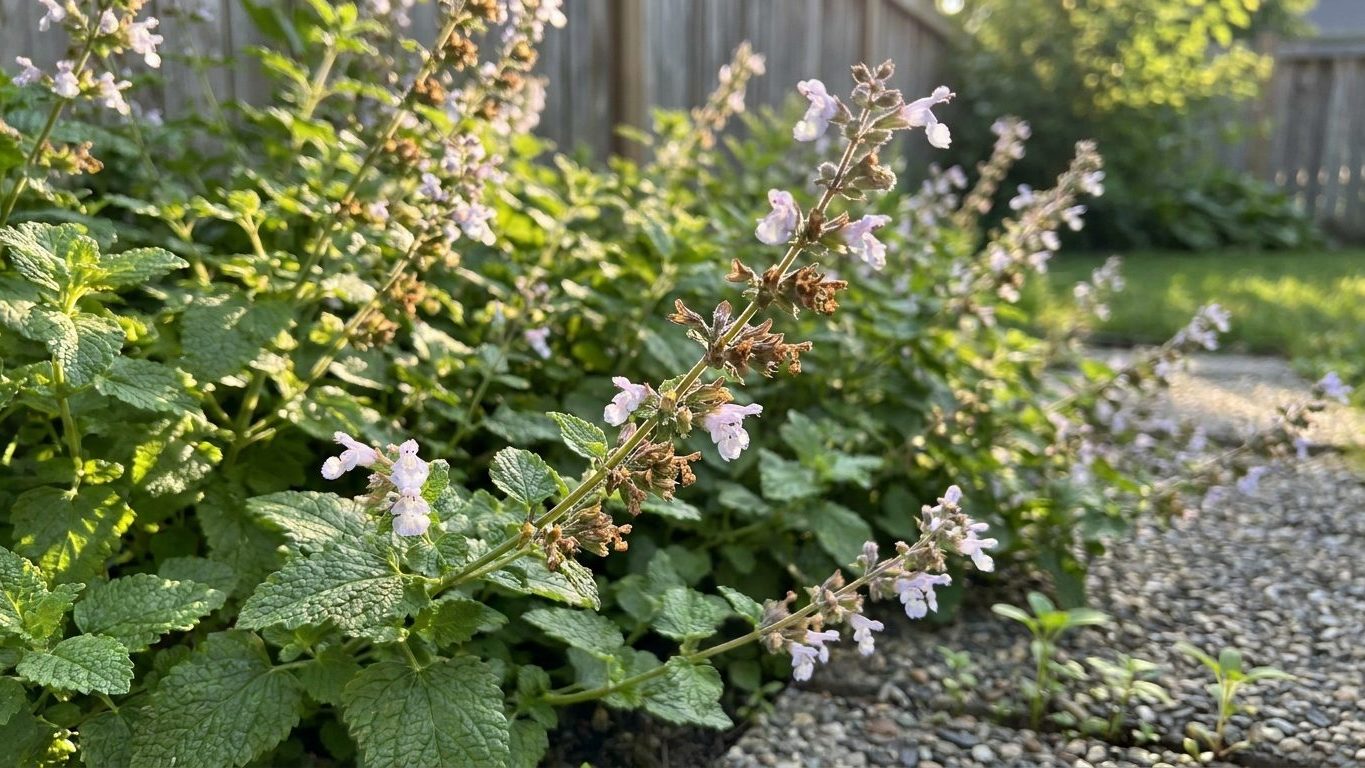

One lemon balm plant left to flower can turn into two dozen by next season, and none of them will stay where you put the original. That’s not an exaggeration gardeners use loosely. It’s the plant’s actual growth pattern, and understanding it changes how you plant, prune, and think about this herb from day one.
What is actually going on
The thing to understand here is self-seeding: lemon balm sets abundant seed that germinates freely in surrounding soil, so the plant spreads by seedlings rather than by underground runners. That’s a meaningful distinction, because it means the spread happens above ground and after flowering, not through a root system quietly traveling under a bed. Mint, lemon balm’s more infamous cousin, colonizes through rhizomes that creep sideways regardless of whether the plant ever blooms. Lemon balm doesn’t do that. Cut off the flowers, and you cut off most of the problem.
Left alone, a single mature plant produces small white flowers in mid to late summer, and those flowers turn into seed heads carrying what can amount to hundreds of viable seeds. Those seeds drop close to the parent plant, get moved a little farther by rain, wind, or foot traffic, and germinate the following spring wherever conditions are decent. A gardener who ignores one plant for two seasons often finds a loose colony of a dozen or more younger plants spreading outward in a rough circle, each one capable of doing the same thing the year after.
This is a member of the mint family botanically, and it shares that family’s general vigor and simple growing requirements, but the seeding habit is a separate trait worth naming on its own. Some plants in this family spread mainly by root, some mainly by seed, and a few, including this one, do both to a lesser degree. Knowing which mechanism you’re dealing with tells you where to put your effort. With lemon balm, the effort belongs almost entirely at the flower stage, not underground.
Lemon balm carries a long-standing reputation in traditional herbal use. This page doesn’t evaluate that reputation one way or another. What follows here is about growing the plant in a home garden and keeping it where you want it, nothing more.
In the garden
Controlling lemon balm’s spread comes down to one habit repeated through the growing season: cutting the plant back before it flowers. Everything else is secondary. The table below walks through the main points of the routine and what tends to happen when each one gets skipped.
| What to do | Why it matters | What happens if you skip it |
|---|---|---|
| Cut back stems once they reach 6 to 8 inches tall and before buds form | Removes the flowering structure before it can set seed | Plant flowers on schedule and seed drops before you notice the buds were there |
| Repeat the cutback every few weeks through the growing season | New growth flowers again if left unchecked, so one cut isn’t enough | A missed round of cutting in midsummer is often the one that produces next year’s seedlings |
| Deadhead any stray flower spikes immediately if you spot them | Even a few missed flower heads can carry enough seed to start a new patch | A handful of ignored flower stalks near a fence line or bed edge becomes a self-sown strip the following spring |
| Grow it in a container or a bottomless raised bed with a root barrier | Limits how far the plant can physically send stems and drop seed into open soil | Ground-planted lemon balm near open beds or lawn edges seeds into both within a season or two |
| Pull volunteer seedlings while they’re small, roots and all | Young seedlings come up easily; established ones develop a tougher root mass | Seedlings left through a full season get harder to remove and start seeding themselves the next year |
Where the seed actually ends up
Gardeners who lose track of lemon balm usually do it in the same two spots: gravel paths and the edges of vegetable beds, where soil is loose enough for seed to settle and germinate without competition. A plant grown in a container on a patio rarely causes trouble, because there’s no adjacent soil for the seed to land in. The same plant grown in an open border next to bare or mulched ground tells a very different story by the second year.
None of this makes lemon balm difficult to grow. If anything, it grows with almost no attention once established, tolerating average soil and inconsistent watering better than many culinary herbs. The tradeoff is that the same toughness that makes it forgiving also makes it a plant you manage on purpose, not one you plant and forget.
What it depends on where you are
How aggressively lemon balm reseeds, and how long its self-sowing window lasts, depends heavily on season length and summer conditions, and this page has no way of knowing which climate a given reader is gardening in. A longer, warmer growing season generally means more flowering cycles and more chances for seed to mature before frost. A shorter season with a hard early frost can cut that cycle off before much seed ever ripens. Summer rainfall matters too, since seedlings need consistent moisture to establish, and a dry summer in one region can suppress the very spread that a wet one encourages somewhere else.
This is exactly the kind of variable that a national gardening page can describe honestly without pretending to resolve it. Anyone gardening in a warm, humid region should expect to cut back flowering stems more often and watch for volunteer seedlings across more of the growing season. Anyone in a shorter, drier, or cooler climate may find the plant far more restrained on its own, with self-seeding limited to an occasional stray plant rather than a spreading patch.
Soil type plays a role as well, though a smaller one than climate. Loose, well-drained soil lets seedlings establish more easily than heavy clay does, which is part of why gravel paths and raised beds with amended soil tend to collect volunteers faster than compacted lawn edges.
Rather than guess at a single answer that would be wrong for a large share of readers, the more useful move is to check the state-specific herb growing guides elsewhere on this site for a picture closer to local conditions, and to call the county extension office for a read on how the current season is actually running. Extension agents track local weather patterns and fielded questions from other gardeners in the same area all season, which makes them a better source for timing than any general guide can be.
The mistake that costs the most
The single costliest mistake with lemon balm is planting it directly in open garden soil and then forgetting about it until it flowers. Everything else, an occasional missed cutback, a seedling or two that gets away, is manageable. But that first decision, made without a plan for containment, is the one that turns an easy-to-grow herb into a multi-year removal project.
Once lemon balm has flowered and dropped seed into open ground a couple of times, getting rid of it stops being a single afternoon’s work. Seed can remain viable in soil for more than a season, so pulling every visible plant one year doesn’t guarantee a clean bed the next. New seedlings keep appearing from a seed bank that’s already built up, often in spots the gardener never planted, tucked against a fence post or coming up through gravel ten feet from where the original plant lived.
The fix is deciding on containment before the first flower ever forms, not after. That means a container, a bottomless raised bed with a physical root and seed barrier, or a spot deliberately chosen away from open beds and lawn where any stray seed has nowhere favorable to land. It also means committing to the cutback routine from the plant’s first season, rather than treating it as optional maintenance once the plant already looks established.
Gardeners who make that decision early get a low-maintenance, fragrant herb that behaves predictably for years. Gardeners who skip it usually end up doing the same containment work anyway, just later, and with a lot more plants to deal with by the time they start.